Birthday games for kids – ideas for an unforgettable celebration

Looking for birthday games for kids that actually work? This guide collects tested party games for kids, activity ideas by age, and simple prep tips — everything you need to turn a birthday into an easy, memorable celebration.

Key Takeaways
- Birthday games for kids support socialization, motor skills, and confidence – not just entertainment.
- Classic kids party games (Bubble Pop, Musical Cushions, Pin the Tail, Freeze Dance) work well for ages 2–6 with little to no setup.
- Screen-free indoor birthday games and outdoor birthday activities for kids both need minimal props – most use items you already have at home.
- Educational birthday games, like Alphabet Hunt or Memory Tray Challenge, mix fun with real learning.
- Prepare 4–6 main games plus 2–3 backups, and alternate active and calm activities every 15–30 minutes.
Birthday Games for Kids That Keep Parties Fun and Easy
They say that the magic of holidays and wonder returns to adults when they have children of their own. With them, it's possible to relive the full spectrum of joy and happiness from birthdays – just like in childhood. These days are always a whirlwind of emotions, laughter, and anticipation of something magical. But along with nostalgia, birthdays can also be a real challenge for parents: how do you entertain a dozen (or more!) little ones without turning the party into chaos? How do you keep their attention and create truly unforgettable memories?
Choosing the right birthday games for kids is not just a way to hold the attention of young guests – it's an opportunity to fill the party with meaningful and developmental activities. Whether you're searching for party games for kids, kids party games for a small backyard gathering, or full-blown birthday party activities for kids that fill an entire afternoon, this article has you covered. We've gathered the best birthday party games for kids: from time-tested classics to modern digital options, along with practical tips for organizing them.
As a mother of three and a former school educator, I've hosted my share of birthday parties – and I can tell you that the games you choose make or break the afternoon far more than the cake does.
Why Birthday Games for Kids Are More Than Just Fun
Birthday games are not just a way to keep children busy. They serve several important purposes that impact both child development and the overall party atmosphere:
- Socialization and friendship. Kids birthday party games create natural moments for communication, teaching children to interact, share, and work together. This helps them make new friends and feel part of the group.
- Skill development. From motor skills to communication, from problem-solving to concentration – every game plays a role.
- Structure and order. Alternating active and calm games helps prevent exhaustion, maintains discipline, and makes the party feel organized and predictable for little participants.
- Educational value. Many birthday party game ideas can be adapted to include learning, turning play into an exciting lesson.
- Reduced stress for parents. When kids are engaged in meaningful and entertaining activities, parents can relax and enjoy the moment, knowing the celebration is going according to plan.
A well-balanced game program that takes into account the age and interests of the guests will turn the party into a truly unforgettable experience, filled with joy and valuable development.
Help your child
grow with Keiki
We’ll help you turn everyday screen time
into real learning progress.
Birthday Games for Toddlers (Ages 2–3)
At this age, games should be simple, short, and based on basic skills. Very young children won't appreciate even the easiest tasks meant for older ones, and those games may feel too basic for the older kids. But for ages 2–3, birthday games for toddlers work best when they look like this:
Bubble Pop
Kids love chasing and popping bubbles. You can add a little competition: who can pop the most in 30 seconds? All you need is a bottle of bubble solution and a wand — it's great for developing hand–eye coordination and sensory exploration.
Animal Parade
Also known as "Zoo," toddlers walk in a circle to music, pretending to be different animals. When the music stops, the host names an animal, and everyone must act it out. This encourages imitation, gross motor skills, and imagination. All you need is some music and open floor space.
Musical Cushions
A simplified version of musical chairs. Instead of chairs, use soft cushions or mats. When the music stops, everyone must find a "home." No one gets eliminated – all just need to find a spot. All you need is a few cushions or mats and some music.
Follow the Leader
One child becomes the "leader" and performs simple movements (jumps, claps, funny steps), while others copy them. A great game for practicing imitation and movement accuracy. No equipment needed, just some open space.
These birthday games for children develop attention, imitation, coordination, and help kids get used to participating in group activities.
Birthday Games for Preschoolers (Ages 4–6)
Children at this age are ready for more complex rules and elements of competition:
Pin the Tail
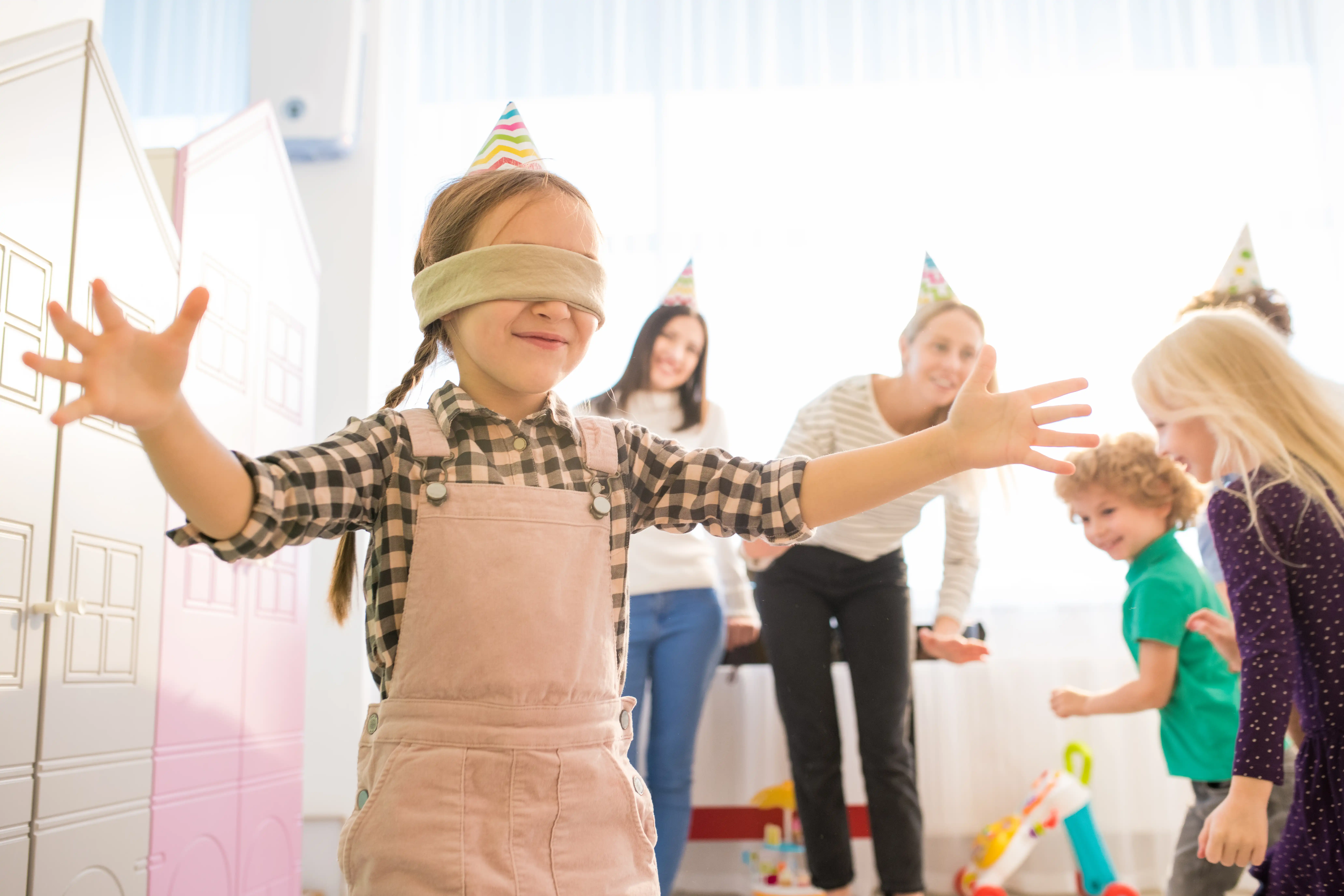
A classic game where a blindfolded child tries to pin a tail on a drawn animal. It's funny and always brings lots of laughter. All you need is a large drawing of an animal, a paper tail, tape, and a blindfold.
Freeze Dance
When the music stops during dancing, everyone must freeze in a silly pose. Anyone who moves is out (or simply has to do a funny task). All you need is some music you can pause on command.
Balloon Relay
Split the participants into teams. The goal is to carry a balloon from start to finish using only specific body parts (like knees, heads – no hands allowed). All you need is one balloon per team and a marked finish line.
Treasure Hunt
Hide a "treasure" (small prizes or treats) and prepare a chain of simple clues leading from one spot to another. All you need is a few small prizes and some simple written or spoken clues.
These birthday games for kids bring children together, make them think and move actively, and create a festive atmosphere of competition and fun.
Indoor Birthday Games – Indoor Fun Made Easy
If the party is held at home, and space is limited or the weather keeps you indoors, these ideas are perfect. These indoor birthday party games for kids require no complex prep or special props.
Simon Says
The leader (an adult or the birthday child) says: "Simon says, touch your nose!" – and children must do it. If the command is given without "Simon says," they shouldn't follow it. Anyone who makes a mistake is out (or receives a fun task). No equipment needed, just a group of kids and a leader.
Magic Box
Place various objects (a fruit, a toy, an item of clothing) inside an opaque box or bag. Kids take turns reaching in and guessing the object by touch only, without looking. This game helps develop sensory skills and expand vocabulary. All you need is a box or bag and a handful of everyday objects.
Story Circle
Remember the importance of alternating energetic and calm activities? Children sit in a circle. The first one starts a story with one sentence, the next adds another, and so on, creating a strange and often hilarious plot together. It's great for building communication and imagination. No equipment needed.
Outdoor Fun – What to Do with Kids Outside?
If the weather is good and you have access to an open area (yard, park, playground), outdoor birthday activities for kids are a fantastic choice. They let children release energy and enjoy active movement. Here are some games for kids birthday party fun outdoors:
Water Balloon Toss
On a hot day, this is a guaranteed hit! Children form pairs and stand across from each other, tossing a water balloon back and forth. After each successful throw, they take a step back. Whoever drops it is out. All you need is a bag of water balloons.
Scavenger Hunt
A bigger version of the treasure hunt. Prepare a list of items (natural objects, specific toys) or riddles to solve and find within a set area. Kids can work in teams or individually. All you need is a written list or a set of riddles.
Obstacle Course
Set up a simple obstacle course using available items: crawl under a chair, jump over a rope, walk across "swamp stones" (spread-out newspapers), carry an item on a spoon. This boosts motor skills, agility, and logic – a great example of educational birthday games. All you need is a handful of household items.
Parachute Games
If you have a big lightweight parachute (or even a large sheet), you can invent lots of games: "Waves," "Mushrooms" (everyone lifts and lowers the parachute together), "Pop the Ball" (tossing lightweight balls on top of the parachute). Perfect for teamwork and social interaction. All you need is a parachute or large sheet, and a few lightweight balls.
Bean Bag Toss
Set up hula hoops, buckets, or draw targets on the ground with different point values. Kids throw bean bags (or soft balls) at the targets. Great for counting practice and improving aim. All you need is a few bean bags and something to use as targets.
Help your child thrive with playful learning
Turn screen time into real growth with Keiki's educational games.
Try KeikiEducational Birthday Games
Combining fun and learning at a birthday party is easy! Educational birthday games for kids not only entertain, but also reinforce knowledge or introduce something new.
Alphabet Hunt
Hide letters around the room or yard (on cards, blocks). Kids search and name the letters they find. You can make it harder: look for only vowels, or the letters in their names. Alternatively, you can use alphabet games in the app based on the same principle. All you need is a set of letter cards or blocks.
Count the Balloons
Scatter balloons around the room. Task: who can collect and count all the balloons of a certain color the fastest, or who finds the balloon with a hidden number. All you need is a bag of balloons in different colors.
Shape Sorting Race
Place cards with different geometric shapes on the floor. Task – collect all the circles, squares, or find objects in the room that resemble triangles. All you need is a set of shape cards.
Memory Tray Challenge
Place 10–15 small items on a tray. Let the kids look at them for one minute, then cover the tray. Each child must recall and name as many items as possible. All you need is a tray and a handful of small household items.
These children's birthday games develop logic, attention, memory, vocabulary, and other cognitive skills – making the party truly meaningful.
How to Prepare Games and Activities Without Losing Your Mind
We fully understand that the entire organization falls on the shoulders of adults. Careful preparation is half the success of any party. Here are a few key steps:
- Create a schedule – don't overdo it with too many games: 4–6 main ones plus 2–3 backup games, alternating between active and calm activities every 15–20 minutes (for toddlers) or 20–30 minutes (for preschoolers)
- Prepare supplies in advance – make a list of everything needed for each game: balloons, prizes, blindfolds, cards, markers. Gather everything into a dedicated kit
- Tech readiness – if you plan to use digital games for kids birthday, download them in advance, check offline performance, and make sure tablets or phones are fully charged
- Consider age and interests – the most important thing is to adapt the games to the age group of most guests. If children of different ages are invited, prepare a few options for both the youngest and the oldest
- Prepare the space – if you're planning backyard birthday games, check the area for safety. For indoor activities, remove fragile items and ensure there's enough space
A solid plan is the key to a successful, fun, and memorable celebration!
Gadget-Based Ideas – Smart Solutions with Keiki
Screens at a party? Why not, if used wisely and with purpose. In today's world, digital games for kids can be a great addition to active fun, offering a "breather" or alternative – especially if you have Keiki. One app can meet many needs, serving both as a developmental tool and a source of entertainment.
Keiki offers birthday games using a device for interactive breaks during the party. For example, if the birthday child or guests are learning English, Keiki provides engaging English games on that topic. This could be a vocabulary quiz, matching games, or simple tasks. The winner can receive a sweet treat or a party favor.
According to parents who have hosted children's parties more than once, creativity is a must. But instead of preparing canvases, paints, and a pile of supplies, interactive coloring pages, tasks, and flashcards will save the day. Children can interact with a tablet either alone or in turns, completing developmental activities, coloring pictures, or learning new words. They can even try to draw a portrait of the birthday child.
Keiki, like many similar apps, offers several advantages:
- suitable for individual or group play. Some tasks in Keiki can be done in turns or competitively (e.g. who names a word faster);
- works offline – convenient for parties, since it doesn't require constant internet access;
- ad-free and safe for toddlers – parents can relax, knowing their child is engaging with high-quality content without distracting or potentially harmful ads;
- if kids are tired of running around or need something to do for 10–15 minutes while snacks are being prepared, you can offer an interactive break with a kids app with games. It's a great alternative to passive cartoon watching.
Related Games in Keiki App





Tips for Parents to Make the Party Stress-Free and Easy
Yes, organizing a kids' party is almost always a challenge for an adult's nervous system. But there are some things that can make it easier and help avoid problems. For example, assign a game host in advance. If it's not you, ask a friend or family member to take on the role of entertainer. This lets you focus on other aspects of the event.
And always have backup games! Kids' moods can shift. Always keep 1–2 extra activities in mind in case something doesn't work out or the group gets tired too quickly.
Also remember – participation should be voluntary. Never force a child to join a game if they don't want to. Offer them an alternative or let them observe. Many will join in once they see others having fun.
It's also a good idea to prepare small prizes for everyone – little souvenirs, stickers, or treats for each participant, not just for the winners. This creates a friendly atmosphere and prevents disappointment.
And don't forget to alternate activity types. After active outdoor birthday games, offer something calmer – like fun activities for kids party at home or interactive tasks in Keiki. This helps guests recharge and avoid overstimulation.