25 Best Interactive Dice Games For Kids of Different Ages

Dice games add surprise and simple rules that kids can learn fast. These ideas support counting, turn-taking, and flexible thinking, making them great for family time, classrooms, or small groups.

This guide rounds up 25 dice games for kids, sorted by age and type — from simple roll-and-count games for preschoolers to family favorites everyone can play together. You'll also find a comparison table to help you pick fast, a few tips for keeping games running smoothly, and answers to the questions parents ask most about games played with dice.
Key Takeaways
- Dice games for kids build real skills — number sense, probability, strategy, and social turn-taking — without ever feeling like a lesson.
- Dice games for preschoolers work best when they skip reading and focus on counting dots, matching colors, or simple physical actions.
- Games with dice for kindergarten start introducing light math and turn-based rules, since five- and six-year-olds can usually hold a simple plan in mind.
- You don't need a store-bought set to get started — a single pair of dice from an old board game covers most of the games on this list.
- Dice games for families work well for mixed-age game nights because most of them scale in difficulty depending on how you play them.
What Are Dice Games for Kids?
Dice games for kids are games where a roll of one or more dice decides a number, action, or outcome, and players use that roll to move, build, count, or compete. They range from purely luck-based (like Dice War) to games that layer in real strategy (like Pig) or creativity (like Dueling Narrators), which is part of why they work for such a wide age range.
A big part of what makes dice games for kids so useful is a skill called subitizing — recognizing a quantity at a glance instead of counting each dot one by one. According to Early Math Counts, a project of the McCormick Center for Early Childhood Leadership, being able to subitize quantities up to four by age five is considered a significant developmental milestone. Every time your kid glances at a die and calls out "five!" without counting the pips, that's subitizing in action — and it's exactly the kind of number sense dice games build without your kid ever realizing it's "math practice."
Benefits of Dice Games for Kids
Dice games for kids do a lot more than pass the time on a rainy afternoon. Here's what they're actually building.
- A foundation for math skills. Rolling, counting pips, and comparing totals builds subitizing, number recognition, and basic arithmetic long before a worksheet ever enters the picture.
- Strategic, goal-oriented thinking. Games like Pig and Shut the Box ask kids to decide when to push their luck and when to stop — an early, low-stakes version of weighing risk against reward.
- Problem-solving under changing conditions. Every roll changes the board, so kids have to adjust their plan on the fly instead of following one fixed path to the finish.
- Pattern recognition and an early feel for probability. Kids start noticing which totals come up more often, which numbers are "safer" bets, and how odds shift as a game goes on.
- Sharper analytical thinking. Score-tracking games like Farkle or Yahtzee-style dice games ask kids to compare options and calculate which move gets them closer to winning.
- Real social-emotional skills. Taking turns, following shared rules, and losing a round without melting down are skills dice games practice over and over, game after game.

Help your child
grow with Keiki
We’ll help you turn everyday screen time
into real learning progress.
Dice Games for Preschoolers and Kindergarten
Dice games for preschoolers work best when there's no reading involved — just counting, matching, and moving. These 5 games with dice for kindergarten and younger kids keep the rules dead simple while still building real number sense.
Roll and Stomp
Grab a big, soft foam die (or tape numbers 1-6 onto a regular one so a toddler can't lose it) and take turns rolling. Whatever number comes up, that's how many times everyone stomps their feet, claps their hands, or hops in place. It sounds almost too simple, but for a wiggly three- or four-year-old, connecting a number to a physical action is exactly how counting starts to click. Swap in different movements — spins, animal walks, silly faces held for that many seconds — to keep it fresh for a week of rainy afternoons.
Roll and Count Bears
Set out a pile of small counters (buttons, mini erasers, or actual counting bears work great) and have your kid roll one die, then count out that many bears into a cup or onto a mat. This is one of the gentlest children's dice games for kids who are still learning that a number represents a specific quantity, not just a word you say. For an easy variation once they've got the hang of it, roll twice and ask them to combine both piles — an early, hands-on introduction to addition.
Color Dice Match
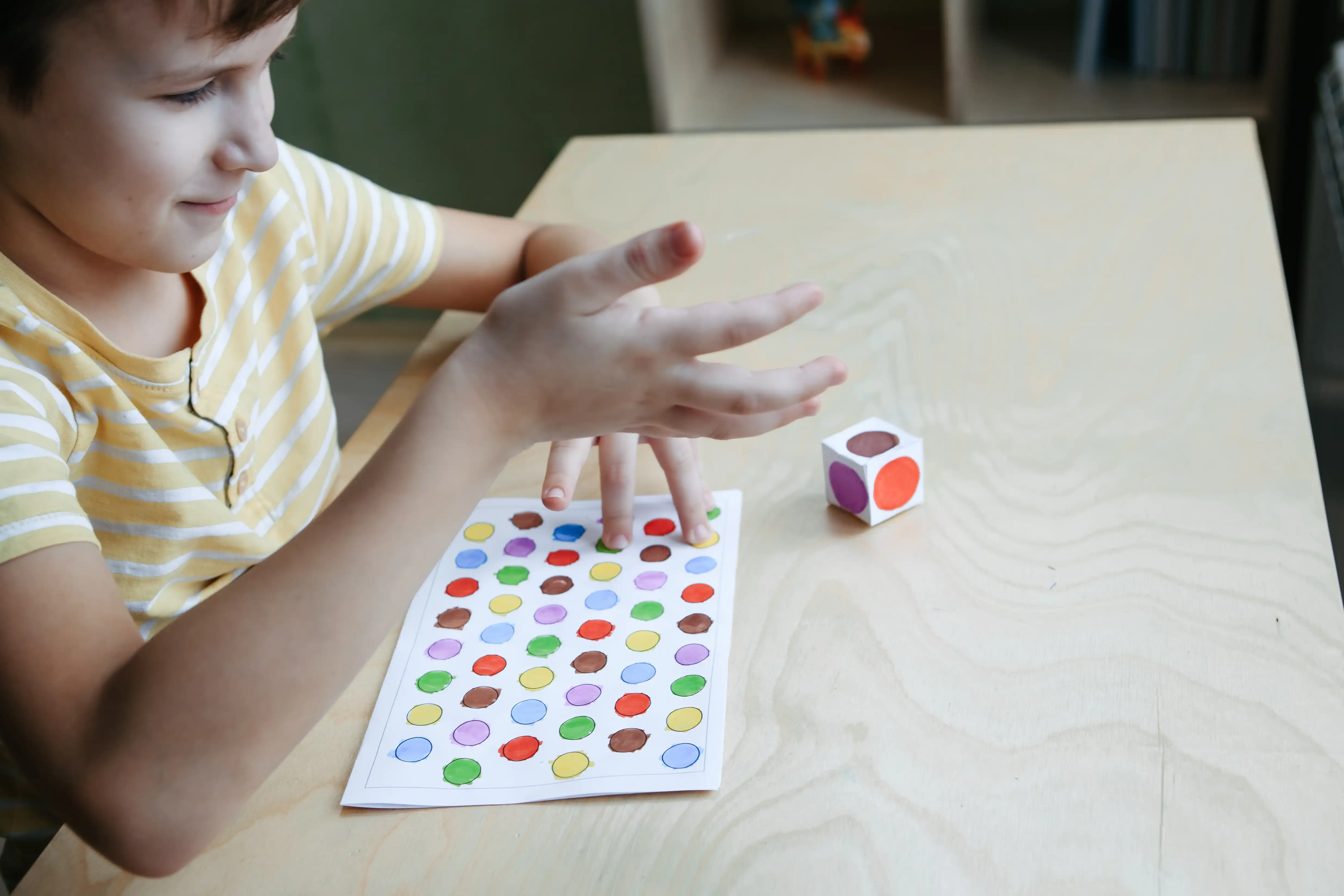
Cover a blank wooden die with colored stickers, or buy a color die from a craft store, and pair it with colored blocks, pom-poms, or crayons around the house. Roll the die and have your kid grab or point to something that matches the color shown. This one leans more visual than numerical, which makes it a great warm-up game for a preschooler who isn't quite ready for number dice yet, and it's an easy way to sneak in color-recognition practice during the day.
Dot Race to Ten
Draw a simple number line from 0 to 10 on paper or use a printed one, and give your kid a small token to move along it. Roll one die, count the dots out loud together, and move the token that many spaces. First to reach (or pass) 10 wins. It's basically a simplified board game with dice, but the slow pace and shared counting make it one of the calmer children's dice games for a kid who gets overwhelmed by games that move too fast.
Dice Bowling
Set up a few empty water bottles or plastic cups as "pins," and instead of a bowling ball, have your kid roll a die first to see how many pins they're allowed to knock down before they even throw anything — then they try to hit exactly that many. It turns a simple prediction into a physical challenge, blending gross motor play with number matching. This is a favorite for backyard afternoons or a rainy day in the living room when your kid has energy to burn but you still want a little counting practice mixed in.
Simple Math Dice Games
These 5 math dice games for kids turn arithmetic into something you actually want to play, using nothing more than a couple of dice and, in most cases, things you already have at home.
Tenzi
Each player gets ten dice, everyone rolls at the same time, picks a target number, and then keeps rerolling only the dice that don't match it. First to get all ten dice showing the same number shouts "Tenzi!" and wins. It's fast, loud, and genuinely fun for a wide age range, which makes it one of the easiest dice games for kids to pull out when you need five minutes of focused chaos before dinner.
Roll to 100
Grab two dice and a pencil, and take turns rolling and adding your total to a running score written on paper. First player to reach 100 wins. This is a simple, no-frills way to practice addition and running totals, and you can make it harder for older kids by requiring them to add the numbers in their head before writing anything down.
Over the Mountain
Draw a hill shape on paper with numbers 2 through 12 written along the slope, with 7 at the very top. Roll two dice, add them together, and cross off that number each time it comes up — the goal is to cross off every number on the mountain. Because 7 comes up more often than any other total, kids start to notice the pattern on their own, which is a sneaky, low-pressure way to introduce basic probability.
Math War
Deal out the rules of classic War, but swap cards for dice: two players each roll two dice, add (or subtract, for older kids) their own pair, and whoever has the higher total wins that round and collects both sets. It's fast, competitive, and a good fit for a kid who already knows their addition facts but needs faster recall under a little friendly pressure.
Shut the Box
Line up tiles numbered 1 through 9 (or use a printed strip if you don't have the classic wooden box). Roll two dice and flip down tiles that add up to your roll — in any combination you like — until you can't make a match anymore. Lowest total left standing wins the round. This one rewards quick mental math and a bit of strategy about which combinations to use first, which makes it a solid pick once basic addition feels easy.
Engaging Strategy Dice Games
Once basic counting is second nature, these 5 strategy dice games for kids add a layer of decision-making — when to push your luck, when to stop, and how to read the odds.
Pig
Roll a single die on your turn, adding each result to your turn total — but roll a 1, and you lose everything you've earned that turn. Bank your points and pass the die whenever you want to stop. First to 100 total points wins. Pig is the simplest possible introduction to risk-versus-reward thinking, and it's short enough to play three rounds in a row without anyone losing interest.
Knock Out
Before rolling, the group (or just one designated caller) picks a "knock-out" number. Players take turns rolling one die, and anyone who rolls that number is out of the game. Last player standing wins. It's quick, a little tense in a fun way, and works well with a big group — cousins at a holiday gathering, a whole classroom, or a car full of siblings on a long drive.
Stuck in the Mud
Similar to Pig but with a twist: roll and accumulate points as usual, but this time a roll of 2 doesn't just end your turn, it wipes out your entire game score, not just the current turn. That higher stakes twist makes kids think harder about when exactly to stop pushing their luck, which is a nice step up once Pig starts feeling too easy.
Fifty
Each player rolls one die per turn, aiming to hit exactly 50 points. Roll a 5 and your whole score resets to zero; roll a 1 and your turn ends immediately with no points added. It's a slightly meaner cousin of Pig, and kids who've mastered the basics of that game usually love the extra tension Fifty adds.
Three or More
Roll five dice at once and look for sets of three or more matching numbers — three 4s, four 2s, and so on — scoring points based on what you find. Non-matching dice can be rerolled once per turn to try to complete a set. This one rewards pattern recognition over pure luck, since kids start recognizing which partial sets are worth chasing and which aren't.
Build real skills through fun, educational games for your child
Try KeikiCreative and Educational Games to Play with Dice
These 5 games swap pure math for storytelling, spelling, and building, proving dice games for kids don't have to be about numbers at all.
Roll-a-Word
Write a different letter on each face of a blank die (or use a set of letter dice), roll it a handful of times, and challenge your kid to build as many words as they can from the letters that come up. It's a playful, low-pressure way to practice spelling, and you can adjust the difficulty by picking which letters go on the dice — vowels and common consonants for a beginner, trickier combinations for a kid who needs more of a challenge.
Roll and Write
Give your kid a blank die and a notebook, and have them roll before each line of a story, using a pre-made key that assigns a prompt to each number — a character, a setting, a plot twist, whatever you want. The die decides what happens next, and your kid fills in the details. This is one of the best children's dice games for a reluctant writer, since the randomness takes the pressure off having to come up with an idea from scratch.
Block Out
Using building blocks and a color or number die, roll and add that many blocks (or that color of block) to a shared tower each turn. The game can end when the tower falls, or when a target height is reached — either way, it blends fine motor practice with counting and a little suspense every single turn.
Dueling Narrators
Two or more kids take turns rolling a die to decide how many sentences they each get to add to a shared story before passing it to the next person. It's chaotic in the best way, and it's a favorite for siblings who love one-upping each other's plot twists — one of the more memorable games to play with a dice when the goal is pure silliness over structure.
Pirates!
Set up a simple treasure-hunt board or grid, and roll dice each turn to move your "ship" toward hidden treasure, avoiding storms or sea monsters marked on certain squares. It's an easy homemade board game with dice that combines movement, luck, and just enough strategy about which route to take to keep both younger and older kids engaged at the same table.
Dice Games for Families and Groups
Dice games for families work best when the rules are simple enough for the youngest player at the table but still give the grown-ups a real decision to make. These 5 games played with dice are built for exactly that.
Farkle Junior
Roll six dice and set aside any scoring combinations (like three of a kind or a run of numbers), then decide whether to bank your points or risk rerolling the rest for a bigger score. A simplified junior scoring chart makes this approachable for kids as young as six, while still giving older siblings and parents a genuine strategic decision every turn.
Left Center Right (LCR)
Each player starts with three chips and rolls three special dice marked L, C, R, and dot. Depending on what comes up, you pass chips left, pass them right, or put them in the center pot — last player holding any chips wins the pot. It's almost entirely luck-based, which makes it one of the most level playing fields around for a family with a big age gap between players.
Dice Bingo
Print or draw simple bingo cards filled with numbers 1 through 6 instead of the usual 1 through 75, then take turns rolling and marking off matches until someone completes a row. This is a gentle, low-stakes children's dice game that works well for a mixed group that includes a preschooler who just wants to feel included alongside older siblings who want an actual game to play.
Bunco for Kids
Split into small teams and take turns rolling three dice, trying to match a target number that changes each round (round one targets 1s, round two targets 2s, and so on). Matching all three dice to the target scores extra points. Bunco works surprisingly well for a big family gathering, since it involves the whole table rotating through rounds together rather than one player winning while everyone else waits.
Roll and Race Yahtzee-Style
Using five dice, take turns trying to build simple combinations — three of a kind, four of a kind, or a full set of one number — over several rolls, rerolling any dice you want to keep trying. A simplified scorecard makes this accessible for younger kids, while older family members can play the full classic Yahtzee scoring if everyone's up for a longer game.
Related Games in Keiki App









Tips for Playing Dice Games with Kids
A few small adjustments make dice games for kids go a lot more smoothly, especially with a younger or more easily frustrated player at the table.
- Start with one die, not several. Games that ask a preschooler to add up two or three dice at once can feel discouraging fast — build up to multi-dice games once single-die counting feels easy.
- Use oversized or foam dice for little hands. Standard dice are easy to lose and surprisingly hard for a toddler to grip and roll on purpose.
- Let younger kids "cheat" a little. Rerolling a bad turn or getting a hint on a tricky combination keeps the game fun instead of frustrating for a kid who's still learning the rules.
- Keep score visually, not just verbally. A simple tally chart or moving token on a number line helps kids track progress without needing to hold running totals in their head.
- Rotate which games you keep in the rotation. Even the best dice games to play get old after the tenth night in a row — swap in a new one from this list every week or two.
- Set a light timer for younger attention spans. Some of these games can run long once everyone's having fun — a rough ten-minute cap keeps things from dragging into meltdown territory for a preschooler.
Play and Learn More with Keiki
If your kid is hooked on rolling dice and calling out numbers, that same love of counting carries straight over into Keiki World's number and counting activities, where flashcards and interactive games build the same number recognition and early math skills — just in digital form. Keiki offers 1,500+ interactive games and lessons across numbers, letters, logic, and more, all ad-free and designed to adapt to your child's pace. For a parent watching a five- or six-year-old build school-ready number sense, it's a solid way to reinforce at the kitchen table what they've already started loving over a pair of dice.