Heavy Work for Kids: 25+ Activities

Picture a typical evening in a family with young kids. Your little one races around the apartment at rocket speed, crashes into the sofa, jumps on the pillows, hangs off your arms. Maybe you've even asked them to calm down, but it made no difference. Maybe your nerves are already frayed, but your child couldn't care less. If this picture is familiar, take a breath. This isn't bad behavior or a wish to fray their parents' nerves; it's a physiological search for heavy work for kids. It's also called proprioceptive input.

Key takeaways
- Heavy work is any pushing, pulling, carrying, or squeezing activity that puts deep pressure on the muscles and joints to calm and organize the nervous system.
- It supports self-regulation, focus, sensory processing, and better sleep by triggering calming brain chemicals.
- Use it proactively in short bursts: mornings, before focused tasks, during transitions, and at the first signs of overstimulation.
- You don't need special gear; everyday items like laundry baskets, cushions, and grocery bags work perfectly.
In this article, we'll take a close look at what is heavy work for kids, why this concept has become a real breakthrough in child psychology and occupational therapy, and how simple physical exercises can transform your child's behavior. We've prepared a big list of activities for all ages, so you can weave these practices into your daily routine, helping your little one find balance, calm, and focus.
What Is Heavy Work?
To understand what "heavy work" is, we need to look at how the nervous system works. Besides the five senses everyone knows (sight, hearing, smell, touch, and taste), our body has a proprioceptive system. Proprioception is the muscle sense, the awareness of where our body is in space. This system's receptors are hidden deep in our joints, ligaments, and muscles.
Any activity that makes us push, pull, carry weights, or squeeze activates these receptors. It's exactly these actions that go by the term heavy work for kids.
Essentially, it's any physical load that provides deep pressure on the joints and muscles. When the proprioceptive receptors get enough stimulation, they send a powerful signal to the brain: "I'm here. I feel my boundaries. I'm safe." For children whose nervous system is still forming and often gets overloaded by an abundance of impressions, this deep sensation works like a lifeline in a raging ocean of emotions.
Help your child
grow with Keiki
We’ll help you turn everyday screen time
into real learning progress.
How Heavy Work Helps Kids
Why do occupational therapists and child development specialists so insistently recommend adding heavy work exercises for kids to every child's schedule? The answer lies in the therapy effect these activities have on the brain.
- Powerful self-regulation. When a child is overstimulated, fussy, or on the edge of a tantrum, their nervous system switches into "fight or flight" mode. Heavy work grounds them. Deep pressure stimulates the production of serotonin and dopamine, the neurotransmitters responsible for relaxation and a sense of satisfaction, providing calming.
- Better focus and attention. Children, especially preschoolers and younger schoolers, find it hard to sit still and concentrate on studying or drawing if their body is "starving" for physical sensations. Doing a short set of heavy exercises before sitting down at the table helps the brain focus on the task.
- Sensory processing. We all take in sensory information differently. Some children need intense movement to feel comfortable. These exercises help satisfy that sensory hunger in a safe way, reducing the need for destructive behavior, such as pushing other children or smashing toys.
- Better sleep. Quality physical activity that engages large muscle groups helps shed the excess adrenaline and cortisol accumulated during the day, making the transition to sleep smoother and easier.

Heavy Work Activities for Toddlers (Ages 1–3)
Between one and three years old, children are just learning to control their bodies. They're curious to test their strength and abilities. The ideal heavy work activities for toddlers should be woven into their natural need to explore the world and help grown-ups. When choosing heavy work for toddlers, make sure the objects they use are safe but still have noticeable weight.
Pushing a Laundry Basket
Put a few heavy books or a bag of flour in the laundry basket (better yet, seat a teddy bear or an older sibling in it). Ask your toddler to push this basket across the carpet from one room to another. The friction of the basket against the carpet creates resistance, activating the arm and back muscles.
Carrying Books
If you're tidying up the room, ask your little one to carry a stack of 3–4 thick children's books from the floor to the shelf. If you're after genuinely useful heavy work activities for toddlers that require balance and strength, this exercise fits well.
Playdough Squishing
Ordinary soft dough is great, but for heavy work you need very dense dough. Make salt dough at home or buy stiff modeling clay. Ask your child to press on it with both hands, roll it out with a tight rolling pin, and press large buttons into it. The pressure through the palms gives excellent sensory feedback, while literally every muscle tenses up.
The Human Sandwich
Lay your child on a soft mat or bed (this is the first slice of bread), then cover them with a dense blanket or a large sofa cushion (the second slice of bread). Gently press on the cushion with your hands, "spreading the butter and jam" over their arms, legs, and back. It's important to avoid the head and neck area. This pressure is incredibly relaxing for little ones.
Bear Hugs
The simplest but one of the most effective methods. Firm, long, tight hugs where you really do squeeze your little one, within a level that's comfortable for them, of course.
Pillow Crashes
Pile up a mountain of sofa cushions, rolled-up blankets, and soft toys on the floor. Let your child take a running start and jump or fall with full force into this heap. The moment of safe collision with an obstacle provides proprioceptive stimulation.
Army Crawl
Line up chairs in a row and ask your child to crawl under them commando-style, on their belly, pulling themselves along with their arms. The friction of the body against the floor provides the needed resistance.
Towel Tug-of-War
Take a large bath towel. You hold one end, your child the other. Gently pull toward yourself, letting your little one exert effort to stay on their feet, and sometimes give way so they can pull you along.
Hanging Wet Laundry
Wet things weigh far more than dry ones. Give your little one small wet towels or their T-shirts and ask them to drape them over the lower bar of the drying rack.
Rolling a Therapy Ball
If you have a large exercise ball, ask your toddler to push it in front of them with both hands down a long hallway, overcoming the resistance you can create slightly by standing on the other side.
Sponge Squeezing
During bath time, give your child a large, firm foam sponge. Let them soak it with water (it'll get heavy) and then forcefully wring it out with both hands into a bucket.
Digging Wet Sand
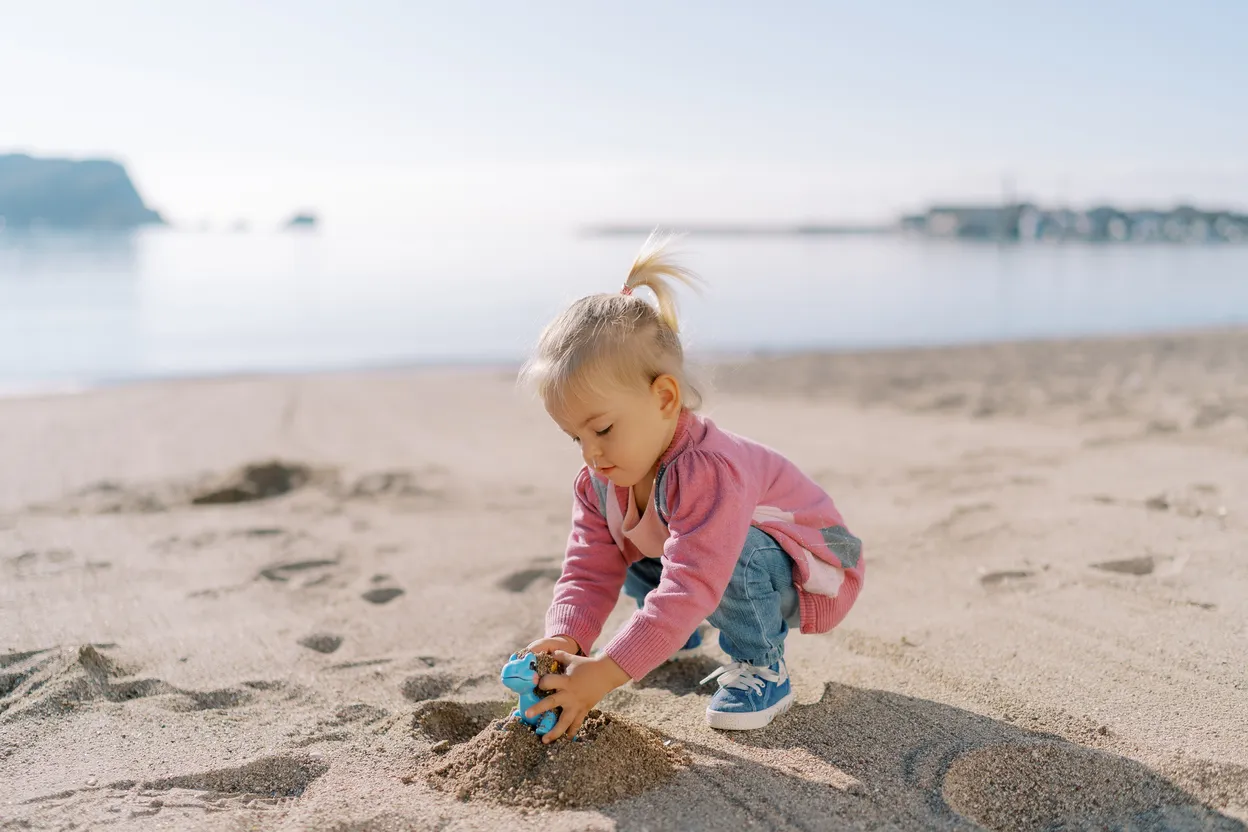
Dry sand is easy play, but digging wet, heavy sand in the sandbox with a small shovel is a full workout for the shoulder-girdle muscles.
Heavy Work Activities for Preschoolers (Ages 3–5)
As children grow, their physical abilities expand, which means heavy work activities for preschoolers should become more complex, creative, and goal-oriented. At this age children already love role-play and helping around the house, so it'll be easier for you to fit them into a fun, non-trivial routine throughout the day.
Groceries Helper
When you come back from the store, always set aside a bag of your child's own. Put a bottle of water, a carton of milk, or a kilogram of apples in it (adjust the weight to your child's strength, but so they have to make an effort). Carrying weights in your hands is the gold standard of proprioception.
Animal Walks
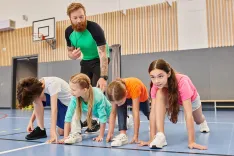
These are classic heavy work ideas for kids that need no props at all. For example, you can do the bear walk: walk on all fours without bending the knees and elbows, so the bottom points high toward the ceiling. Or you can try the crab walk: sit on the floor, lean on your hands and feet, lift your hips, and walk backward. A truly big challenge is the frog jump. From a deep squat, you sharply leap up and forward.
Wall Pushes
A great way to quickly calm a child before an activity. Ask them to go up to the wall, place their palms on it at shoulder height, and try to "push the wall," straining with all their might for 10–15 seconds. Repeat 3–4 times.
Weighted Obstacle Course
Build an obstacle course at home, but add a condition: the child has to go through it carrying a heavy backpack (put a couple of books in it) or hugging a heavy sofa cushion with both arms.
Vacuuming
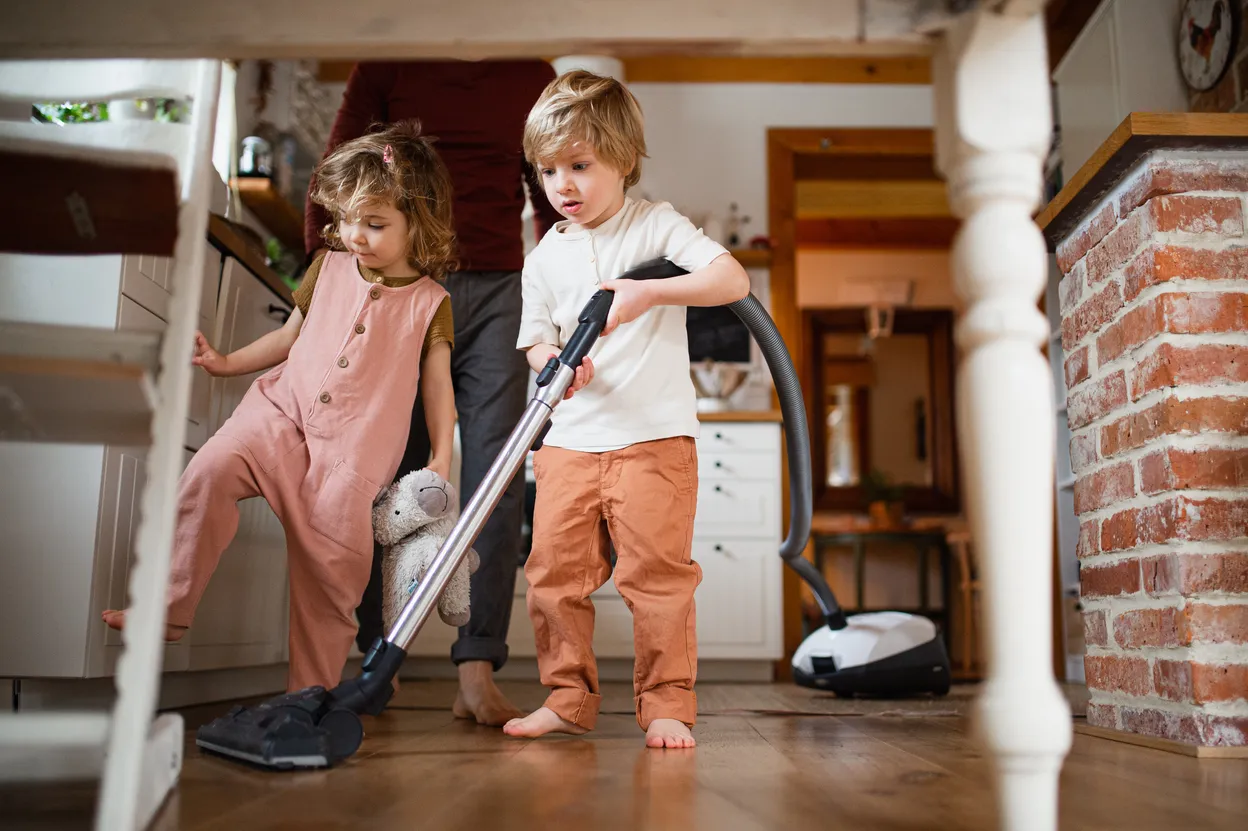
Pushing and pulling the vacuum brush across a fluffy carpet isn't just helping mom; it's one of the highest-quality kinds of heavy work for preschoolers.
Wheelbarrow Walking
A classic game from our childhood. The child lies on their belly, leaning on straightened arms. You take them by the hips or ankles, lift them up, and the child "walks" on their hands around the room. This exercise also strengthens the core and shoulder girdle.
Watering Plants
Give your preschooler a large watering can filled with water. They'll have to not only carry that weight but also coordinate their movements to water the plants carefully.
Shoveling
If you have a yard, hand your child a small shovel. Scooping heavy wet snow or damp autumn leaves is the ideal whole-body work.
Furniture Movers
Of course, we're not asking children to move oak wardrobes. But if you need to vacuum under a light armchair, pouf, or kitchen chair, ask your preschooler to be your "mover" and help shift the furniture.
Squish Machine
Have your child lie on the sofa while you surround them on all sides (including on top) with lots of heavy cushions, leaving the head free. Then ask them to wriggle out of this pile without using their hands, using only squirming movements of the body.
Tearing Cardboard
It sounds unusual, but it's great for relieving stress and tension. Save the thick cardboard delivery boxes. Your child's task is to tear them apart with their hands into small pieces, to then put in the recycling bin. Cardboard tears with difficulty, and that requires great effort from the fingers and hands.
Bucket Fill
At the beach or in the sandbox, give your child a task: bring you the heaviest bucket of wet sand and water. The very process of digging the heavy mass, and then carrying the bucket by the handle, activates the muscles wonderfully.
Monkey Bars
Any exercise where a child has to hold up their own body weight in the air belongs to the heavy work category. Hanging on rings, doing pull-ups, or moving across the monkey bars at the playground is proprioceptive and sensory stimulation.
Medicine Ball Toss
Use a light ball (about 1 kg) or a tightly packed heavy backpack. Sit on the floor facing each other a short distance apart and gently roll or toss it from hand to hand, making sure the child catches the weight.
When and How Often to Use Heavy Work
The main rule for adding heavy work ideas for kids is regularity. Don't wait until your child starts screaming and dashing around the room. It's far more effective to use these exercises preventively, making them part of your everyday life.
Here are the perfect moments for this kind of work:
- Morning. Wake up, stretch, and do 10 frog jumps to wake up the nervous system.
- Before tasks that require concentration. If your child is about to sit at the table (draw, do a puzzle, make a craft), ask them beforehand to push the wall or carry a basket of toys. This will boost focus and attention.
- During transitions. The switch from active play to dinner, or from a walk to sleep, is often accompanied by protests. Make that transition physical: for example, let the child get to the bathroom using the bear walk.
- At the first signs of overstimulation. If you see your child starting to talk too loudly, bumping into things, or unable to stay in their chair, that's a signal. Urgently give them a tight bear hug or let them tear a piece of cardboard.
Build Focus and Calm Through Play With Keiki
Specialists note an important sequence: for a child to be able to do intellectual or calm work well, their sensory "jug" must be filled through the body. First you give the child a physical load, and then you offer them calm, developmental activities for the mind.
The Keiki platform is exactly the right tool for the second phase. Our goal is to help parents create a harmonious balance between physical activity and cognitive development. After your child has jumped to their heart's content or built a fort out of heavy cushions, their nervous system is ready to concentrate.
That's exactly the moment for Keiki. Our app has a huge library of interactive games that don't just entertain but also develop. They train logic, memory, math skills, and reading basics. For example, after heavy work activities for kids it's the perfect time to focus on the many brain development games, which include logic and creative tasks where you sort objects by different features, look for hidden objects, show attentiveness, and so on. Or it's the perfect time to practice writing with writing games featuring various fun tracings and copybooks.
Build real skills through fun, educational games for your child
Try KeikiConclusion
Childhood shouldn't be quiet and motionless. The requests "sit still" and "stop fidgeting" contradict the very nature of a developing child's body. Our brain learns about this world through the body, and the harder the body works, the more clearly the brain understands its boundaries.
By adding heavy work activities for kids to your everyday life, you give your child the chance to develop harmoniously and without tantrums. You teach them self-regulation, help them cope with stress, boost their attention span, and simply make your life together much more fun. Try suggesting your little one drag the laundry basket or turn into a crab today, and you'll be amazed at how quickly this exercise relieves tension and brings smiles and calm back into your home!