Veterans Day for Kids: 25 Activities, and Easy Ways to Explain the Holiday

Veterans Day lands on November 11 every year, and for a lot of kids it's just "the day there's no school." Then a flag goes up outside the grocery store, or grandpa mentions "his service," and suddenly there's a kid in the backseat asking what a veteran actually is. Good question. It deserves better than a quick "it's a holiday, honey." Veterans Day for kids is basically an invitation: a chance to explain what a veteran is, why the country sets aside a day for them, and how even a 4-year-old can show that they care.
Trying to pull together a veterans day activity for kindergarten at 9 p.m. the night before? Building out a whole week of lessons instead? Either way, there's something below that fits your age group and the time you've actually got.
Key Takeaways
- Veterans Day for kids is an age-appropriate way to explain that a veteran is anyone who has served in the U.S. military, and that November 11 is set aside to thank them.
- Keep veterans day explained for kids simple: no graphic war details, just service, sacrifice, and gratitude, scaled to what a child can actually process.
- Veterans Day and Memorial Day are often confused — Veterans Day honors everyone who has served, living or deceased, while Memorial Day honors only those who died in service.
- Letter-writing, flag crafts, and classroom visits from a veteran are some of the most common, highest-impact ideas whether you're planning veterans day for kindergarten or preschool.
What Is Veterans Day? (Explained for Kids)
Veterans Day is a holiday on November 11 that says thank you to everyone who has served in the U.S. military, whether they served decades ago or are retired from service today. That's the whole concept in a single sentence, and it's genuinely all a preschooler needs to start.
The history behind it gives older kids a bit more to chew on. Fighting in World War I stopped at the eleventh hour of the eleventh day of the eleventh month in 1918, and that's why the date stuck. That day became a legal holiday in 1938, originally called Armistice Day, focused on honoring World War I veterans specifically. Then in 1954, after World War II and the Korean War had added millions more veterans to the country's history, Congress swapped "Armistice" for "Veterans." November 11 became a day to honor anyone who had served, in any war.
For a kid-sized version, try: “A long, long time ago, a huge war ended on November 11. People were so happy it was over that they made that day special. Now we use it to say thank you to everyone who has ever been a soldier, sailor, airman, or Marine.”
Veterans Day vs. Memorial Day: What's the Difference?
Veterans Day honors everyone who has served in the military, including people who are still alive today. Memorial Day, observed on the last Monday in May, honors only service members who died while serving. Kids mix these up constantly, and honestly, so do a lot of adults.
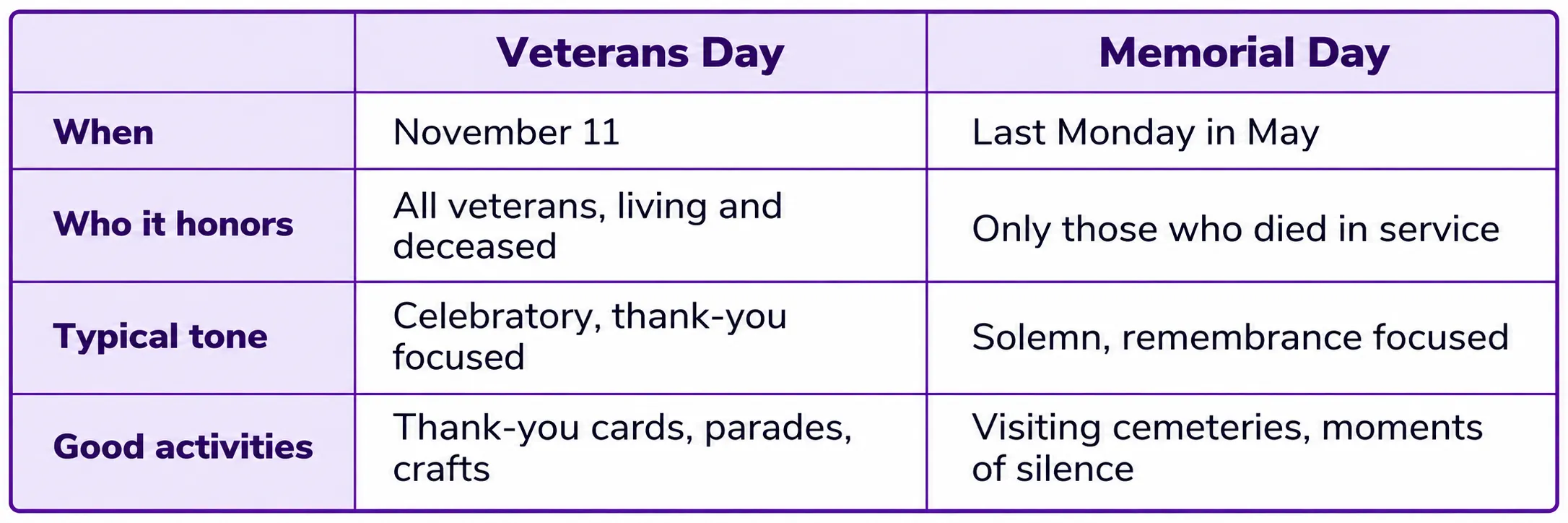
A simple way to say it to a child: "Veterans Day is for saying thank you to veterans who are here with us. Memorial Day is for remembering the ones who aren't."
Help your child
grow with Keiki
We’ll help you turn everyday screen time
into real learning progress.
Why Veterans Day Matters for Kids
Teaching kids about Veterans Day does more than fill a day off from school. It plants some real, lasting ideas, and the good news is none of them require a lecture.
- It builds gratitude as a practiced skill, not just a word. Writing a card or making a craft gives gratitude a physical action to attach to, instead of leaving it as an abstract concept.
- It introduces the idea of service to others. Kids start to understand that some jobs mean putting someone else's safety ahead of your own comfort.
- It connects history to real people. A veteran isn't a textbook photo. For a lot of kids, it's a grandparent, a neighbor, or a parent, which makes the history lesson personal instead of abstract.
- It teaches respectful curiosity. Kids learn there's a right way to ask questions and a right way to say thank you, both useful social skills well beyond November 11.
- It gives quieter kids an easy way to participate. A card, a drawing, or a quiet nod from the back of the room lets a shy kid show they care without having to stand up and speak.
Veterans Day Crafts for Kids
Give a kid's hands something to do, and a real conversation about service and gratitude tends to happen almost by accident. That's the quiet magic behind veterans day crafts for kids, and it's why they work better than a straight-up lecture. Most of these just need supplies you probably already have in a drawer or a classroom closet.
- Handprint Flag — Press red and white painted handprints in rows on blue paper to build an American flag, one small hand at a time.
- Thank-You Card — Fold construction paper in half and let kids draw a picture or dictate a sentence of thanks to mail or hand to a veteran.
- Paper Poppy — Twist red tissue paper or cut red construction paper into a poppy shape, the flower long associated with remembering those who served.
- Medal Craft — Cut a cardboard circle, cover it in foil or gold paint, and attach a ribbon so kids can "award" a veteran in their life.
- Patriotic Pinwheel — Fold a square of red, white, and blue paper into a pinwheel and pin it to a straw for a craft that doubles as outdoor play.
- Service Branch Collage — Give kids pictures or stickers representing the Army, Navy, Air Force, Marines, and Coast Guard to sort and glue onto a poster.
- Veterans Day Wreath — Trace and cut paper leaves in red, white, and blue, then glue them around a paper plate ring for a door decoration.
- Star-Spangled Headband — Cut a paper strip to fit a child's head and glue on stars for a wearable craft that works well for a classroom parade.
Veterans Day Activities for Preschool
A 3- or 4-year-old isn't going to sit through a history lesson, and that's fine. Veterans day activities for preschool work best when they're short, sensory, and light on explanation, since this age group learns by doing, not by listening to an adult talk.
- Flag Coloring Page — A simple printable American flag to color introduces the colors and shape kids will see all day.
- Red, White, and Blue Sorting — Set out red, white, and blue pom-poms, blocks, or buttons and have kids sort them by color into bowls or cups.
- "Thank You" Sign Making — Hand preschoolers a blank sign and markers, and let them decorate it however they like while an adult writes "Thank You" across the top.
- Marching Game — Play upbeat music and let kids march around the room, which works as both movement break and a gentle intro to the idea of a military parade.
- Picture Book Read-Aloud — Choose a short, simple picture book about veterans or community helpers and talk through the pictures together.
- Veteran Photo Share — If a family member has served, bring in a photo for circle time and let the child point and say one thing about that person.
Veterans Day Activities for Kindergarten
Five- and six-year-olds can handle more than a coloring page, and they usually want to. Veterans day activities for kindergarten can carry extra structure since this age group follows multi-step directions and sits through slightly longer explanations without losing the plot.
- Class Thank-You Card Drive — Have the whole class make cards, then mail them through an organization that delivers letters to veterans or active-duty troops.
- Veterans Day Word Hunt — Hand out a short printable with words like "flag," "soldier," and "honor" to circle or trace, tying literacy practice to the theme.
- Branch Matching Game — Match pictures of military vehicles, uniforms, or emblems to the correct branch — Army, Navy, Air Force, Marines, Coast Guard, Space Force.
- Classroom Parade — Let kids wear their patriotic crafts and "parade" around the classroom or hallway to music, mimicking real Veterans Day parades.
- Veteran Visitor Q&A — Invite a veteran parent, grandparent, or community member to answer a few prepared, age-appropriate questions from the class.
- Veterans Day Bulletin Board — Build a class display together, with each child contributing one drawing, handprint, or sentence about gratitude.
Build real skills through fun, educational games for your child
Try KeikiChildren's Veterans Day Activities Beyond the Classroom
A craft table is a fine starting point, but it's not the finish line. Some of the most memorable children's veterans day activities happen once you're actually out in the community, whether it's a weekend project or a one-off family outing.
- Write to a Veteran or Active-Duty Service Member. Organizations exist specifically to deliver kid-written thank-you letters to deployed troops and veterans, so a craft turns into something that reaches a real person.
- Attend a Local Parade or Ceremony. Many towns hold a Veterans Day parade or ceremony, and seeing it in person makes the holiday far less abstract than hearing about it.
- Visit a VA Hospital or Veterans Home. With a parent or group, kids can hand out cards or simply say thank you face-to-face. It tends to stick with a child far longer than a craft made at a desk.
- Assemble a Care Package. Pack a small box with snacks, socks, or handwritten notes to donate through a veterans' organization drive.
- Watch a Kid-Friendly Veterans Day Video. A short, age-appropriate video explaining the holiday gives visual context that pairs well with a follow-up conversation.
Keep the Gratitude Going with Keiki
A craft or a conversation is a good start, but the matching and sorting skills a Veterans Day activity builds are worth practicing past November 11. Keiki World’s matching and sorting games work the same mental muscles as the Branch Matching Game or the red, white, and blue sorting activity above, just applied to shapes, colors, and everyday categories. It’s an easy, low-pressure way to keep that skill growing without needing a lesson plan to back it up.
Tips for Talking About Veterans Day With Kids
Some Veterans Day conversations land well. Others leave a kid wide-eyed and whispering "wait, is there going to be a war?" at bedtime. A few small choices decide which one you get.
- Skip the graphic war details. Focus the conversation on service and thanks, not combat. Young kids don't need to know what war looks like to understand gratitude.
- Use the words "job" and "helper" for younger kids. Framing a veteran as someone with an important, brave job lands faster than the word "soldier" alone.
- Let questions lead. If a child asks "will we go to war?" or "what is war?", answer only what was asked, calmly, instead of expanding into more than they're ready for.
- Connect it to someone real when you can. A grandparent, neighbor, or family friend who served makes the lesson concrete instead of textbook-abstract.
- Keep the tone celebratory, not somber. Unlike Memorial Day, Veterans Day is meant to feel like a thank-you, so smiles, cards, and crafts are exactly the right register.
- Follow up after November 11. A single conversation rarely sticks. Bringing up veterans again around the next holiday reinforces the idea instead of letting it fade by December.