16+ Problem Solving Activities for Kids (Fun & Easy)

Here's a scene every parent knows: your kid hits a snag — a puzzle piece won't fit, a tower keeps toppling, a sibling won't share — and within about four seconds, they're looking at you to fix it. The instinct to jump in and solve it for them is strong. Honestly, it's usually faster. But it's also exactly the moment that teaches your kid the opposite of what you're trying to teach them.
Table of contents
- Key Takeaways
- Why Problem-Solving Skills Matter
- The Four-Step Problem-Solving Process
- How Logic Changes from Age 1
- Engineering and Spatial Activities
- Logic and Creative Thinking
- Social Problem-Solving Games
- Everyday Life Problem-Solving Quests
- Outdoor Problem-Solving Adventures
- Story-Based Problem-Solving
- Tips for Supporting Your Kid
- ow Keiki Helps Kids Practice
Key Takeaways
- Problem-solving activities for kids work best when a parent resists the urge to jump in immediately — a brief "supportive pause" gives a kid room to try their own idea first.
- How a child solves problems changes dramatically between ages 1 and 7, from physical trial-and-error to full mental planning several steps ahead.
- Problem-solving activities for preschoolers should stay short, concrete, and low-stakes — a 3-year-old and a 7-year-old need very different versions of "the floor is lava."
- Praising effort and strategy, not just a correct answer, is what keeps a kid willing to attempt a hard problem instead of giving up at the first sign of difficulty.
Why Problem-Solving Skills Matter for Kids
Problem-solving skills matter for kids because they're the foundation of what researchers call executive function — the mental skill set behind planning, focus, and adapting when a first plan doesn't work. According to the Harvard Center on the Developing Child, developing these early building blocks is "one of the most important and challenging tasks of the early childhood years," and the researchers compare executive function to an air traffic control system: the part of the brain that plans, focuses attention, and juggles multiple pieces of information at once, much like a busy airport tower.
Here's where a lot of us get it wrong, though: the instinct to swoop in and solve a kid's problem the second they get frustrated actually short-circuits the exact skill we're trying to build. A "supportive pause" — waiting a beat, offering a small nudge instead of the full answer — gives your kid the chance to move through the real problem-solving cycle themselves instead of outsourcing it to you every single time.
The Four-Step Problem-Solving Process
Every problem-solving activity in this guide runs on the same underlying cycle, whether your kid is stacking blocks or negotiating who gets the last cookie.
- Awareness. Your kid notices something isn't working — the tower fell, the puzzle piece doesn't fit, the plan hit a wall.
- Generating ideas. They come up with one or more possible fixes, even if the first idea is objectively terrible (it usually is, and that's fine).
- Action. They actually try the idea instead of just talking about it.
- Evaluation. They check whether it worked, and if it didn't, they loop back to generating a new idea.
Your job through all four steps is mostly to resist doing step 2 and step 3 for them. That supportive pause is uncomfortable — watching a kid struggle for thirty extra seconds feels longer than it is — but it's the entire mechanism these activities rely on.
Help your child
grow with Keiki
We’ll help you turn everyday screen time
into real learning progress.
How Problem-Solving Skills Change from Age 1 to School Age
Problem-solving looks completely different at 18 months than it does at 7 years old, and knowing roughly where your kid sits on that curve helps you pick the right activity instead of one that's guaranteed to end in tears.
- Ages 1-2: Problem-solving is almost entirely physical trial and error — stacking, dropping, banging two things together to see what happens. There's no planning yet, just experimenting.
- Ages 3-4: Kids start understanding cause and effect, though magical thinking still creeps in ("if I close my eyes, the problem goes away"). This is the age for simple, concrete challenges with an obvious physical solution.
- Ages 5-6: Real mental problem-solving kicks in — kids can plan two or three steps ahead before acting, instead of only reacting in the moment.
- Ages 6-7: Kids start handling more complex, multi-step rules and begin applying problem-solving to social situations, not just physical ones — working out a conflict with a friend instead of just a stuck puzzle piece.
Engineering and Spatial Problem-Solving Activities
These 4 engineering and spatial activities ask your kid to build, rescue, or navigate using whatever's on hand, which makes them some of the best hands-on problem-solving games for kids who'd rather touch something than talk about it.
Ice Rescue Mission
Freeze a few small toys inside a block of ice (an old container works fine), then hand your kid a spray bottle of warm water, some salt, a spoon, and a small plastic hammer, and let them figure out which tool melts, cracks, or chips the ice fastest. There's no instruction sheet here on purpose — your kid has to test each tool, notice what's working, and adjust, which is the four-step process in miniature. Salt usually wins, but half the fun is watching your kid discover that for themselves instead of you announcing it.
Bridge Over Lava
Declare the living room floor "lava," place a toy on the far side of the room, and hand your kid a pile of cushions, cardboard, and a length of rope to build a safe path across without touching the ground. This one forces real spatial planning — your kid has to figure out how many "stepping stones" they actually have and plan a route before committing to it, not just start laying things down randomly and hope for the best.
Tower with Restrictions
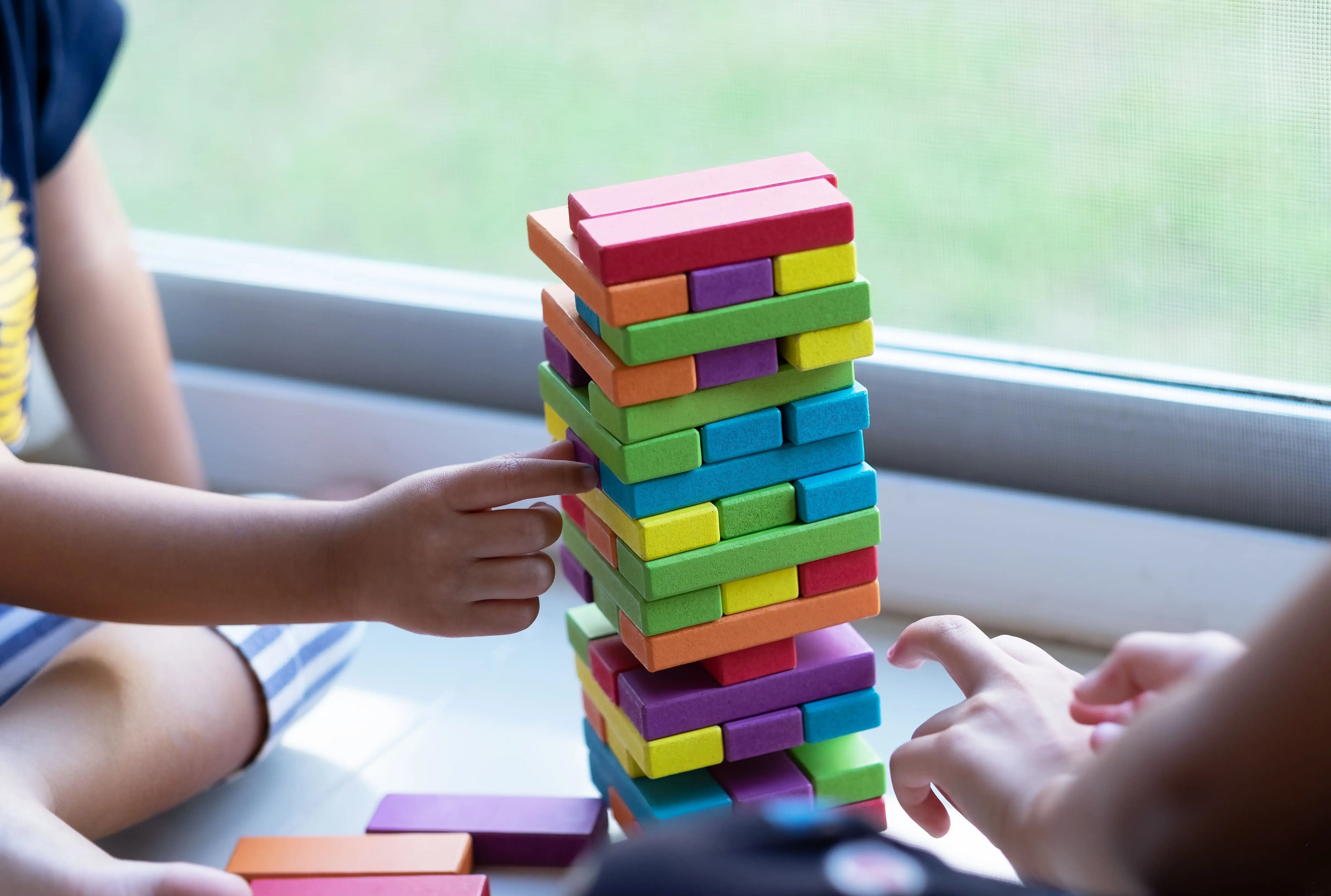
Challenge your kid to build the tallest tower they can using exactly 10 building blocks, with the rule that the base can only be a single piece. It sounds like a small constraint, but it completely changes the problem — a wide, stable base is off the table, so your kid has to experiment with balance and weight distribution instead of just stacking blocks straight up.
Tape Sensory Maze
Build a maze on a table or the floor using strips of painter's tape, then have your kid guide a cotton ball through the maze using only a straw to blow it along. This one combines problem-solving with fine motor control and breath control, and it's a genuinely good option for a kid who needs a calmer, quieter activity than a full-body challenge like Bridge Over Lava.
Logic and Creative Thinking Activities
These 4 logic and creative thinking games for kids build reasoning and flexible thinking without any building materials required — just a bit of imagination and, in a couple of cases, a good poker face from you.
What's Inside the Box
Hide an everyday object in a box and let your kid ask only yes-or-no questions to figure out what it is, without ever peeking. This is a genuinely great logic game for kids because it forces them to think strategically about which questions actually narrow things down ("Is it bigger than a shoe?") instead of just guessing randomly, which is a skill that transfers directly to real troubleshooting later.
Broken Robot
Pretend to be a "broken robot" that only follows instructions exactly as stated, no inference allowed — tell your kid to guide you to a specific object or task using only their words, and follow their instructions with deliberately literal, occasionally ridiculous precision. Kids find this hilarious almost immediately, and it teaches something genuinely useful: clear, precise communication is itself a problem-solving skill, especially once they realize "go to the kitchen" gets them a very different result than "walk three steps forward, then turn left."
Alternative Uses
Pick any everyday object — a paperclip, a sock, a cardboard tube — and challenge your kid to come up with as many non-obvious uses for it as they can in two minutes. This is a classic creative-thinking exercise for a reason: it trains your kid to break out of "this object only does one thing" thinking, which is exactly the mental flexibility that helps when their first solution to a real problem doesn't pan out.
Continue the Pattern
Lay out a simple sequence — colored blocks, shapes, numbers, even claps and stomps — and have your kid figure out what comes next and continue it. Start dead simple (red, blue, red, blue) and build up to patterns with two or three repeating elements once they're consistently getting it right, since a pattern that's too easy stops being a problem worth solving at all.
Team and Social Problem-Solving Games
These 4 team and social games for kids build problem-solving skills that only show up when another person is involved — communication, patience, and trusting someone else's instructions.
One Marker for Two
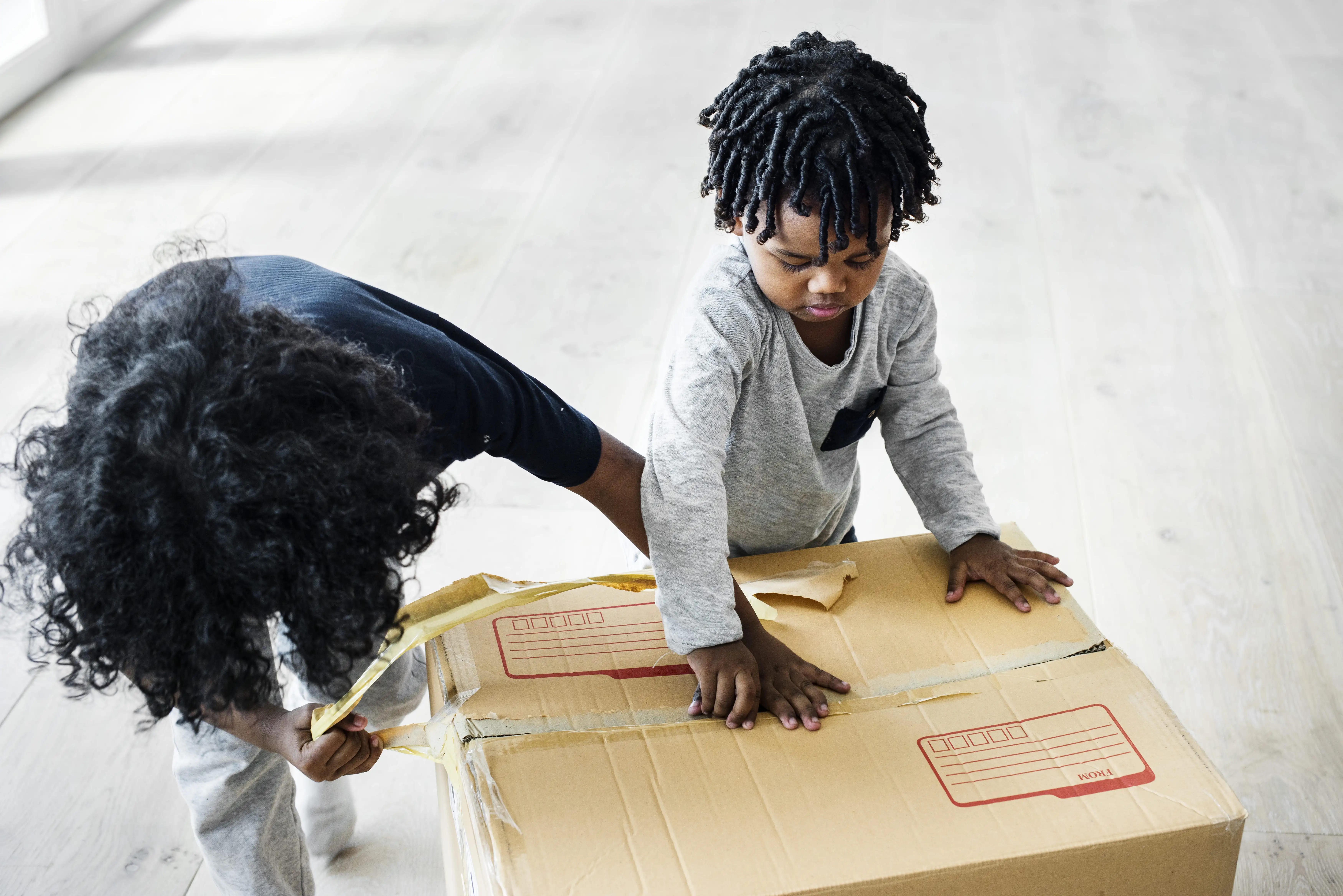
Give two kids a single marker and one piece of paper, and ask them to draw something together — a house, an animal, whatever they agree on — without ever letting go of the marker or talking through exactly who draws what next. It forces real-time negotiation and compromise in a way that feels like a game rather than a lecture about "sharing," which makes it land a lot better with most kids.
Blind Crossing
Set up a simple, safe obstacle course of cushions or boxes, blindfold one kid, and have a partner guide them across using only verbal directions — no touching allowed. This one builds trust and precise communication fast, since vague directions ("go that way") clearly don't work, and your kid quickly figures out that specific instructions ("three steps forward, then stop") are the only ones that actually help.
Build from Description
Sit two kids back-to-back, give one of them a simple block structure, and have them describe it out loud so the second kid can build a matching copy without ever seeing the original. The gap between what gets said and what gets built is usually huge at first, and watching kids close that gap over a few rounds is a genuinely satisfying way to see communication skills improve in real time.
Rescue Club
Set up a pretend emergency — a stuffed animal stuck in a tree, a bridge that's "washed out," a town that needs supplies — and have a small group of kids brainstorm multiple possible solutions before picking one to act out. Requiring more than one idea before choosing is the key move here; it stops kids from locking onto the very first suggestion and stops listening to anyone else.

Everyday Life Problem-Solving Quests
These 4 everyday life quests take real household situations and turn them into problem-solving practice, which means no extra setup, no special materials, and no pretending required.
Missing Sock Detective
Next time a sock actually goes missing (it will), turn the hunt into a real investigation — have your kid form a hypothesis about where it might be, check that spot, and then form a new hypothesis if they're wrong instead of just wandering randomly from room to room. It's a genuinely low-stakes way to practice the awareness-idea-action-evaluation cycle on something that was going to happen anyway.
Packing with Restrictions
Before a trip or even a simple overnight at grandma's, hand your kid a small bag and a rule — "pack only 5 things" or "you need one item from each of these three categories" — and let them work out what actually makes the cut. The restriction is what makes it a real problem instead of just packing everything they own, since they have to weigh what they'll actually need against what they just want to bring.
Dinner from Three Ingredients
Pick three random ingredients from the fridge or pantry and challenge your kid to help plan a simple meal or snack using only those three (plus basics like salt or bread). It's a creative-constraint exercise disguised as being helpful in the kitchen, and even a "bad" combination still counts as a win if your kid actually worked through the logic of why it might or might not taste good.
Supermarket Quest
Give your kid a small budget and a short list of items to find at the store, and let them navigate the aisles, compare a couple of options, and keep a rough running total in their head (or on a phone calculator for younger kids). Real budget constraints and real navigation make this one of the most authentic problem-solving activities on this list, since there's genuinely no adult-provided answer key.
Outdoor Problem-Solving Adventures
Fresh air adds real variables — uneven ground, wind, things that don't behave the way they do indoors — which makes these 3 outdoor problem-solving activities for kids a genuinely different kind of challenge than anything on a tabletop.
Backyard Scavenger Hunt Detective
Hide a series of 5-8 clues around the yard or a park, where each clue has to be solved or a small challenge completed (find something round, find something that makes a sound) before it reveals the location of the next one. Unlike a simple "find these items" list, building in a mini-challenge at each stop means your kid has to keep problem-solving the whole way through instead of just running around collecting things on autopilot.
Stick and Stone Ramp Engineering
Hand your kid a pile of sticks, stones, and a few small balls or toy cars, and challenge them to build a ramp that gets the ball the farthest, the fastest, or the most accurately into a target like a bucket. This is real, hands-on physics — height and angle change everything — and because nature doesn't offer perfectly straight sticks or flat rocks, your kid has to adapt their design to the actual materials in front of them instead of an idealized version.
The Great Puddle Crossing
After rain (or with a hose and a patch of grass), set up a "puddle" your kid isn't allowed to step in, and give them a pile of flat stones, boards, or stepping blocks to build a crossing. Outdoor terrain is never as tidy as a living room floor, so this version of the classic "cross without touching the ground" challenge forces real adaptation — a stone that looked stable from a distance might wobble once it's actually placed, and your kid has to problem-solve around that in the moment.
Story-Based Problem-Solving
These 2 story-based activities build problem-solving through narrative instead of hands-on building, which makes them a good fit for a quieter moment, like right before bed when nobody has the energy for a full obstacle course.
Fix the Story
Read a favorite story out loud, but stop right before the character solves their main problem, and ask your kid what they think the character should do next. Let them talk through a few options before you reveal how the book actually resolves it, and compare notes — there's rarely a wrong answer here, and a kid who comes up with a totally different solution than the author did is doing exactly the kind of flexible thinking this whole guide is about.
Choose Your Own Adventure Retelling
Have your kid retell a story they already know well, but change one key detail early on — the wolf is friendly, the bridge is already broken, the treasure map is missing a corner — and then work out loud through how the rest of the story has to change to still make sense. It's a surprisingly deep problem-solving exercise disguised as a bedtime game, since your kid has to trace the ripple effects of one change through an entire plot.
Build real skills through fun, educational games for your child
Try KeikiTips for Supporting Your Kid Through a Tricky Problem
A few small habits make the difference between a kid who pushes through a hard problem and one who gives up the second it stops being easy.
- Use the supportive pause. Count to ten in your head before jumping in — most kids need less help than your instinct tells you they do.
- Break big problems into smaller ones. If your kid is stuck on the whole tower, ask about just the base first instead of the entire structure.
- Praise effort and strategy, not just the right answer. "You tried three different ways before that worked" teaches more than "good job."
- Match the challenge to the age, not the calendar. A 4-year-old and a 7-year-old doing "the same" activity should have genuinely different versions of it.
- Let a bad idea play out sometimes. A plan that visibly fails teaches the evaluation step better than you explaining in advance why it won't work.
- Watch for frustration versus real distress. A little frustration is part of the process; a full meltdown means it's time to scale the challenge back, not push through.
How Keiki Helps Kids Practice Problem-Solving Skills
Digital play can genuinely complement hands-on problem-solving when it's built around the same core skills instead of just passive entertainment. Keiki World includes matching and sorting games that build pattern recognition, logic puzzles like geometric silhouette matching and shape-arranging challenges, and cause-and-effect activities that reinforce the same "try it, see what happens, adjust" loop your kid practices with a block tower or a maze. Keiki offers 1,500+ interactive games and lessons that adapt to a child's own pace, making it a solid way to reinforce problem-solving thinking on the days a screen is the realistic option, without pretending it replaces hands-on play.