25+ Airplane Activities for Kids (By Age)

Every parent who has ever traveled with children knows that particular feeling right before boarding a plane. It's a mix of enormous anticipation for the family vacation and a little, entirely justified panic. You only need to see the inside of an airplane once to start asking yourself: how to keep kids entertained on a plane when they literally can't leave their seats for several hours?
We've all been there. Kids are full of energy, their bodies are built for movement and exploration, and the safety rules require them to buckle up and sit quietly. In that situation, the standard "please sit still" simply doesn't work, or it works the first few times, and not for long. That's why we've put together this list of ideas for you. We'll talk about how to assemble the perfect busy bag, discuss healthy screen time, and reveal the secrets to surviving even transatlantic flights.
Key Takeaways
- The golden rule of flying with kids is novelty — a brand-new toy held until takeoff will keep attention three times longer than any favorite from home.
- Keep it mess-free and quiet — no slime, no markers without caps, no sound toys, and nothing with tiny rolling parts that'll disappear under seats.
- Match activities to the flight length — short haul needs 3–4 activities, long haul needs one new thing roughly every 45 minutes, ideally wrapped up to make the unboxing part of the fun.
- Preschoolers do best with tactile, visual activities like stickers and water coloring books, while 7–10 year olds are ready for card games, logic puzzles, and even keeping a travel journal.
What Makes a Good Airplane Activity?
Before we get to any ideas, we need to talk about safety. An airplane cabin is a very specific environment. You have only a small tray table, limited legroom, neighbors who want to sleep, and turbulence that throws everything off. So under these conditions, not every toy is actually suitable for travel. When choosing activities for kids on plane, check them against the following checklist:
- Low-mess. Nothing runny, sticky, crumbly, or staining. If a toy can dirty your child's clothes, the airplane seat, or your neighbor's outfit, leave it at home.
- Quiet activities. Toys with music buttons, sirens, and loud jingles are a no. The exception is if they can be plugged into headphones. Respect other passengers' comfort.
- No small rolling parts. Bringing Lego, bracelet beads, or a puzzle? Be prepared to suffer. Retrieving them mid-flight will be impossible, and as a result, tears await.
- Compactness. All your travel toys should fit easily into a carry-on or a child's backpack.
- The novelty effect. This is the golden rule of traveling parents: a new toy will hold attention three times longer than the most beloved but old one from home. Buy activities specifically for the flight and hide them until takeoff.
The ideal airplane toy is one that takes up minimal space, doesn't scatter around the cabin, doesn't dirty little hands, and encourages your child toward flight entertainment.
Help your child
grow with Keiki
We’ll help you turn everyday screen time
into real learning progress.
Airplane Activities for Preschoolers (Ages 3–5)
Preschoolers are probably the toughest audience in the sky. Their ability to concentrate is still developing, they physically need to move, and their mood can change at the speed of light. The ideal airplane activities for preschoolers should be visually appealing, tactile, and offer a quick result. If you're looking for the best plane activities for 4 year old, this list will save your flight.
Silicone window stickers
If you got a window seat, that's a real jackpot. Buy a set of reusable gel stickers (they come as animals, cars, planets). Your child can stick and peel them off the window dozens of times. They leave no marks and don't dirty the glass.
Play tip: ask your little one to sort the stickers by color or build a whole story with them on the glass.
Reusable water coloring books
A true hit among kids airplane activities. You pour a little water into a special brush-marker, and your child runs it over the pages. The water makes them change color. As soon as the paper dries, the color disappears and you can color again. This is 100% low-mess drawing.
Painter's tape
You won't believe it, but ordinary paper painter's tape is a unique developmental toy. It tears easily by hand and leaves no sticky residue on plastic.
Play tip: stick strips of tape onto the tray table to create roads and intersections. Pull out a couple of small cars, and your child has a whole city to play with. You can also just stick little pieces of tape onto their fingers or the back of the seat in front and peel them off.
Triangular wax crayons
Drawing on a plane is a great idea, but ordinary round pencils will roll off the table onto the floor. Buy special triangular wax crayons. They rest securely on the surface even during turbulence. Pair them with a new notebook of blank pages.
A snack box with a twist
Food is an activity too. Take a new, clean 7–14 day pill organizer with closing compartments. In each compartment, place a different small snack: a raisin, a piece of cracker, a nut, a blueberry, a gummy bear. Opening each little lid develops fine motor skills.
Finger puppet theater
Soft toys that slip onto your fingers take up no space at all but open up an incredible space for imagination. Act out dialogues between a puppy and a bunny. Let the toys "discuss" the view out the window or the rules of behavior on a plane.
Sticky-note pad
Colorful office sticky notes with an adhesive edge are another non-obvious favorite. Kids can tear them off, draw faces on them, and stick them to their table or armrests. It also develops the pincer grasp.
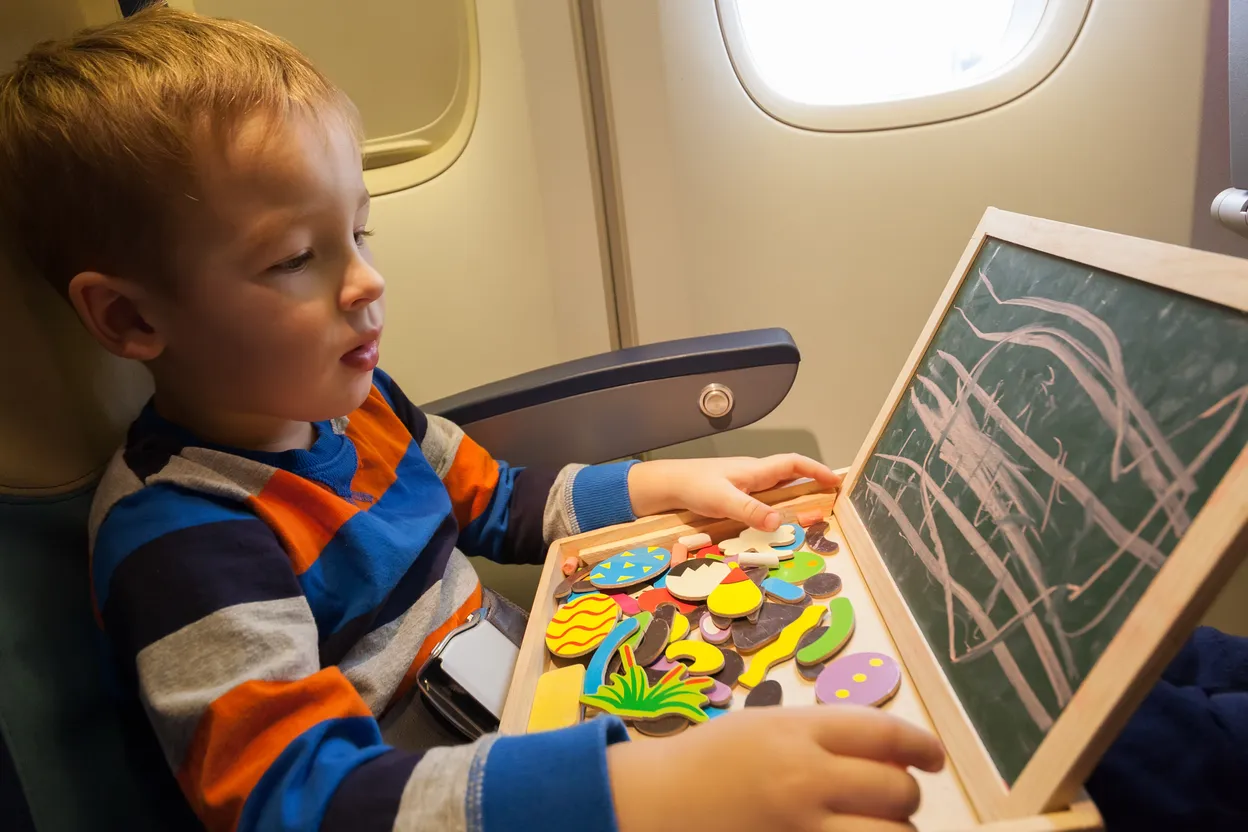
Magnetic construction tins
Small tin boxes containing magnetic pieces inside (for example, to assemble a funny monster's face, dress a doll, or build a car). The magnets hold firmly to the box, so the risk of losing pieces on the floor is minimal.
Airplane Activities for Kids Ages 5–6
At this age, children take a qualitative leap in cognitive development. They become more patient, can hold their attention on a single task longer, and start to get into role-play. The best airplane activities for 5 year old and airplane activities for 6 year old should include elements of creativity, building, and simple problem-solving.
Scratch-art notebooks
These are black sheets of paper you scrape with a special wooden stick. A bright background hides under the black layer. Small downside: it produces a bit of black shavings, so put a napkin underneath.
Wax sticks
These are flexible sticks coated in colored wax. They're slightly tacky, so they connect to one another easily and stick to the airplane table without leaving marks. You can create 2D pictures on the plastic or sculpt 3D figures: glasses, a crown, a funny little person. Ideal kids plane activities for developing the imagination.
Seek-and-find toys
These are clear pouches or plastic tubes densely packed with tiny plastic pellets. Dozens of tiny figures are hidden among the pellets (a little heart, a coin, a dinosaur). The child has to squeeze and turn the pouch to find a particular object. It's a soothing, anti-stress toy that's a great save at takeoff.
Lacing and threading sets
Sturdy cardboard shapes with holes around the edges you thread colored laces through. This activity requires high concentration and quiet, and it's great preparation for the hand for writing at school.
Sticker mosaic by numbers
Unlike ordinary coloring books, here the child has to match a sticker of the right shape to the corresponding number on the picture to assemble a whole image. This activity can captivate a 6-year-old for a good 40–50 minutes.
A jar of soft modeling clay
Take one or two small jars of the most ordinary modeling clay and a couple of plastic knives (the kind handed out with the in-flight meal). The clay gathers up easily, doesn't scatter like sand, and lets your child sculpt and cut shapes right on the table.
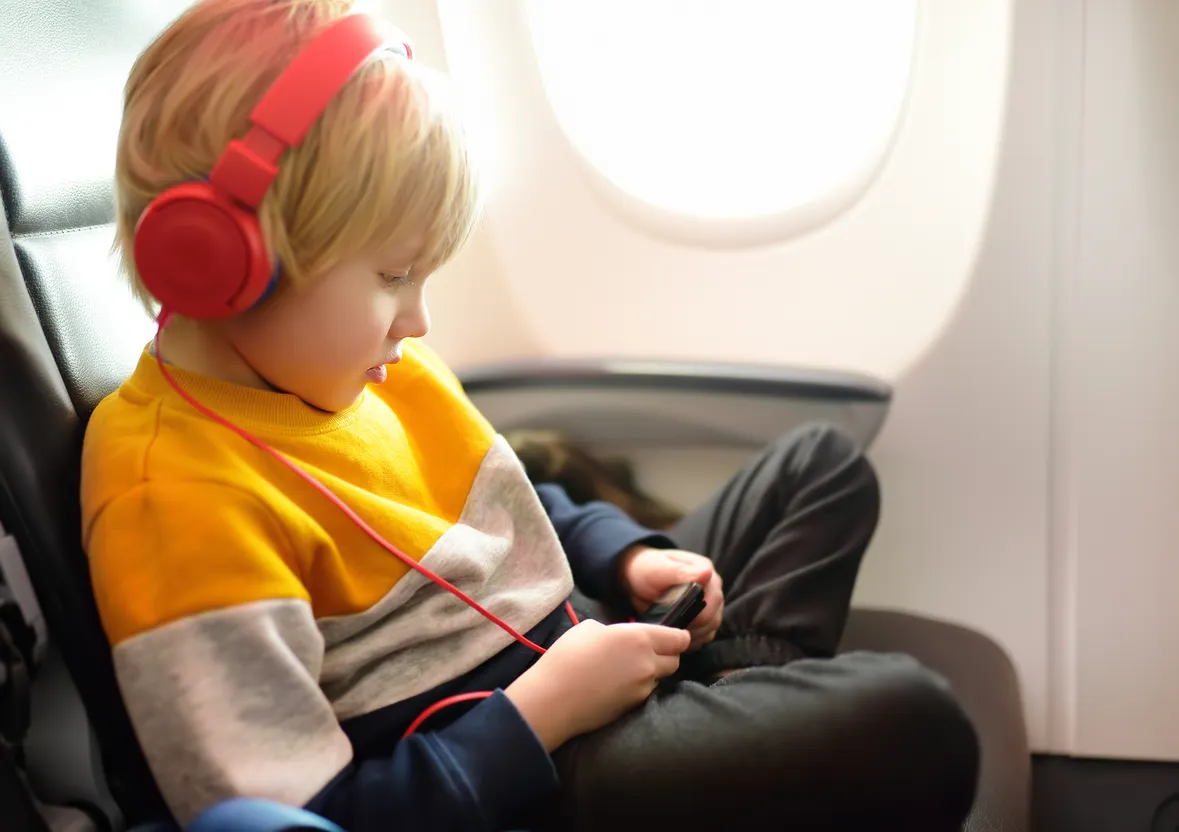
Audio stories in new headphones
Before the flight, buy your child comfortable kids' headphones with a volume limit and download a few hours of new audio plays or stories. Plug them in, hand your child a soft toy, and enjoy the quiet.
A playset with mini figures
Kids this age love miniatures. Take a plastic food container, stick green paper on the bottom to act as grass or foil (a river), and put 5–7 figures inside (dinosaurs, fairies, puppies). The container becomes a stage for storytelling play.
Airplane Activities for Elementary-Age Kids (7–10)
Elementary schoolers are already almost grown-up travelers. They understand safety rules, can read, and love to compete. At this stage, you don't need to bring a bag of small toys. The best airplane activities for kids this age shift toward logic, strategy, art, and quality humor.
Magnetic board games
Chess, checkers, backgammon, tic-tac-toe, or snakes and ladders in a magnetic travel format. The magnets keep the pieces in place even in strong turbulence. You can play together with your child, which turns the flight into quality time.
Card games for the whole family
A deck of cards weighs nothing but delivers hours of fun. UNO, Dobble (Spot It!), Svintus, or ordinary playing cards for games of solitaire. The main thing is to make sure the excitement doesn't turn into overly loud shouts of joy.
Mad Libs pads
This is a popular word game. On the page there's a ready-made text with blanks. The player asks the child to name any noun, verb, or adjective (while the child can't see the text). Then you fill those words into the blanks and read out the absurd and wildly funny story that results. Great grammar practice and a reason to laugh.
The art of origami
Take a pack of square colored origami paper and download a few step-by-step diagrams onto a tablet. The fold-down tray table is a suitable flat surface for folding paper.
Traveler's journal
Give your child a nice notebook and a pen. They can keep a travel diary starting right from the plane. They can write down the flight number, sketch the view from the window, describe the food on board, and make a plan of what they want to see on vacation.
Puzzle books
Sudoku, crosswords, high-difficulty mazes, hidden-object pictures. These are wonderful quiet activities that make the brain work hard.
Learning to draw
Books from the "How to Draw Anything in 4 Steps" series. The child follows the instructions and transfers them to their own sketchbook. It's a very calming, meditative activity.
Mini Lego sets in a container
We remember advising against bringing construction sets on a flight. However, with older children and proper preparation, it's doable. If your child is a Lego fan, gather a few pieces at home in a tightly sealing food container-lunchbox. Important: bring only square or rectangular base blocks, skipping the small round pieces. The container serves as both storage and a play platform.
A disposable film camera
Give your child a real film point-and-shoot. Ask them to document the flight from their point of view. The limited number of shots (usually 36) teaches a schooler to value every picture and to hunt for shots, unlike unlimited shooting on a smartphone.
How Many Activities Should You Pack? (By Flight Length)
One of parents' main mistakes when putting together a packing list is pulling out all the toys at once the moment the "Fasten seatbelts" sign lights up. The secret to a successful flight lies in smart time management. Toys should be handed out one at a time.
- Short flights (1–3 hours). 3–4 new activities plus a favorite snack is enough. The flight goes by quickly, the child watches the clouds with interest and gets in a little play time.
- Medium flights (4–6 hours). Here you'll need 5–7 quality activities. Main rule: one new game for every 40–45 minutes of flight.
- Long flights (long-haul flight, 7+ hours). This is where the experienced traveler's secret weapon comes into play: the gift method. Wrap each small toy in several layers of wrapping paper or foil. The unwrapping process alone will take the child 5–10 minutes. For such long flights, alternate: physical play (modeling), logical (puzzle book), a snack, screen time, and sleep.
And remember that a child over 4 carries their own kids' carry-on backpack. This gives them a sense of independence and control over the situation.
What NOT to Bring on a Plane
Sometimes what seems like a great idea on the ground turns into a disaster in the sky. When making your list of in-flight entertainment, we advise ruling out these categories of things right away:
- Kinetic sand and slime. Turbulence + sticky slime = ruined hair, seat upholstery, and clothes. Kinetic sand sooner or later spills onto the floor, and you'll be collecting it throughout the cabin.
- Markers without caps or permanent markers. First, caps tend to get lost under seats, after which the marker dries out. Second, one clumsy move and the neighboring seat is ruined. Use pencils and wax crayons.
- Toys that imitate weapons. Airport security (TSA) may confiscate them during screening, and that's stress for the child even BEFORE boarding.
- Toys with sound. The main rule of airplane activities for kids is not to disturb others. Any squeakers, talking robots, or musical books that can't be turned off or set to silent don't belong here. Engine noise tires passengers as it is; don't add melodies on repeat.
- Puzzles with 100+ pieces. There isn't enough room on the tray table to lay out the picture, and losing a single piece defeats the whole game.
Make Travel Days a Learning Adventure With Keiki
At ten thousand meters up, when you're already five hours into the flight and all the stickers are stuck and the cookies are eaten, screen time becomes a parent's best friend. And there's absolutely nothing wrong with that! The key is the quality of the content your child consumes. Just think about it: dozens of educational, thoughtful, and useful games that require no space in your hand luggage, no preparation, and no supervision from an adult, all gathered on a tablet or smartphone.
With Keiki, you'll be able to entertain your kids without overstimulation or harm. Unlike watching cartoons, games on our online platform require the brain's active participation. We specifically created a safe, digital environment with no ads and no random links, so you don't have to worry about safety.
We've gathered plenty of travel games that will keep young travelers busy for a long time. For example, on the plane it's the perfect time to brush up on numbers, only without the boredom and rote learning, in the format of quests and all sorts of tasks. Number learning games will help with that. Another activity that never gets old, delights with its variety, and doesn't threaten stained seats and hands is coloring pages! Keiki also has puzzles, attention games, logic, memory, creative tasks, and ones that build up reading and writing. The main thing is that your child learns, solves problems, laughs at cute characters, and develops critical thinking in a fun, interactive format.
Help your child thrive with playful learning
Turn screen time into real growth with Keiki's educational games.
Try KeikiConclusion
Traveling with children is a small step out of your comfort zone, but it's also an incredible adventure that broadens a child's horizons and forms the brightest memories. A plane shouldn't be associated with stress. It's a magical flying machine carrying you toward new horizons.
With a thoughtful arsenal of plane activities for kids on hand, a cozy blanket, a favorite snack, and a useful app loaded on the tablet, you'll handle any flight. Don't be afraid to get creative, join in your child's games, be silly together, and let even the process of flying become a wonderful part of your family vacation!