Animal Games for Kids: Game and Activity Ideas That Build Knowledge

Ask almost any toddler what they want to learn about today, and there’s a solid chance the answer involves a lion, a dinosaur, or whatever bug just crawled across the sidewalk. Animals are basically a universal obsession in the 1-6 age range, which makes them one of the easiest, most reliable themes you’ll ever build a game around. No expensive gear, no petting zoo membership required — just a few plastic figures, some cardboard, and a kid willing to pretend to be a kangaroo for the next ten minutes.

Rainy afternoon, classroom circle time, or a backyard full of cousins on a Saturday — there’s an animal game in here for it.
Why Animal Games Matter for Child Development
A simple interest in animals turns out to carry a lot of developmental weight. Through children's animal games, kids build several skills at once, often without any of it feeling like “work.”
- Empathy and care. Feeding, “healing,” or putting toy animals to bed helps kids practice understanding another creature’s needs — an early rehearsal for compassion and responsibility.
- Vocabulary and speech development. Naming animals, describing their features, and mimicking their sounds gives kids new words attached to something memorable. Animal sound games for kids are especially effective here, since the sound itself becomes a built-in memory hook.
- Gross and fine motor skills. Hopping like a frog or slithering like a snake works large muscle groups, while sorting animal figures or assembling animal puzzle games for kids builds the hand control kids will later need for writing.
- Cognitive development and classification. Educational animal games are genuinely excellent for teaching kids to sort by category — domestic versus wild, mammal versus reptile, predator versus prey — which is early logic and science rolled into one.
- Creativity and imagination. Building a “den” out of couch cushions or inventing a backstory for a stuffed lion taps straight into role-play and storytelling.
A 2024 University of Plymouth study led by Dr. Gray Atherton and Dr. Liam Cross, published in the Journal of Experimental Child Psychology, found something worth noting here: when more than 100 children ages 5 to 10 were tested on “theory of mind” (reading social cues like tone and intent) using stories with animal characters versus human ones, the youngest kids scored as well with animal characters as children two years older did with human characters. In other words, animal themes aren’t just fun — they may genuinely help younger kids grasp social and emotional concepts sooner.
Help your child
grow with Keiki
We’ll help you turn everyday screen time
into real learning progress.
Animal Games for Toddlers (1-3 Years)
It’s 5 p.m., everyone’s cranky, and you need something that buys you ten calm minutes without a single piece of equipment. Animal games for kids this age work best when they’re short, loud, and endlessly repeatable — yes, that same “moo” for the fifth time in a row, because repetition is exactly what’s building those early language connections.
Animal Sound Guessing Game
Make an animal sound — or show a picture and let your toddler guess who it belongs to — then swap roles so they get to stump you back. It’s a fast, low-effort animal game for kids that works auditory memory every single round, and most toddlers will happily play it in the car, the bath, or mid-diaper-change.
Find the Hidden Animal
Hide a handful of toy animals around one room and send your toddler off to find and name each one as it turns up. Zero prep, and it’s a genuine lifesaver for a rainy day when going outside isn’t an option.
Copy My Animal Walk
Call out an animal — bunny, duck, elephant — and both of you move like it across the room together. It builds balance and body awareness, and there’s something about watching a grown-up flap around like a duck that toddlers never, ever get tired of.
Point-and-Name Animal Books
Flip through a picture book together and just point and name: “That’s a goat. Goats say baa.” It’s about as low-effort as an activity gets, but at this age, that repetition is exactly where vocabulary comes from.
Animal Activities for Preschoolers (4-6 Years)
Preschoolers have the fine motor control to make and sort things, not just imitate them, so these animal activities for preschoolers layer in a craft or sensory piece on top of the pretend play. They’re just as easy to run solo at the kitchen table as they are with a small group.
Animal Track Painting
Dip plastic animal figures’ feet in paint and stamp them across paper, then compare whose tracks belong to which animal. It’s messy in the best way, and it sneaks in real observation skills between paint smears.
Paper Plate Animal Masks
Paint a paper plate, add ears and a snout for whichever animal your kid picks, punch a couple of eye holes, and tie on a string. The craft itself holds attention, and then the mask buys you a whole second round of pretend play once it’s actually wearable.
Habitat Sensory Bin
Fill a bin with sand for desert animals, blue rice for ocean creatures, or dried leaves for forest animals, then let your child match toy animals to the right bin. This is one of the most effective activities with animals for preschool age, because it turns an abstract idea like “habitat” into something they can actually dig their hands into.
Life-Size Animal Outline
Grab the sidewalk chalk and draw an animal at its actual size — a whale’s length, an elephant’s height — then let your preschooler stand next to it. The scale usually gets a genuine gasp, which is honestly half the fun of doing this one.
Textured Animal Collage
Glue cotton balls for a sheep’s wool, yarn for a lion’s mane, or shredded paper for a bird’s nest onto a printed animal outline. It builds fine motor control while reinforcing exactly what makes each animal look the way it does.
Animal Story Stones
Paint simple animal pictures on smooth stones, then pull a few at random and invent a story together using whichever animals show up. It’s great for language development, and honestly the stories your kid comes up with tend to be the best part.
Zoo Theme Activities for Preschool
Zoo theme activities for preschool earn their own category here, because the zoo setting naturally bundles counting, sorting, vocabulary, and dramatic play into a single theme that can carry a whole classroom unit, not just one afternoon.
Build-Your-Own Cardboard Zoo
Use shoeboxes or cardboard dividers as “enclosures,” then sort toy animals into the right one — savanna animals together, jungle animals together, and so on. It’s one of the most popular zoo theme activities for preschool for a reason: it doubles as a habitat-sorting lesson without feeling like one.
Zoo Animal Scavenger Hunt
Print pictures of zoo animals and hide them around the room or yard for kids to find and check off a list. It works just as well as prep for an actual zoo visit as it does on its own at home.
Zoo Ten-Frame Counting
Use small zoo animal counters — or crackers, if that’s what’s on hand — to fill in a printed ten-frame, building number sense one animal at a time.
Zookeeper Dramatic Play
Set up a pretend zoo with stuffed animals as residents, and let kids take turns being the zookeeper: feeding, checking on, and “giving tours” of their animals. It’s strong for vocabulary and turn-taking, and kids tend to stay in character a lot longer than you’d expect.
Zoo Animal Syllable Clap
Say a zoo animal’s name and clap out the syllables together — “el-e-phant” is three claps, “li-on” is two. It’s a simple pre-reading skill dressed up as a clapping game.
Zoo Sound Matching
Pair recorded or imitated zoo animal sounds with picture cards, and have kids match the sound to the right animal. It’s a fun variation on classic animal sound games for kids, just with a wider cast of characters than the usual farmyard lineup.
Farm Animal Games
Farm animal games are some of the most familiar animal themed games out there, since most kids meet cows, pigs, and chickens in books and songs long before they meet them in person.
Match the Baby to the Parent
Pair pictures of adult farm animals with their babies — a lamb with a sheep, a chick with a hen — teaching animal names and family relationships in the same breath.
Feed the Farm Animal
Assign pretend food to each toy animal (grass for the cow, slop for the pig) and have your kid “feed” the right animal the right meal. Simple, but it’s a surprisingly solid way to introduce what different animals actually eat.
Farm Animal Sound Match
A farm-flavored spin on animal sound games for kids: moo, oink, cluck, and baa, matched to picture cards or toy figures.
Barn Chores Pretend Play
Set up a play barn with chores to “complete” — collecting eggs, milking a toy cow, brushing a horse — for a hands-on taste of farm routines that most kids find genuinely satisfying to act out.
Build real skills through fun, educational games for your child
Try KeikiActive and Imitation Animal Games
These games let kids physically act out animal roles, which is where a lot of the gross motor and coordination benefits of animal games for kids really show up.
Animal Sound Games
The classic version: make a sound, guess the animal, then add a challenge by mimicking its movement too. It boosts auditory perception and motor skills in one round, and it never seems to get old no matter how many times you play it.
How Do They Move?
Name an animal — frog, snake, kangaroo, butterfly — and have your child demonstrate the movement with their whole body. Great for balance and coordination, and a good excuse to get everyone off the couch for five minutes.
Wild Safari Explorer
Hide animal figures around the room, yard, or park, hand your child cardboard-tube “binoculars,” and send them off to find animals in their habitats. This quest format sharpens observation and spatial thinking, and it turns a plain backyard into an actual expedition.
Build a Home for the Animal
Use pillows, blankets, or boxes to construct a burrow, nest, den, or aquarium — whatever a chosen animal actually lives in. It encourages spatial thinking and gets kids genuinely curious about what different animals need to survive.
Animal Tag
One player is the predator (a lion, say), and everyone else is prey — zebras, antelopes — trying to escape. The rules stay simple, the energy runs high, and it scales up easily for a bigger group of kids.
Related Games in Keiki App


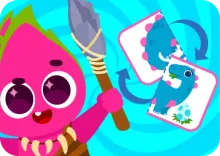

Educational Animal Games
These educational animal games lean harder into cognitive skills — sorting, classifying, counting — while keeping the animal theme doing the heavy lifting on engagement.
Animal Sorting
Hand your child a set of animal figures or cards and ask them to sort by habitat, diet, or class (reptiles, mammals, birds). Apps like Keiki also offer matching and sorting games if you want a digital version on hand.
Whose Tail?
A matching game using cards that show an animal on one and just its tail, paw, or ear on another. It builds observation skills and attention to detail, and it’s harder than it sounds once the animals start looking similar.
Animal Puzzles
Animal puzzle games for kids are reliably popular across every age, from chunky toddler puzzles to more intricate ones for older kids, building fine motor skills and spatial reasoning along the way.
Animal Quiz
Ask age-appropriate riddles: “Which animal lives in water and has fins?” or “Who sleeps in a den all winter?” These learning animal games for kids are a quick way to stretch memory and vocabulary during a car ride or a waiting-room wait.
Animal Math
Use animal figures for counting, addition, and subtraction — how many legs does this group of animals have altogether? It makes abstract math concepts visual in a way worksheets alone usually can’t.
Animals and Their Babies
Match adult animals to their young while learning the specific names — cat and kitten, cow and calf, kangaroo and joey. It’s a small vocabulary win that tends to stick because the pairs are so satisfying to match.
Tips for Parents: Making Animal Games a Pleasant Experience
A handful of small habits go a long way toward keeping animal games fun for everyone, not just the kid.
- Mix up your materials. Don’t limit yourself to plastic animal figures — books, flashcards, stuffed animals, and modeling clay all work the theme from different angles.
- Build a themed space. A corner of the room draped in blankets can become a jungle, farm, or ocean floor in about five minutes flat.
- Get loud and physical. Animal sounds and movements aren’t just fun — they build articulation, coordination, and rhythm.
- Read alongside the play. A quick picture book about whichever animal you’re playing with deepens the connection and sneaks in some reading time.
- Point out real animals when you see them. A spider on the porch or a bird at the feeder is a free, in-the-moment animal lesson.
- Take real-world trips when you can. A zoo, farm, or aquarium visit turns pretend play into something your child has genuinely experienced.