26 Critical Thinking Activities for Kids: From Toddlers to School Age

From a certain age, around 3–4 years old, children enter a phase of interest in literally everything. Every day, adults are showered with dozens, if not hundreds, of questions. “Why is the sky blue?”, “Where does wind come from?”, “Why can’t a dog talk?”. Our first, completely natural reaction is to quickly give a ready-made answer based on our adult experience. But as soon as we say the treasured phrase, “What do you think?”, some kind of magic begins. This is where critical thinking is born – a skill no less useful than the ability to count or write.
Key Takeaways
- Critical thinking starts earlier than you think. Even toddlers aged 1.5–2 can begin building cause-and-effect understanding through simple object-based play.
- The magic phrase is "What do you think?" Asking instead of telling is the single most effective way to spark critical thinking in children of any age.
- Activities should match the age. Toddlers need visual and sensory tasks; preschoolers benefit from role play and STEM experiments; school-age kids thrive with deduction games, mazes, and hypothetical questions.
- Explaining the "why" matters most. Whether sorting objects or spotting the odd one out, asking a child to justify their choice is more valuable than the correct answer itself.
In a world where any information is available in just a couple of taps on a smartphone, the ability to analyze, ask the right questions, doubt, look for unconventional solutions, and draw your own conclusions is especially valuable. And boring memorization is definitely not suitable for training cognitive functions.
The best critical thinking activities for kids are not dull lectures, but engaging games, shared discoveries, and everyday conversations filled with genuine curiosity. In this article, we have gathered more than 25 ideas that will help your child learn to think deeply, independently, and creatively.
What Is Critical Thinking for Kids – and Why Does It Matter?
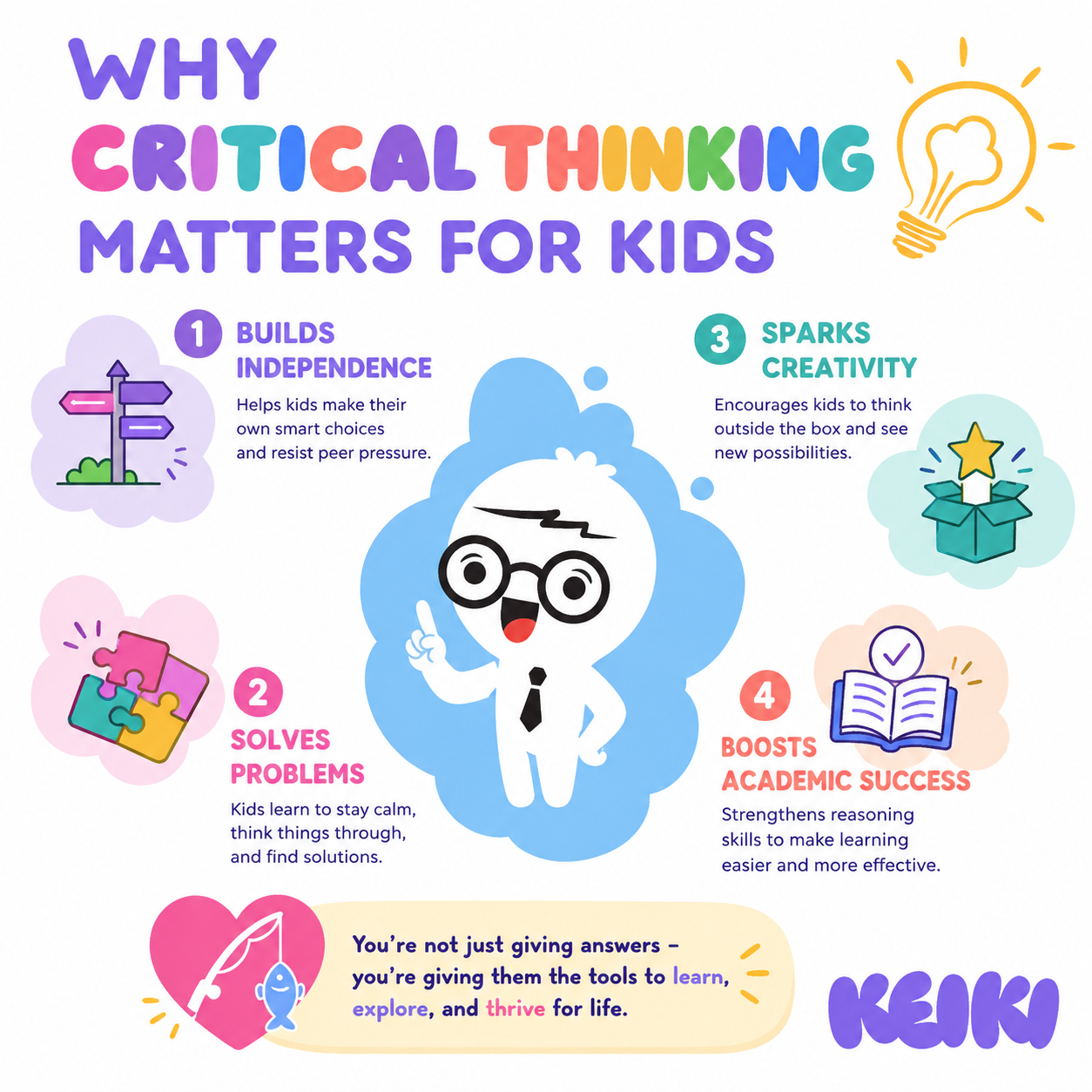
Critical thinking in children is the ability not to take all information on faith. It is the ability to analyze facts, see cause-and-effect relationships, and find logic explanations for what is happening around them. For modern children, these skills are important for a number of reasons:
- A foundation for independence. Children who can think critically are less likely to give in to peer pressure because they are used to analyzing other people's words and actions.
- Effective problem-solving skills. Instead of panicking or crying when they face difficulties, a child learns to look for a way out.
- Creativity development. True creativity is impossible without the ability to go beyond patterns. Critical thinking makes it possible to see things from a different angle.
- Academic performance. The school curriculum is becoming increasingly analytical. The ability for reasoning will help children cope more easily with mathematics, natural sciences, and literature.
By offering your child quality kids critical thinking activities, you are, as the saying goes, giving them a fishing rod rather than a fish. You teach them to learn, explore, and understand this complex yet fascinating world.
Critical Thinking Activities for Toddlers
Many parents think that only older children can analyze and draw conclusions. But the foundation is laid from an early age. Even at 2–3 years old, a toddler's brain is actively building neural connections. At this age, critical thinking activities for toddlers should be visual, object-based, and connected with their everyday experience.
Sorting with a Twist
Sorting is a classic activity for toddlers. But let's make the task more challenging. Invite your child to sort objects not only by color, but also by properties. For example, divide them into soft and hard items. By identifying non-obvious features of objects, the child practices more flexible approaches to analyzing the world around them.
Cause-and-Effect Games
Toddlers love observing how their actions change the world. Fill a basin with water and give your child different objects: a sponge, a plastic cup, a metal spoon. Ask, "What do you think will happen if we put the sponge into the water?". Let the toddler see for themselves how the sponge absorbs water and becomes heavy.
Help your child
grow with Keiki
We’ll help you turn everyday screen time
into real learning progress.
Simple Puzzles
Wooden inset puzzles, where the child needs to match an animal figure to the correct silhouette, are not just a motor skills game. Any puzzles also teach the basics of logic and analysis. The child has to assess the shape of the object and find the matching opening.
What Disappeared?
Place 3–4 familiar objects in front of the child, such as an apple, a toy car, and a block. Let the child look at them carefully. Then ask them to close their eyes and remove one object. "What disappeared?". This trains working memory and attention to detail.
A Pillow Obstacle Course
Place pillows of different sizes around the room. The toddler's task is to get from the sofa to the door without touching the floor. It may seem like a basic physical problem-solving task. But behind this fun activity, the child has to assess distances, understand where to place their foot, and adjust their movements if they lose balance. The brain and body work in harmony here.
Sensory Boxes with a Secret
Fill a container with rice or beans and hide small toys of different textures inside. Ask the toddler to put their hands into the container with their eyes closed and guess by touch what they have found, developing cognitive functions through tactile experience.

Critical Thinking Activities for Preschoolers
At ages 3–5, children experience a peak in role play and begin to take an active interest in how things work. During this period, critical thinking activities for preschoolers can include elements of basic science and open-ended questions.
Building without Instructions
Give the child a box of blocks, Lego, or even just toilet paper rolls and tape. Do not give any diagrams. Say, "Build the tallest house for the bear that will not fall down if I blow on it." This is both engineering and trial and error.
Engaging STEM Experiments
Build a volcano using baking soda and vinegar. But do not do everything yourself. Ask questions during the process: "What do you think will happen if we add this red liquid?". STEM activities are ideal for forming scientific thinking.
The "What Does Not Belong?" Game
Place several cards or objects in front of the preschooler: an apple, a banana, an orange, and... a shoe. Ask the child to find what does not belong and, most importantly, explain why. Explaining the choice is the key point of any critical thinking activity for kids.
Role Play "Doctor for Toys"
If a toy rabbit's "paw hurts," do not tell the child what to do. Ask, "The bunny hurt itself. How can we help it?". Let the child come up with the treatment algorithm on their own: find a bandage, comfort the toy, give it "medicine."
Who Left the Tracks?
During a walk in a park or forest, pay attention to tracks on the ground, broken branches, or gnawed cones. Ask, "Who do you think ran here? A big dog or a small bird? Why do you think so?".
Cooking Challenges
Cooking is a wonderful brain trainer. Give the child a set of ingredients, such as bread, cheese, cucumber, and a safe knife. Invite them to make a sandwich that looks like a cat's face. The child will need to plan their actions and visualize the result. And even if it does not look similar, that is not a problem – the main thing is that there is clear logic in the actions.
Studying the Properties of a Magnet
Give the child a large safe magnet and send them on a journey around the house. Let them experimentally check which surfaces the magnet sticks to and which it does not. Then ask them to draw a conclusion: what do all the things the magnet sticks to have in common?

Critical Thinking Games for Kids
When children approach school age, around 5–8 years old, they begin to understand complex rules and can think abstractly. This is where various kids critical thinking games come to the rescue, and they can easily be integrated into family evenings. If you are looking for effective critical thinking activities for 5 year olds, pay attention to this section.
"I Spy Something..."
A classic game, but with an added challenge. Instead of naming the color of an object, such as "I spy something red," describe its properties or function: "I spy something that works on electricity and helps us stay warm." Such descriptions require analysis of the surrounding space.
Cooperative Board Games
Games where participants do not compete with each other, but play together against the game itself, such as Outfoxed! or children's versions of pandemic-style games. These are successful critical thinking activities for kindergarten, as they teach children to discuss strategy, listen to other people's ideas, and make joint decisions.
The "What If..." Game
Ask hypothetical questions during dinner. "What if gravity suddenly turned off? How would we eat soup?", "What if dogs could talk? What would our Rex tell us?". In a funny and relaxed way, you constantly keep young children engaged and make their imagination go beyond familiar logic.
Creating Their Own Mazes
Drawing mazes on paper is good training for spatial thinking. Ask a 6-year-old to draw a maze for you with dead ends and false paths. To create a difficult maze, the child needs to think strategically and plan steps ahead.
The "Guess Who?" Game
This is one of the best games for developing the deductive method. By asking questions that can only be answered with "yes" or "no" – "Does this character have glasses?", "Is he wearing a hat?" – the child learns to eliminate unnecessary options and narrow the search through logical inferences.
Building a Fort
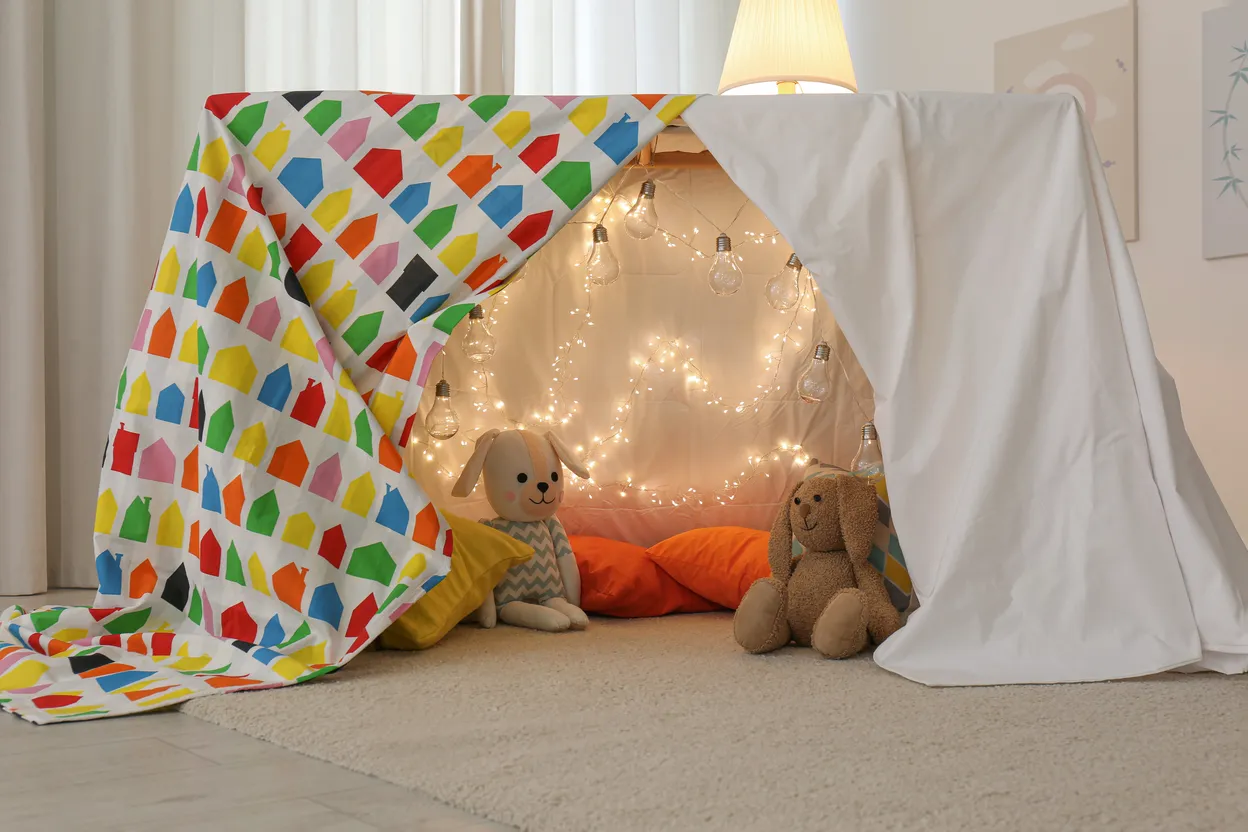
Give children blankets, pillows, chairs, and clothespins. Their task is to build a sturdy fort that will not collapse. They will face problems – the roof sags, a chair falls – and will have to look for ways to solve them in real time.
"Fact or Fiction?"
Tell the child three interesting facts about animals. For example: "Pigs cannot look up at the sky," "An octopus has three hearts," "Giraffes eat clouds." Ask them to guess which one is false and support their answer with arguments.
Codebreakers
Create a simple graphic cipher where each letter corresponds to a symbol, and write the child a secret message. Decoding the text requires a high level of concentration, perseverance, and well-developed attention to detail.
Critical Thinking through Reading and Storytelling
Reading is not just the mechanical process of putting letters into words. It is a tool for working with imagination and meaning. Storytelling and shared reading open endless opportunities for developing an analytical mind, especially if you use the right questions and approaches.
Changing the Ending of a Familiar Fairy Tale
Take a classic story, for example, "The Gingerbread Man" or "The Three Little Pigs." After reading to the middle, stop and ask, "What do you think would have happened if the wolf had turned out to be kind and brought the pigs a pie?". Such critical thinking activities for children teach mental flexibility and scenario planning.
Analyzing Characters' Motives
When reading a book, discuss the characters' actions. "Why did this boy act so rudely? What do you think he was feeling at that moment?". This develops not only critical, but also emotional thinking, helping the child put themselves in another person's place.
Book Detectives
In good children's books, especially wimmelbooks, illustrations often tell their own parallel story. Study the pictures in detail: "Look at the expression on this little dog's face in the background. What scared it? Where did we see this character on the previous page?".
Creating a Chain Story
This is an excellent game for the whole family before bedtime. One person says the first sentence: "Once upon a time, there was a blue dragon." The second continues: "He loved eating strawberry ice cream." The third adds their own detail. The task is to maintain the logic of the narrative so that the story does not turn into chaos, which requires constant control and adaptation to the ideas of other players.
Reading without the Ending
Read a new story unfamiliar to the child, but stop right before the climax. Invite the child to come up with the ending themselves, relying on the facts and the characters' personalities they have already learned from the text. This is the highest level of working with information.

Grow Your Child's Thinking Skills with Keiki
As parents, we understand very well that in the flow of everyday life, there is not always enough energy to organize complex quests, build forts, or conduct chemistry experiments in the kitchen. Does this mean giving up on tasks that develop critical thinking? No, and once again no. Even an ordinary tablet or smartphone can become an addition to your daily games. Keiki helps with this by bringing together a wide variety of brain development tasks. The focus here is on a comprehensive approach, as they include memory development games, puzzles, cards, logic brainteasers, and matching activities.
And all of them are adapted even for young children. Together, they serve as harmonious and accessible critical thinking games for kids. No intrusive advertising, no stress – only gentle, natural development and the joy of independent discoveries.
Help your child thrive with playful learning
Turn screen time into real growth with Keiki's educational games.
Try KeikiConclusion
Raising a thinking, reasoning person is a marathon, not a sprint. You will not see results in one day. But every time you ask your child a follow-up question instead of giving a direct answer, every time you encourage them to build silly constructions or argue with the ending of a fairy tale, you are laying the most important bricks in the foundation of their personality.
When introducing critical thinking activities for kids into your routine, remember the main rule: learning should bring joy. Do not turn games into strict exams. Making mistakes is allowed and necessary. Fantasizing is essential.