26 Engineering Games for Kids – Ideas for Developing an Engineering Mindset

You have probably noticed this – in fact, you could hardly miss it. Sooner or later, every child suddenly shows remarkable resourcefulness and thoughtfulness. They try to understand how a toy works, experiment with water and sand, build structures from sofa cushions, and test whether a paper boat can hold three toy dinosaurs at once.
The task of adults is to support these impulses, or even create conditions where they can develop. Many parents are intimidated by the phrase "engineering activities for kids," imagining complex diagrams and expensive robot kits. In reality, engineering for children begins with the question "What happens if...?" and a roll of painter's tape.
What Is Engineering for Kids?
Engineering is the science of solving problems. When we offer children engineering games for kids, we are not teaching them to assemble mechanisms according to instructions. We are teaching them to think like engineers: to notice a problem, generate ideas for solving it, test those ideas, and improve the result.
At the heart of any high-quality kids engineering project is the so-called Engineering Design Process. For adults, it may sound complicated, but for children it is a natural sequence of play:
- Ask. The child faces a problem. Your role is to ask guiding questions without giving ready-made answers.
- Imagine. Creativity switches on. The child comes up with ideas: "We can build a bridge! Or use a catapult!" Your role is to accept any ideas, even absurd ones.
- Plan. The child draws a diagram or gathers the necessary materials. Your role is to help organize the workspace.
- Create. The actual building and assembly of the project begins. Your role is to ensure safety, especially if scissors or glue are involved.
- Improve. The bridge collapses under the weight of a toy. The child looks for the reason and rebuilds it, making the supports wider. Your role is to praise the effort, not just the result.
The point is that failure is not the end of the game, but only a step toward improvement. This is exactly how problem-solving skills are formed – skills that will serve a child throughout their entire life.
Help your child
grow with Keiki
We’ll help you turn everyday screen time
into real learning progress.
Engineering Activities for Toddlers and Preschoolers (Ages 2–5)
Toddlers think in terms of the physical world. Ideal engineering activities for toddlers should be safe, large-scale, and give an immediate result. Engineering challenges for kids at this age are best done with familiar materials.
The Classic Block Tower
What you need: Wooden or plastic blocks of different sizes.
How to play: Ask your child to build the tallest tower possible. Then suggest building a tower with only one block at the bottom and a wide platform on top. What happens?
What it teaches: Balance, gravity, the basics of architecture.
Ramps and Rollers
What you need: Pieces of thick cardboard or smooth boards, toy cars, balls, books.
How to play: Make a ramp by leaning cardboard against a stack of books. Ask your child to roll cars down the ramp. Then change the angle of the slope. Which angle makes the car go fastest? Which makes it go slowest?
What it teaches: Slope angle, acceleration, the concept of friction.
Sticky Tape Spider Web
What you need: Painter's tape.
How to play: Stick tape between door frames in the shape of a web, with the sticky side facing the child. Give them cotton balls, crumpled paper, and light toys. The child's task is to throw objects at the web and see what sticks and what falls.
What it teaches: Material properties, weight, adhesive force.
Cardboard Box Forts
What you need: Large cardboard boxes, blankets, clothespins.
How to play: You cannot simply throw a blanket over a box – it will slide off. The child will need to figure out how to secure the structure. Using clothespins, tape, or heavy books as anchors will teach them about structural stability.
What it teaches: Calculating the center of gravity, creating coverings, design.
Sink or Float Boats
What you need: A basin of water, foil, modeling clay, corks, pebbles.
How to play: Ask your toddler to make a boat from a piece of modeling clay. Most likely, it will sink. Then make a boat from foil with a wide bottom and high sides. Now load it with pebbles. How many can it hold before sinking?
What it teaches: Buoyancy, displacement, material density.
Mega Bloks Bridge
What you need: Large building blocks, two stools.
How to play: Place two stools 30 cm apart. Ask your preschooler to build a bridge that connects the two "shores" so a toy car can drive across it.
What it teaches: Structural integrity, the basics of how bridges work.
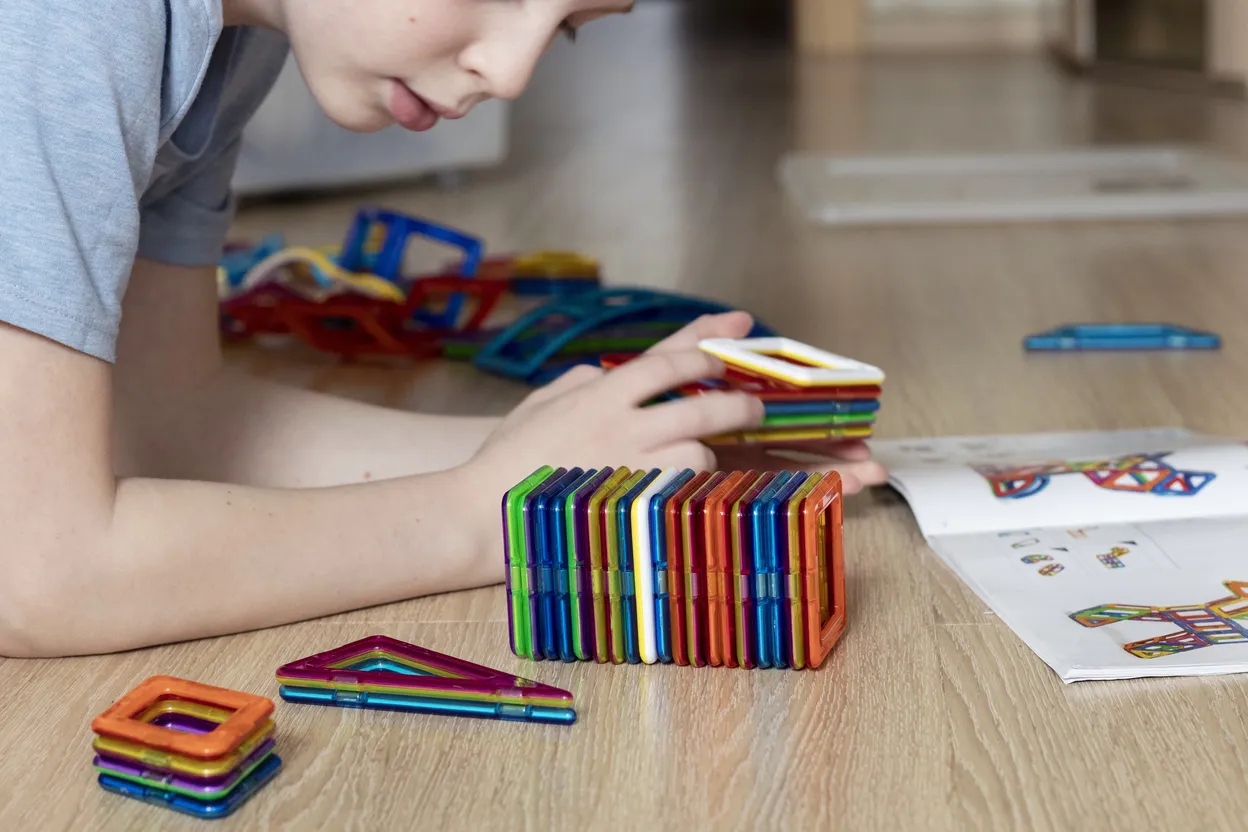
Magnetic Tile Mazes
What you need: Magnetic building tiles, a metal ball.
How to play: Build a maze from magnetic pieces on a flat surface. The child's task is to tilt the board so the ball travels the whole path.
What it teaches: Movement trajectory, magnetic attraction, route planning.
Mechanical Engineering Projects for Kids
When we talk about fun engineering projects for kids, nothing creates as much excitement as mechanisms that move by themselves! Here we will use forces, leverage, and energy.
Balloon Powered Car
What you need: An empty plastic bottle or cardboard tube, 4 bottle caps, drinking straws, wooden skewers, a balloon, tape.
How to play: Build a basic car. Attach the balloon to a straw with tape so that air does not escape. Attach the straw to the roof of the car. Inflate the balloon and release it on a smooth floor.
What it teaches: Newton's third law, jet propulsion.
Spoon Catapults
What you need: 7–10 wooden popsicle sticks, rubber bands, a plastic spoon, soft pom-poms.
How to play: Stack 5–7 sticks and secure them with rubber bands at both ends – this will be the fulcrum. Take two sticks and tie them together with a rubber band at one end. Slide the fulcrum between the two sticks near the tied end, then attach the spoon to the free end. Load the spoon with a pom-pom and launch!
What it teaches: Potential and kinetic energy, the lever principle.
Pulley System for Toys
What you need: A long rope, an empty plastic bucket, a smooth door handle or tree branch.
How to play: Throw the rope over a door handle or a wall bar. Tie the bucket to one end. Tell your child to put heavy toy cars into the bucket and pull the other end of the rope. Watch how much easier it is to lift the load using the pulley.
What it teaches: Simple machines, changing the direction of force.
Wind-Powered Sailboats
What you need: Foam or cork, toothpicks, paper, a basin of water, drinking straws.
How to play: Make several boats with sails of different sizes together with your child. Put them in the water. Give your child a straw and ask them to blow at the sails. Which sail shape moves the boat fastest?
What it teaches: Aerodynamics, wind force, balance.
Rubber Band Helicopters
What you need: Thick cardboard, a rubber band, a paper clip, a propeller.
How to play: Assemble a structure where the rubber band winds around the propeller axis. When the child twists the rubber band with their finger, they store energy. When released, the propeller spins rapidly.
What it teaches: Storing elastic potential energy.
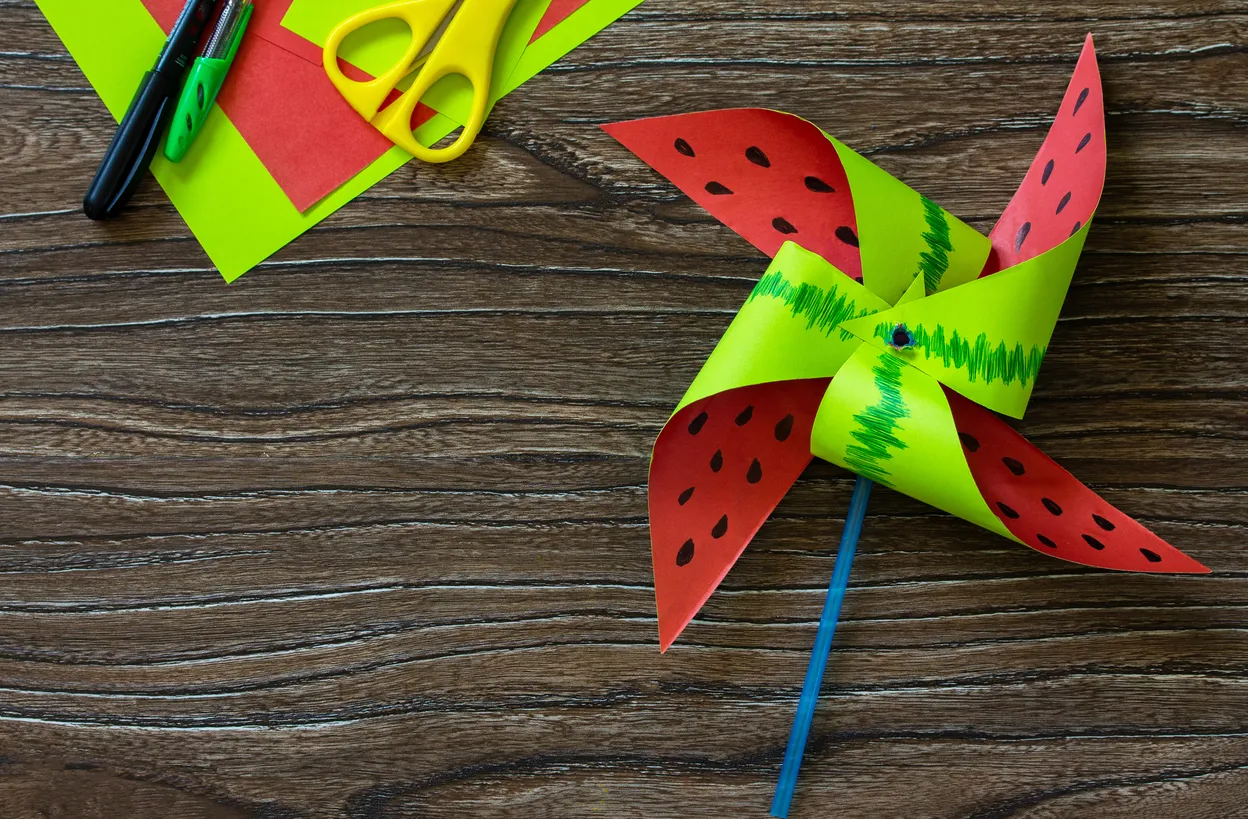
DIY Pinwheels
What you need: A square sheet of paper, a pin with a bead on the end, a pencil with an eraser on the end.
How to play: Make cuts from the corners of the square toward the center, fold the corners inward, and pin them to the pencil eraser. Children can run with them outdoors or blow on them to make them spin.
What it teaches: Converting wind energy into rotational motion.
Zipline for Action Figures
What you need: A long rope or thick fishing line, a paper clip, a paper cup, a favorite figure.
How to play: Tie one end of the rope high and the other low. Make a basket from the cup and pierce it with the paper clip. Place the figure in the basket and hook it onto the rope. The figure slides down. Experiment with different angles.
What it teaches: Gravity, slope angle, and sliding friction.
Engineering Activities for Kindergarten and Elementary Kids
At ages 5–7, children can already maintain focus for longer, and their fine motor skills allow them to do more precise work. This is the time for engineering activities for kindergarten that introduce real challenges.
The Classic Egg Drop Challenge
What you need: A raw egg, recycled materials.
How to play: This is one of the most famous kids engineering projects. The child's task is to create a capsule for a raw egg so that it does not break when dropped from a height of 2 meters. Materials are limited to what is available at home.
What it teaches: Kinetic energy, shock absorption, protective design.
Popsicle Stick Bridges
What you need: Popsicle sticks, PVA glue or hot glue.
How to play: Give the task of building a bridge that can hold the weight of a heavy book. Children will intuitively begin building the bridge from stronger geometric shapes – triangles and arches.
What it teaches: Load distribution, geometry in architecture, towers and bridges.
Marble Run Madness
What you need: Toilet paper and paper towel tubes, painter's tape, a wall or cabinet door, marbles.
How to play: Tape cardboard tubes to the wall at different angles so that a marble dropped into the top tube rolls through the entire system to the bottom. Add twists, drops, and loops.
What it teaches: Kinematics, gravity, momentum.
Marshmallow and Toothpick Towers
What you need: A pack of mini marshmallows and wooden toothpicks.
How to play: Build the tallest tower possible. Marshmallows serve as connecting joints, and toothpicks serve as beams. This game requires incredible attention to balance and geometry.
What it teaches: Center of mass, structural rigidity.
Penny Boat Challenge
What you need: Aluminum foil, a basin of water, many coins.
How to play: Give your child a square piece of foil, 15 × 15 cm, and ask them to fold it into a boat. Place the boat on the water and start adding coins one by one. The goal is to hold as many as possible without sinking. Then redesign the boat to beat the record.
What it teaches: Displacement, surface area, hydrodynamics.
DIY Hovercraft
What you need: An old CD, a bottle cap with a dispenser, glue, a balloon.
How to play: Glue the cap exactly in the center of the CD, over the hole. Inflate the balloon and stretch it over the closed cap. Place the disk on a smooth surface and open the dispenser. The air escaping downward creates a cushion, and the hovercraft glides effortlessly across the surface.
What it teaches: Reducing friction, pneumatics, air cushion.
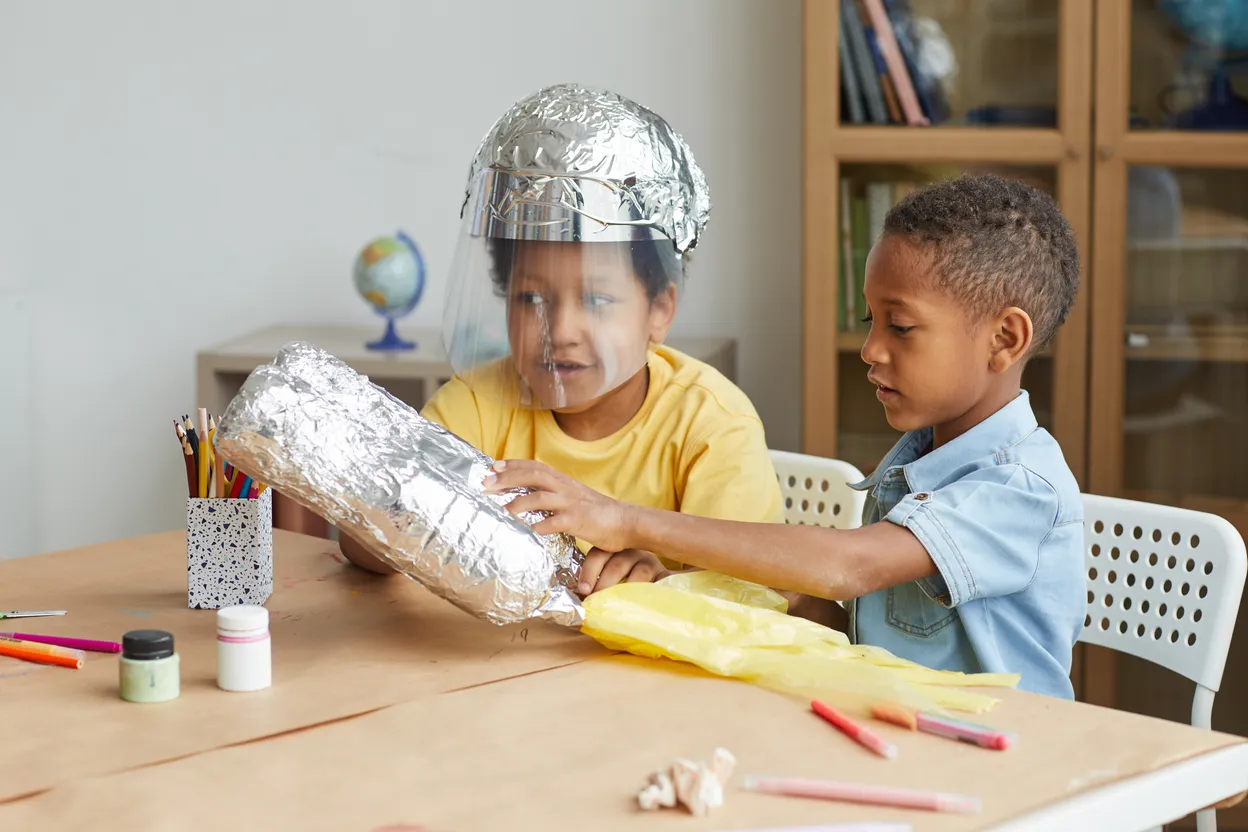
Easy Engineering Challenges for Kids with What You Have at Home
Sometimes you are looking for simple engineering projects for kids that do not require going to the store at all. These challenge games can be organized in minutes from materials already in your home.
Plastic Cup Pyramid
What you need: 30–50 cheap plastic cups.
How to play: A classic of the genre. Build a pyramid. Now make it harder: how can you build a wall? How can you build a round tower? The cups are very light, so even a breath of air can collapse the structure. Patience is required.
What it teaches: Fine motor control, architectural planning.
Newspaper Domes
What you need: Old newspapers or magazines, a stapler, tape.
How to play: Roll newspaper sheets into dense, long tubes. These tubes can be used to build a real geodesic dome large enough for a child to climb inside.
What it teaches: Spatial geometry, material strength.
Spaghetti Strength Test
What you need: Raw spaghetti, two books, a paper cup with string, coins.
How to play: Place one piece of spaghetti between two books like a bridge. Hang a cup from it. Put coins into the cup. The spaghetti will break very quickly. Now try two, three, or ten strands bundled together. How does the load capacity change?
What it teaches: Load distribution, composite materials.
Pillow Fort Engineering
What you need: Chairs, pillows, heavy books, blankets.
How to play: Leave the children in the living room with the task: "Build the strongest roof." Building a fort is not just entertainment. If they pull the blanket too hard on one side, the chair on the other side falls over. Children intuitively discover tension and counterweight.
What it teaches: Tension, counterweight.
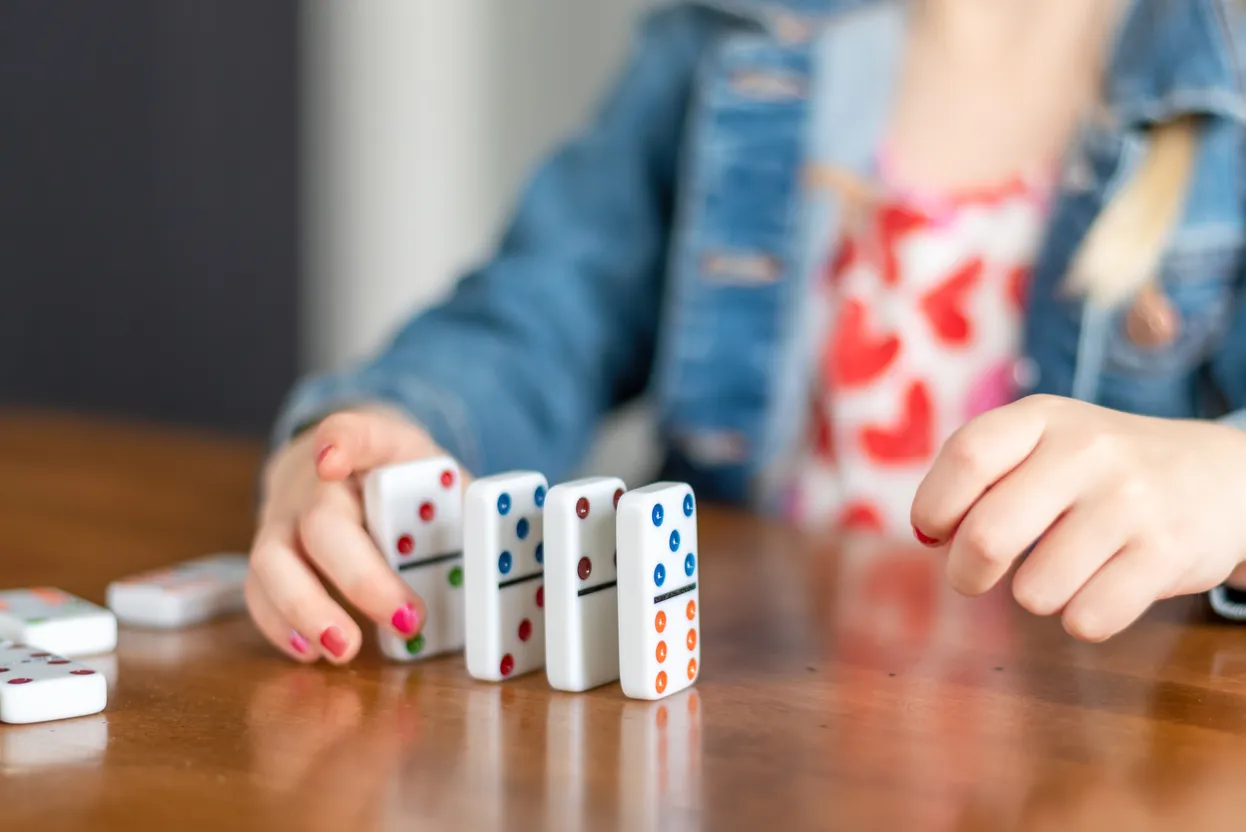
Domino Chain Reaction
What you need: Dominoes, books, building block pieces.
How to play: Build a long domino track. For the chain reaction not to stop, the dominoes must be placed at a very specific distance from one another. Children quickly realize that both too close and too far apart will prevent the chain from completing.
What it teaches: Kinematics, energy transfer, cause-and-effect relationships.
Aluminum Foil Aqueducts
What you need: Foil, a jug of water, an empty basin.
How to play: Ask your child to make a long water channel from pieces of foil so that they can pour water from a jug standing on a chair into a basin standing on the floor, without spilling a drop along the way.
What it teaches: Hydrodynamics, slope angle for maintaining flow.
Build Skills with Keiki's Learning Games
Engineering projects for kids require a lot of energy – both physical and mental. A preschooler's brain works at full capacity when they try to understand why a bridge collapses or how a pulley works. After active building sessions, children need a calm transition to a different kind of thinking.
In the Keiki app, engineering thinking moves to a new cognitive level. This is supported by numerous brain development games – tasks for logic, memory, spatial thinking, and attention. While a child's hands rest, their mind continues to work on the same skills that make a great young engineer: pattern recognition, sequencing, and problem-solving.
Build real skills through fun, educational games for your child
Try KeikiConclusion
Engineering is far from boring formulas. In reality, it is the science of asking questions and understanding how things work. When you introduce engineering activities for kids into everyday play, you give children a tool for life – the ability to look at any problem and think: "How can I solve this?"