Thanksgiving Facts for Kids, From Preschool to Grade School

Somebody’s going to ask about Thanksgiving this week, whether it’s a kindergartener pointing at a turkey decoration or a 9-year-old wanting to know why the holiday even exists. This list has an answer ready either way: more than 70 facts, grouped by age first and topic second, so you’re not scrolling past grown-up history to find something a 3-year-old will actually use.
Thanksgiving Facts for Preschoolers (Ages 2-4)
At this age, facts work best when they connect to something your toddler can already see, smell, or touch. Skip the dates and names and stick to the sights and sounds of the day.
- Turkeys make a "gobble gobble" sound, and kids this age love imitating it.
- Pumpkins grow on a vine in a garden or a field, not on a tree.
- Thanksgiving happens in the fall, when the leaves turn orange, red, and yellow.
- A really big meal, like the one on Thanksgiving, is called a "feast."
- Thanksgiving is a day for saying "thank you" for the people and things you love.
- Turkey feathers come in reds, browns, and golds, like the colors of fall leaves.
- Pumpkin pie is a sweet treat a lot of families eat for dessert.
- Cranberries are small, round, and red, and some of them grow right in water.
- Thanksgiving always lands on a Thursday, every single year.
- Many families say what they're thankful for before they eat dinner together.
- Grandparents, aunts, uncles, and cousins often all come to the same house for Thanksgiving.
- A turkey has a fan of feathers on its tail that it can spread open wide.
- Apple pie and pumpkin pie are both popular treats at Thanksgiving dessert time.
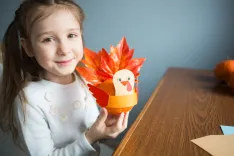
If your preschooler likes turning a new fact into something they can make, Thanksgiving crafts for preschoolers give them an easy, hands-on way to act out a few of these facts instead of just hearing them.

Help your child
grow with Keiki
We’ll help you turn everyday screen time
into real learning progress.
Thanksgiving Facts for Kindergarteners (Ages 5-6)
At this age, kids can start handling real history, as long as the names and dates stay small and concrete. A 5- or 6-year-old can hold onto a date, a ship's name, or one new word at a time.
- Thanksgiving started a long time ago with a group of people called Pilgrims.
- The Pilgrims sailed to America on a ship called the Mayflower.
- The Pilgrims shared their very first big dinner with the Wampanoag people, who already lived there.
- That first Thanksgiving feast didn't last one day. It lasted three whole days.
- Thanksgiving became an official holiday because President Abraham Lincoln said so, back in 1863.
- Thanksgiving is always the fourth Thursday in November. This year, that's November 26, 2026.
- Every year, the president "pardons" one lucky turkey instead of it ending up on a dinner table.
- Lots of families watch a big parade with giant balloons on Thanksgiving morning.
- Farm turkeys can't fly very far, but some wild turkeys can run surprisingly fast.
- Many families watch or play a game of football after Thanksgiving dinner.
- The trip across the ocean took the Mayflower more than two months.
- A turkey dinner, a parade, and a football game are three things a lot of American families share on the day.
- Canada has its own Thanksgiving too, but it happens in October instead of November.
Counting fits the season too. Kids working on numbers can try Keiki World's harvest-themed game, which gives them a fall-themed way to keep practicing while the holiday's still on their mind.
The History of the First Thanksgiving
The first Thanksgiving took place in 1621 in Plymouth, Massachusetts, and looked nothing like today's holiday. Here's what actually happened, and how the holiday grew into what it is now.
- The people we call "Pilgrims" didn't actually call themselves that. At the time, they used words like "Separatists" or "Saints," and the term "Pilgrims" only caught on in the 1800s.
- The 1621 feast brought together about 53 English colonists and roughly 90 Wampanoag men, led by their leader, Massasoit.
- The feast lasted three days, not one, and likely included games, demonstrations, and shared meals.
- Nobody at the table used a fork. Forks weren't common in English colonies yet, so people ate with spoons, knives, and their hands.
- Historians aren't even sure turkey was on the menu. Records mention deer and wild birds, but don't name turkey specifically.
- There was no pumpkin pie either. The colonists didn't have butter, wheat flour, or an oven for a pie crust.
- For centuries, Thanksgiving wasn't a single national holiday. Different colonies and states celebrated their own harvest feasts on different days.
- A writer named Sarah Josepha Hale spent about 17 years writing letters asking for a national Thanksgiving holiday before anyone listened.
- President Abraham Lincoln finally made Thanksgiving an official national holiday in 1863, in the middle of the Civil War.
- In 1939, President Franklin D. Roosevelt moved Thanksgiving a week earlier to give stores more shopping days before Christmas. People nicknamed it "Franksgiving," and it didn't stick.
- In 1941, Congress settled the date for good: the fourth Thursday in November, every year since.
- For the Wampanoag and many other Native American communities, the holiday carries a different, more complicated history. Some gather each year for a National Day of Mourning instead of a celebration.
- The Wampanoag had already lived in that part of Massachusetts for thousands of years before the Pilgrims arrived.
- The first nationwide Thanksgiving proclamation actually came from George Washington in 1789, more than 70 years before Lincoln's.
- Plymouth Rock, the boulder many people associate with the Pilgrims' landing, wasn't identified as the spot until more than 100 years later.
Fun Facts About Thanksgiving Dinner
Here's what's actually behind the dishes on a typical Thanksgiving table. Most of it comes down to how one meal turned into a whole set of traditions.
- Turkey wasn't always the main course. It only became the go-to centerpiece sometime in the 1800s, alongside the holiday's growing popularity.
- Green bean casserole, that dish with the crispy onions on top, was invented in 1955 by a Campbell's Soup employee named Dorcas Reilly.
- Most of the orange "yams" in a can at the grocery store are actually sweet potatoes. True yams are a different plant altogether.
- Stuffing and dressing are often the same recipe with two different names. Some families call it "dressing" when it's baked outside the bird instead of inside.
- Cranberries float, and a ripe one will actually bounce. Some farmers used to test for ripeness by dropping the berries and watching which ones bounced back.
- Canned cranberry sauce often keeps its can-shaped ridges on purpose, since plenty of families expect that exact look on the table.
- Pumpkin pie filling usually comes from the same cinnamon, nutmeg, and ginger spice mix used in a lot of fall baking.
- Pecan pie and apple pie both show up on Thanksgiving tables almost as often as pumpkin pie does.
- Some families split kids and adults into two separate tables, with the "kids' table" becoming its own small tradition.
- The day after Thanksgiving is practically its own holiday for leftovers, especially the classic turkey sandwich.
- In parts of New England, oyster stuffing is a long-running regional tradition, dating back to when oysters were cheap and plentiful.
- Many Southern tables add collard greens or cornbread stuffing alongside the more familiar dishes.
- Plenty of families skip turkey altogether and build the meal around ham, chicken, or a vegetarian main dish instead.
- Whipped cream is the most common way kids finish off a slice of pumpkin pie.
If your family's Thanksgiving centers on more than one game night, Thanksgiving family games are worth bookmarking for after the plates are cleared.
Help your child thrive with playful learning
Turn screen time into real growth with Keiki's educational games.
Try KeikiTurkey Facts Kids Will Gobble Up
Turkeys are stranger and more interesting than most kids expect. Here's what makes them such a memorable bird.
- Tom: the name for a male turkey.
- Hen: the name for a female turkey.
- Poult: the name for a baby turkey.
- Wattle: the loose, colorful flap of skin under a turkey's chin.
- Snood: the small flap of skin that hangs over a turkey's beak.
- Only male turkeys gobble. Female turkeys make a quieter clicking or clucking sound instead.
- A group of turkeys has its own name: a "rafter."
- Turkeys got their English name from a mix-up. European traders first met a similar-looking bird through merchants connected to Turkey, and the name stuck to the wrong bird.
- Wild turkeys can actually fly, in short, fast bursts up to about 55 miles an hour. Most farm-raised turkeys are bred too heavy to get off the ground.
- On the ground, a turkey can run as fast as 25 miles an hour, which is faster than most kids can sprint.
- A turkey's head can actually change color, from red to blue to white, depending on how excited or upset it is.
- Benjamin Franklin once wrote a letter saying he thought the turkey would have made a better national bird than the bald eagle.
- Presidents have pardoned a turkey nearly every year since 1989, letting it live out its life instead of ending up on a plate.
- Wild turkeys sleep up in trees at night to stay safe from foxes and other animals on the ground.
- Turkeys have excellent eyesight and can see nearly all the way around themselves without turning their head.
- Americans eat a lot of turkey on Thanksgiving. The National Turkey Federation estimates about 46 million turkeys get eaten across the country on Thanksgiving Day alone.
- A poult, or baby turkey, can start finding its own food just hours after hatching.
- Turkeys are surprisingly good swimmers, even though people rarely picture them in water.
- A fully grown turkey can weigh anywhere from about 15 to more than 30 pounds, depending on its breed.
Turn These Facts Into Quiet Coloring Time
After a table full of trivia, kids usually need a few quiet minutes before the next activity. Coloring gives them that pause without losing the Thanksgiving theme.
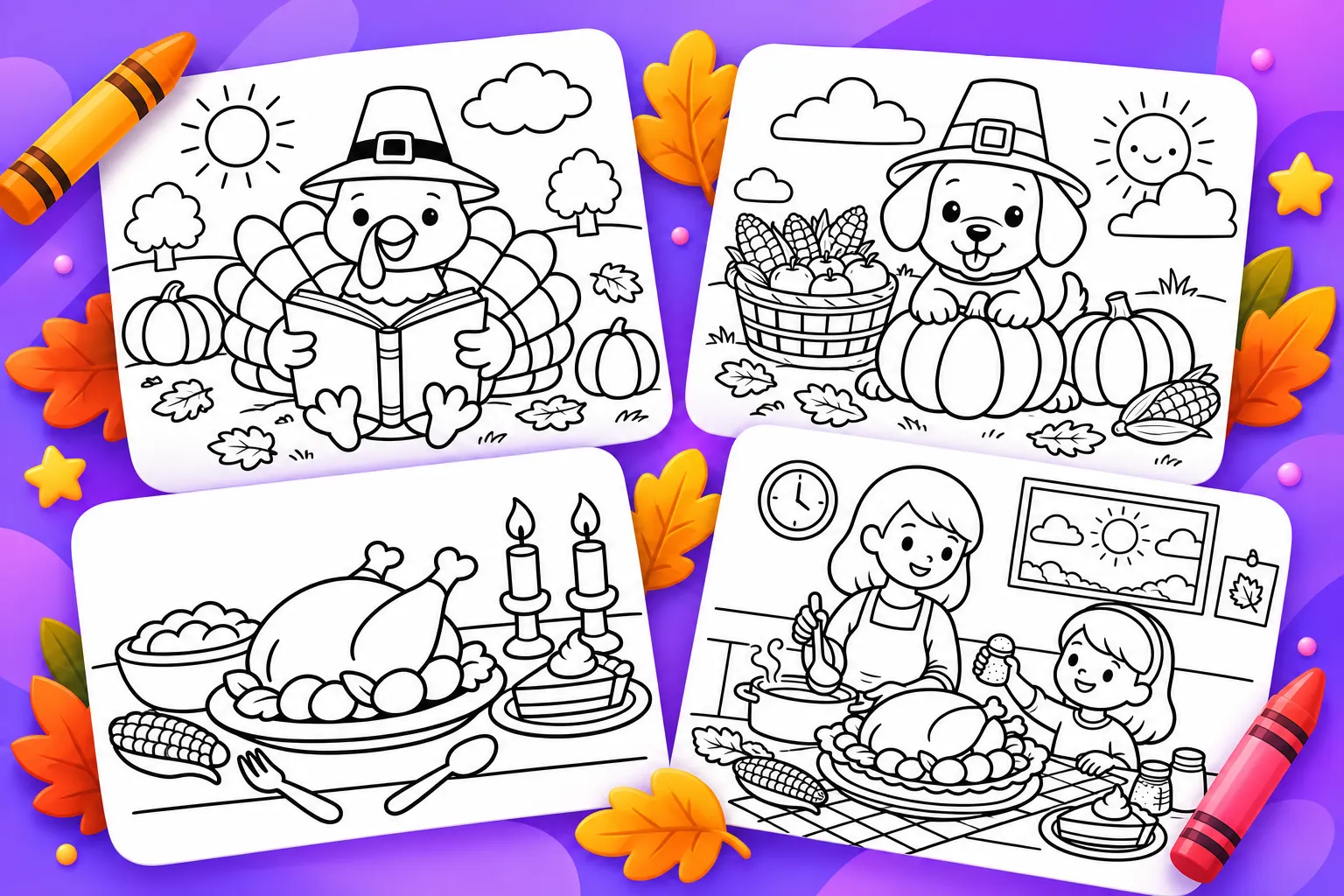
Keiki World's Thanksgiving coloring pages are free to use on the website. Print a page the moment a kid asks for something to do with their hands.
Pages like a turkey, a pumpkin, or a Pilgrim hat give a preschooler something to match to the facts they just heard. An older kindergartener gets something to work on while the grown-ups finish cleaning up.
It's a small way to stretch the facts past the dinner table, without turning them into another lesson.