Parachute Games: The Simplest Way to Get Kids Moving Together

Think back to your school days or preschool. What memory brings a genuine smile to your face? We bet it’s that moment when your teacher or gym instructor pulled out a huge, rustling, multicolored parachute. It always sparked laughter, anticipation, and excitement.
Key Takeaways
- Parachute games are a surprisingly powerful tool — they build coordination, teamwork, and social skills while kids are just having a blast.
- Games scale easily with age — toddlers enjoy simple wave-making and mushroom lifts, while older kids can handle competitive and even math-based challenges.
- You don't need a real parachute to get started — a large bedsheet works just fine for small groups at home.
- A few basic safety rules (proper grip, enough space, a clear stop signal) are all you need to keep the chaos fun and safe.
Today, that huge, colorful parachute isn’t just a nostalgic relic — it’s one of the most effective and beloved tools for early childhood development. High-quality parachute games for kids have a superpower: they bring children together, break down barriers of shyness, and turn any group of little ones into a cohesive team.
During these activities, children develop important life and physical skills: coordination, gross motor skills, the ability to listen to a leader, teamwork, and cooperation. Plus, this type of group game is considered an excellent choice for children’s parties, birthday celebrations in the park, picnics, or school recess.
Best Parachute Games for Kids
A major advantage of these games is that they’re essentially versatile. You can adapt the rules on the fly, making them more or less challenging depending on the participants’ ages. Let’s break down these kids’ parachute games into categories to make it easier for you to plan your perfect children’s party or educational activity.
Games for the Youngest Children
For children under 3–4 years old, visual cues, simple instructions, and the magic of the process are key. Suitable parachute games for preschoolers don’t have strict rules, winners, or losers — the only things that matter here are fun and movement.
The Classic Mushroom
This is a basic parachute game for kids that’s a great way to start any activity.
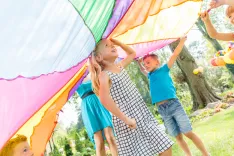
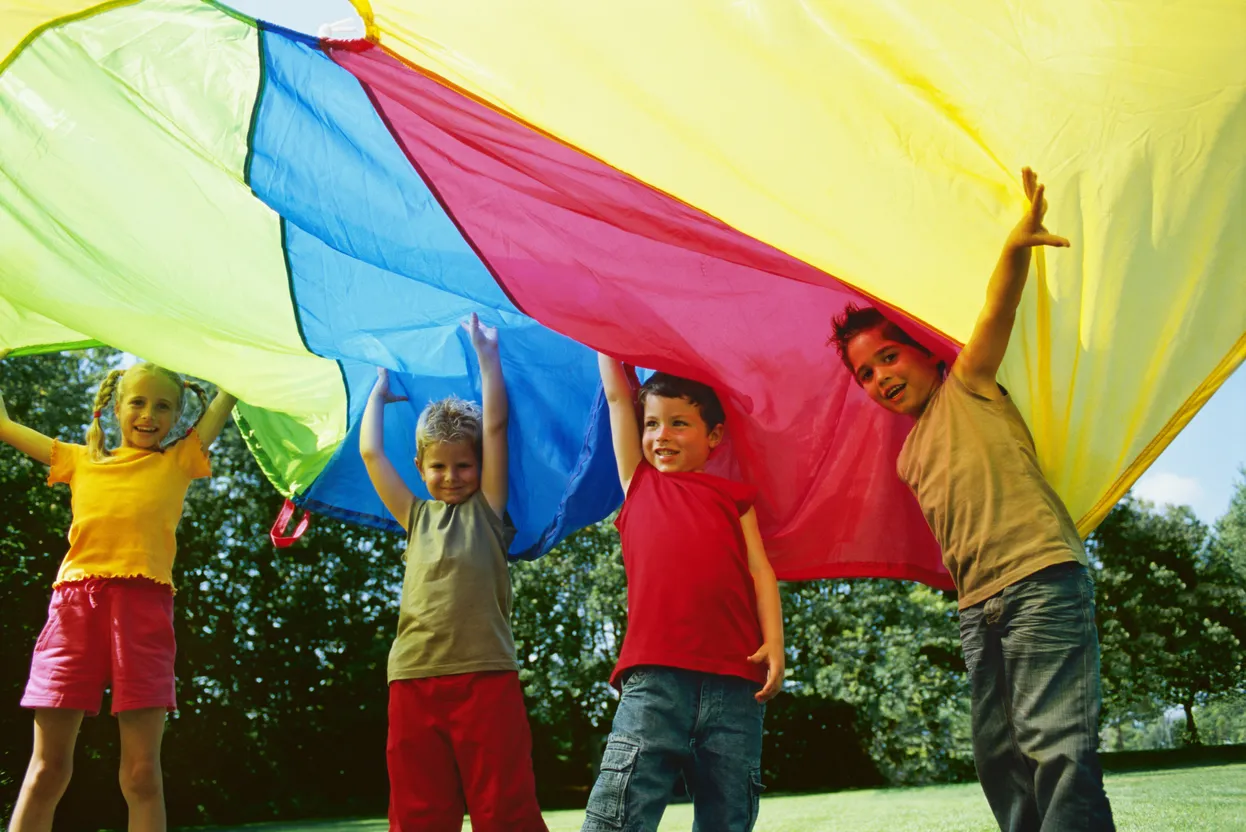
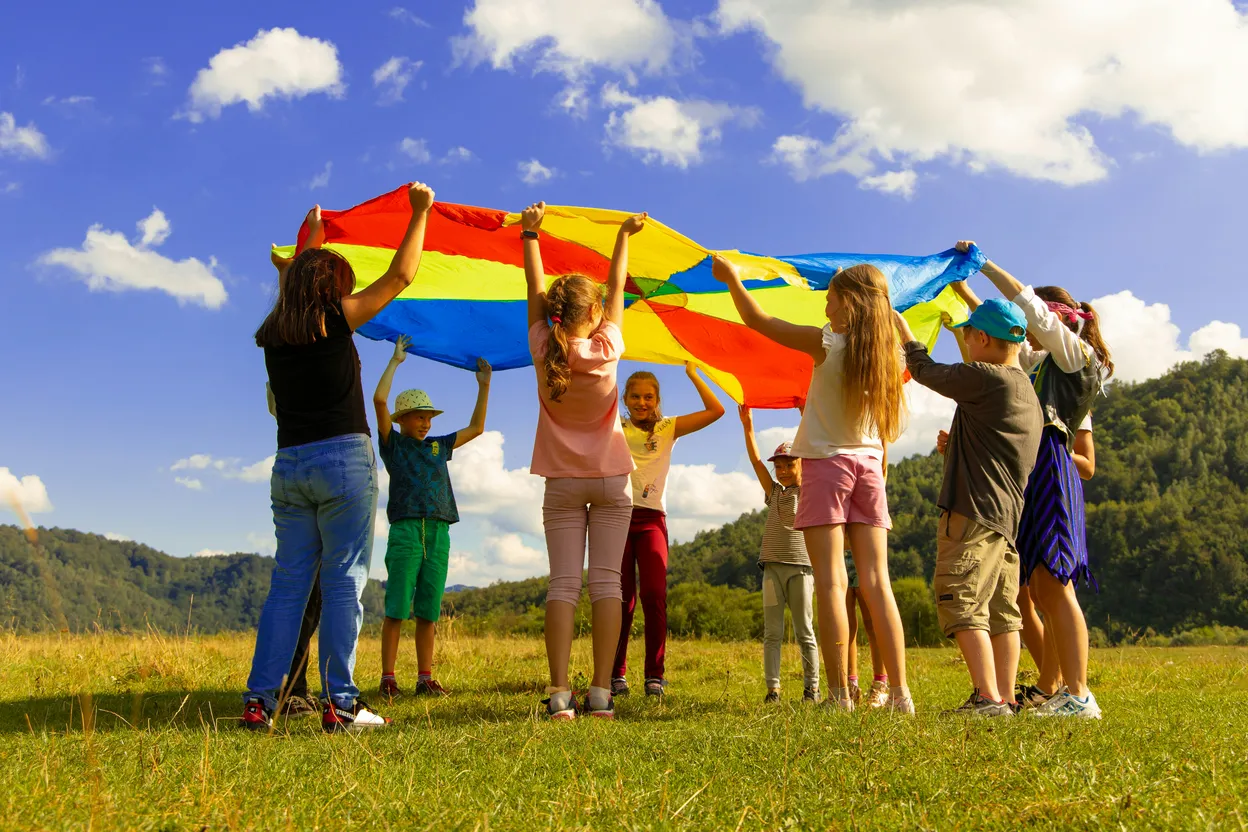
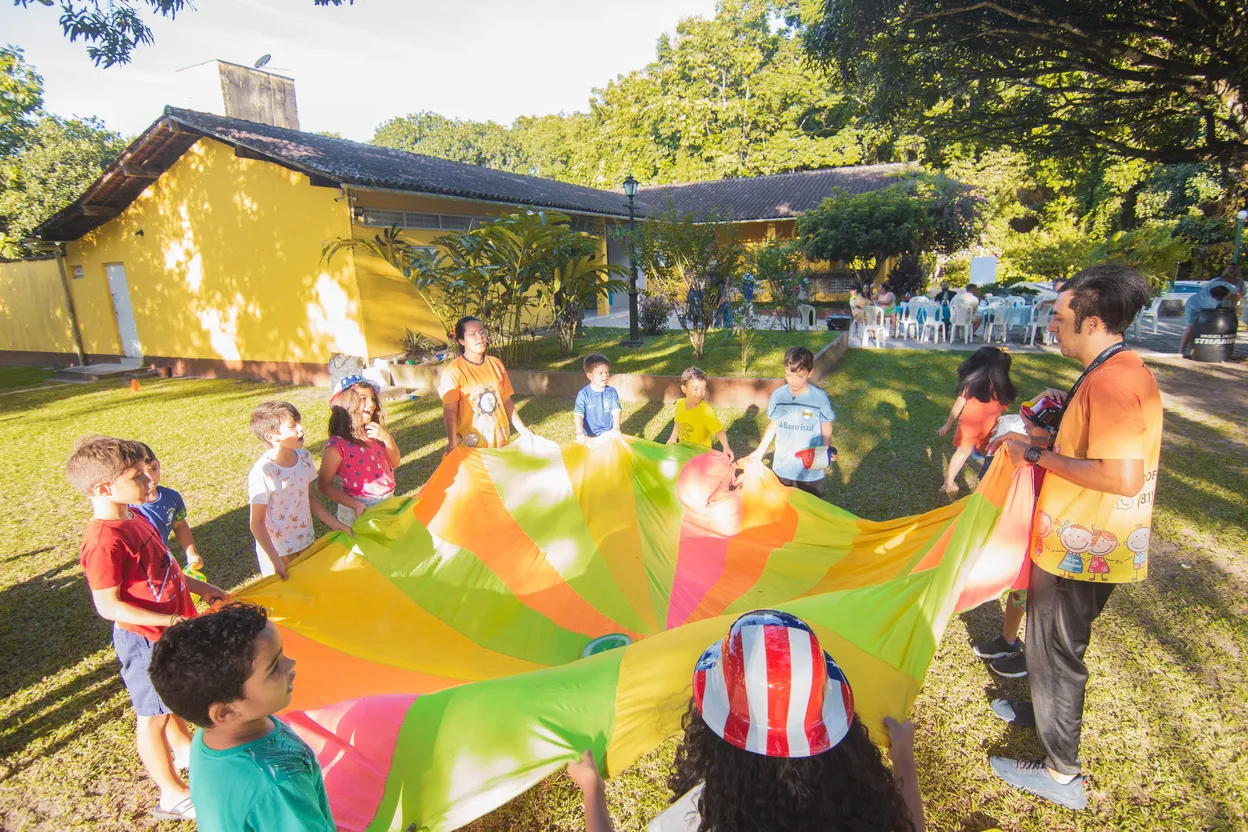
How to play: The children stand around the parachute and hold its edges with both hands, forming a circle. On the command “One, two, three, up!” everyone raises their hands high above their heads together. The parachute inflates with air, forming a mushroom. On the command “Down!” the children lower their hands to their feet.
Benefits: Teaches coordination, the ability to follow basic commands, and strengthens arm muscles.
Popcorn
Perhaps the most fun and boisterous parachute games fall into this category.
How to play: Place lots of light plastic balls or crumpled paper balls in the center of the parachute. The children’s task is to shake the parachute hard enough so that the balls bounce like popping popcorn, but try not to let them fall to the ground.
Benefits: excellent physical activity and training for hand-eye coordination.
Help your child
grow with Keiki
We’ll help you turn everyday screen time
into real learning progress.
Ocean Waves
If you’re looking for a sensory play activity that calms little ones, this one is a great choice.
How to play: The children hold onto the edges of the fabric. The leader announces the “weather.” If it’s “calm” or a “light breeze,” the children create very gentle, smooth waves. If a “storm” is announced, the cloth should be shaken vigorously and energetically.
Benefits: Teaches children to control the force of their movements, improves reaction time, and fosters imagination.
Tent
A magical game that gives children a sense of shelter and coziness.
How to play: The children form the classic “Mushroom” shape (lifting the parachute high into the air). As soon as the parachute is fully inflated, the leader gives the command, and everyone takes a step forward, pulls the edges of the parachute behind their backs, and sits down on them. The entire group ends up inside a huge, colorful tent.
Benefits: Creates a strong sense of belonging to the group; it’s the perfect place to sing a song or tell a story.
The Sleeping Giant
There’s a whole category of parachute activities for kids that have a calming effect and are best used toward the end of a session.
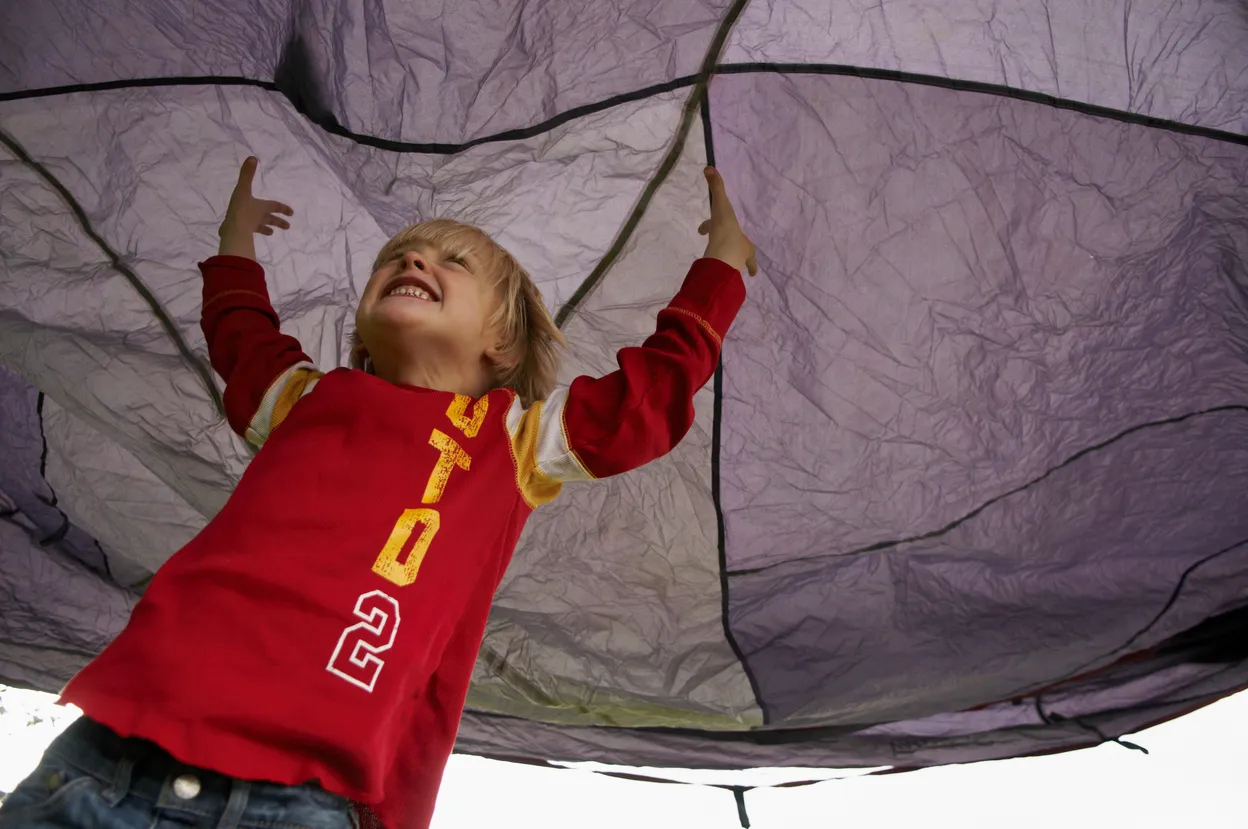
How to play: The parachute lies on the ground. The children must sneak up to it, grab the edges, and begin lifting and lowering it as quietly as possible so as not to wake the imaginary giant. Whoever laughs or makes too much noise “wakes up” the leader, who then starts tickling the children.
Games for Attention and Reaction Time
As children get a little older (ages 4–6), you can add elements of logic, speed, and reaction time to fun parachute games.
Color Change
A great classroom game for attention.
How to play: The children hold the parachute up. The leader calls out a color loudly, for example, “Red!” All children holding onto the red section must quickly let go of the fabric, run under the canopy, and switch places with another player before the parachute touches the ground.
Benefits: Trains quick reactions, color recognition, and spatial thinking.
Crocodile in the River
A game that elicits lots of squeals and laughter.
How to play: The children sit on the floor with their legs stretched straight out in front of them so that they are under the parachute. The fabric is stretched out at chest level. One child or adult becomes the “Crocodile”—they crawl under the canopy. The Crocodile’s goal is to grab someone by the ankles and gently pull them under the parachute. The person who is pulled in becomes the new Crocodile.
Hide-and-Seek with Names
The perfect parachute activity for kids on the first day of school or camp.
How to play: Raise the parachute. The leader calls out the names of two children. Their task is to meet in the middle of the parachute, say “Hi!” to each other or high-five, and switch places.
Rolling Ball
A game that requires a high level of teamwork.
How to play: Place one large but light ball—such as a beach ball—on the parachute. The group’s task is to tilt the fabric so that the ball rolls strictly along the very edge, tracing a circle, but doesn’t fall to the floor or roll into the center hole.
Benefits: practice of team balance and focus.
Turtle
An excellent example of cooperation, where every player is important.
How to play: The entire group crawls under the parachute and gets on all fours. The children must hold the fabric on their backs like a turtle’s shell. The group’s goal is to move synchronously in one direction (for example, toward a tree) so that the “shell” doesn’t fall off and the turtle doesn’t fall apart.
Team and Competitive Games
Parachute games for children of school age should be more challenging, requiring strategy and agility.
Mousetrap
How to play: Half the group holds the parachute, raising and lowering it. The other half (“mice”) runs around under the canopy. When the leader shouts “The mousetrap has snapped shut!”, the children holding the parachute quickly lower it. All the “mice” caught under the canopy join the team holding the parachute. The game continues until only the most agile mouse remains.
Score a Goal
How to play: Place a soft soccer ball on a piece of fabric. Divide the children into two teams: for example, those holding warm colors versus those holding cool colors. The goal is to use sharp swings of the fabric to toss the ball over the heads of the opposing team so that it lands on the floor behind them.
Flying Saucer
This game requires an open space and a well-coordinated team.
How to play: The children pull the parachute taut. On command, they take a step forward, raise their arms high, and on the count of “three,” they simultaneously and sharply let go of the parachute. If everyone acts in sync, the parachute will smoothly soar high into the air, like a flying saucer.

Math Under the Canopy
A great example of how kids parachute games can support academic learning.
How to play: Assign each child a number (from 1 to 10, depending on the number of participants). Hold the parachute up high. The leader calls out a math problem: “Five plus two!” The children whose numbers match the answer must run under the parachute.
Cat and Mouse
How to play: One child is the “Mouse” (under the parachute, crawling on all fours). The second child is the “Cat” (on top of the parachute, also crawling on all fours). The rest of the children sit on the floor and create small ripples. The Cat’s goal is to find and catch the Mouse (by lightly touching it through the fabric), using only the bumps as a guide, while the others distract the Mouse with their ripples.
Treasure Hunt
A fun sensory play activity for all ages.
How to play: While the children look away, scatter various objects (blocks, small toys) under the parachute. The children hold the edges, create gentle ripples, and one “diver” goes under the parachute to find a specific object by touch within 30 seconds.
Parachute Play Safety Tips
Although parachute games for toddlers and older children are considered one of the safest forms of children’s play, when many excited, running children gather in one place, parents and educators must follow basic safety rules:
- Space. Make sure there’s enough room around the area. If you’re playing outdoors, check for nearby trees with low branches, holes, or sharp rocks. Indoors, move chairs and tables out of the way.
- Proper Grip. Teach children to hold the fabric with an overhand grip, with their fingers pointing downward. Proper technique ensures that no one dislocates their wrist when the fabric is suddenly jerked up or down.
- Footwear. If you’re playing in a gym, make sure the children are wearing non-slip sneakers. If you’re on the grass in a park, ideally, play barefoot. You can only run on the fabric without shoes to avoid damaging the material and to prevent slipping.
- Discipline. The most important rule: the parachute doesn’t move until an adult gives the command. Establish a “stop word” at which all children must immediately lower the fabric and freeze.
Bring Learning Into Playtime With Keiki
Movement, teamwork, and active outdoor play are essential components of a child’s well-rounded development. But other, equally important components include calm and thoughtful learning — not through rote memorization or boring rules, because learning can also happen through play. To reinforce the cognitive skills gained through play, it’s important to combine them with high-quality educational tools at home. That’s where Keiki comes in.
At Keiki, we understand that children love variety, and parents value a balance between offline activities and safe screen time. Our app is designed to make learning just as fun and exciting as playing with a parachute.
For example, after practicing color recognition in the Color Switch game outdoors, you can open the app and continue exploring shapes and shades. Matching games are perfect for this. Some parachute activities touch on number learning, so you can try delving deeper into this topic with number-learning games.
And if you want to switch your child over to calm, quiet creativity at the table — we have a huge library of coloring pages. You can choose the ones you like and simply print them out. They offer the perfect balance: interactive logic games in the app develop the brain, while PDF coloring pages on paper help practice fine motor skills and prepare the hand for writing!
Help your child thrive with playful learning
Turn screen time into real growth with Keiki's educational games.
Try KeikiConclusion
Childhood is a time of vibrant colors, genuine laughter, and shared discoveries. Parachute activities are both physical exercise and a tool for socialization. They teach children that we’re all connected: if one person lets go of the edge of the fabric, the parachute won’t fly as high. There you have it — a simple metaphor for teamwork that children can easily understand, one that can be explained through play.
Save these parachute activities for kids and be sure to try them out at your next children’s party. Whether it’s simply tossing plastic balls or building a cozy tent, we guarantee that your children’s happy eyes and rosy cheeks will be your best reward.