30 Fine Motor Skills Activities for Preschoolers

Does your preschooler trace the same line ten times, but the pencil still slips out of their hand? Or do scissors in their hands look more like a weapon than a tool for creativity? That's completely normal — and it's not a reason to worry, just a sign that those small hand muscles need more practice.

Fine motor activities for preschoolers aren't boring desk exercises — they're simple, fun play that quietly gets a child's hand ready for writing, buttoning clothes, and a hundred other everyday tasks. This article collects 30 preschool fine motor activities, organized by skill stage and age, from building hand strength to the first confident cuts with scissors.
Key Takeaways
- Developing fine motor skills is directly linked to writing readiness, independence, and even math achievement.
- The best activities are simple, short, and need no special prep — play dough, clothespins, and household items are probably already in your home.
- Progress moves through stages: first hand strength, then precision of movement, then a proper pencil grip, and finally scissor skills.
- Even 10-15 minutes of fun fine motor activities for preschoolers a day show noticeable results within a few weeks.
- Everyday tasks — zipping a jacket, setting the table — are also great fine motor practice, with zero prep required.
What Are Fine Motor Skills?
Fine motor skills are a child's ability to control small, precise movements of the hands and fingers. They govern hand-eye coordination — the coordinated work of the eyes and hands — as well as hand strength, the muscle strength in the palm and fingers without which a child struggles to hold a pencil for long or fasten a button.
Research shows that a child's level of fine motor development by the time they start school is one of the strongest predictors of reading success, and children with stronger hands often show higher math results too. In other words, motor skills activities for preschoolers aren't really about cute crafts — they're about laying the foundation for future learning.
Fine motor skills develop in stages: first a child learns to open and close a fist, then to control individual fingers, then to coordinate both hands together (this is called bilateral coordination), and only after that comes the precision needed for writing and using scissors. That's exactly why fine motor activities for preschoolers should be chosen based on age and current skill level, rather than jumping straight into complex tasks.
Help your child
grow with Keiki
We’ll help you turn everyday screen time
into real learning progress.
Hand Strengthening Activities
Before a child can confidently hold a pencil or use scissors, their palms and fingers need to get strong enough. These fine motor activities for preschoolers are great for kids aged 2-4 and need almost no prep.
1. Play dough sculpting — Squeezing, rolling, flattening, and pinching off pieces of play dough works nearly every muscle in the hand at once. Add cookie cutters or a plastic knife, and you've got sensory play that keeps a child engaged for a long time.
2. Clothespins and a basket — Give your child clothespins and ask them to clip them around the edge of a box or plate. This simple exercise is great for strengthening the thumb and index finger — the very fingers that later hold a pencil.
3. Playing with homemade dough — Homemade salt dough works just as well as store-bought play dough, but it's denser, which means it takes more effort — and builds hand strength even better.
4. Squeezing a sponge in water — Fill a basin with water and give your child a sponge — have them transfer water from one container to another by squeezing the sponge with their fist. A simple but effective exercise for building hand strength.
5. Tearing paper — Ask your child to tear colored paper into small pieces for a collage. Tearing takes strength and coordination from both hands — and the pieces can then go into a creative project.
6. Large building blocks — Assembling and taking apart big chunky building blocks strengthens the fingers through resistance — the child has to apply real effort to snap the pieces together or pull them apart.

Fine Motor Precision Activities
Once a child's hand strength is developing, precision — the ability to guide the fingers accurately toward a target — is the next stage to work on. These fine motor games for preschoolers are generally a good fit for children age 3 and up.
7. Tweezers and small objects — Give your child kid-friendly tweezers and ask them to move pom-poms, buttons, or beads from one bowl to another. This exercise directly trains the pincer grasp — the thumb-and-index-finger movement that's later used to hold a pencil.
8. Bead stringing — Large wooden beads and a shoelace with a stiff tip are a classic, but still one of the best activities for fine motor skills for preschoolers. It builds both precision and hand-eye coordination.
9. Sorting small objects into compartments — An ice cube tray or an egg carton works great for sorting buttons, beads, or small toys by color or size. This trains fine motor skills and logical thinking at the same time.
10. Stickers — Peeling and sticking stickers requires a precise pincer grasp — and kids usually love it. Ask your child to place stickers inside an outline or along a line to make the exercise even more useful.
11. Pipette and colored water — Give your child a pipette or dropper and ask them to transfer colored water from one container to another, drop by drop. It's a great sensory play activity that also strengthens the fingers.
12. Paper clips on a card — Glue a few pictures onto a card and ask your child to attach a paper clip to each one. A simple exercise you can take on the go.

Pencil Grip and Pre-Writing Activities
Writing readiness doesn't start with writing itself — it starts with the hand strength and finger coordination a child builds through activities like play dough, clothespins, and tweezer work. These activities help move a child from a fisted grip toward a more mature pencil grip.
13. Drawing with broken crayons — A short, broken crayon is physically impossible to hold in a fist — the child has to use their fingers, which naturally nudges them toward a proper grip.
14. Dot-to-dot tracing — Simple lines, shapes, or letters marked out in dots help a child practice control over their hand movements without the pressure of "getting it right the first time."
15. Drawing on a vertical surface — An easel or a sheet of paper taped to the wall forces the wrist into a position that's useful for future writing — much more useful than drawing while lying on the floor.
16. Letter and number clothespin games — Clip letter- or number-labeled clothespins onto a card with the matching answer — this preschool fine motor activity combines writing prep with learning through play.
17. Pencil mazes — Simple mazes in workbooks or printables build pencil control and coordination — the hand's ability to follow the eyes along a line.
What Age Should a Child Learn to Hold a Pencil Correctly?
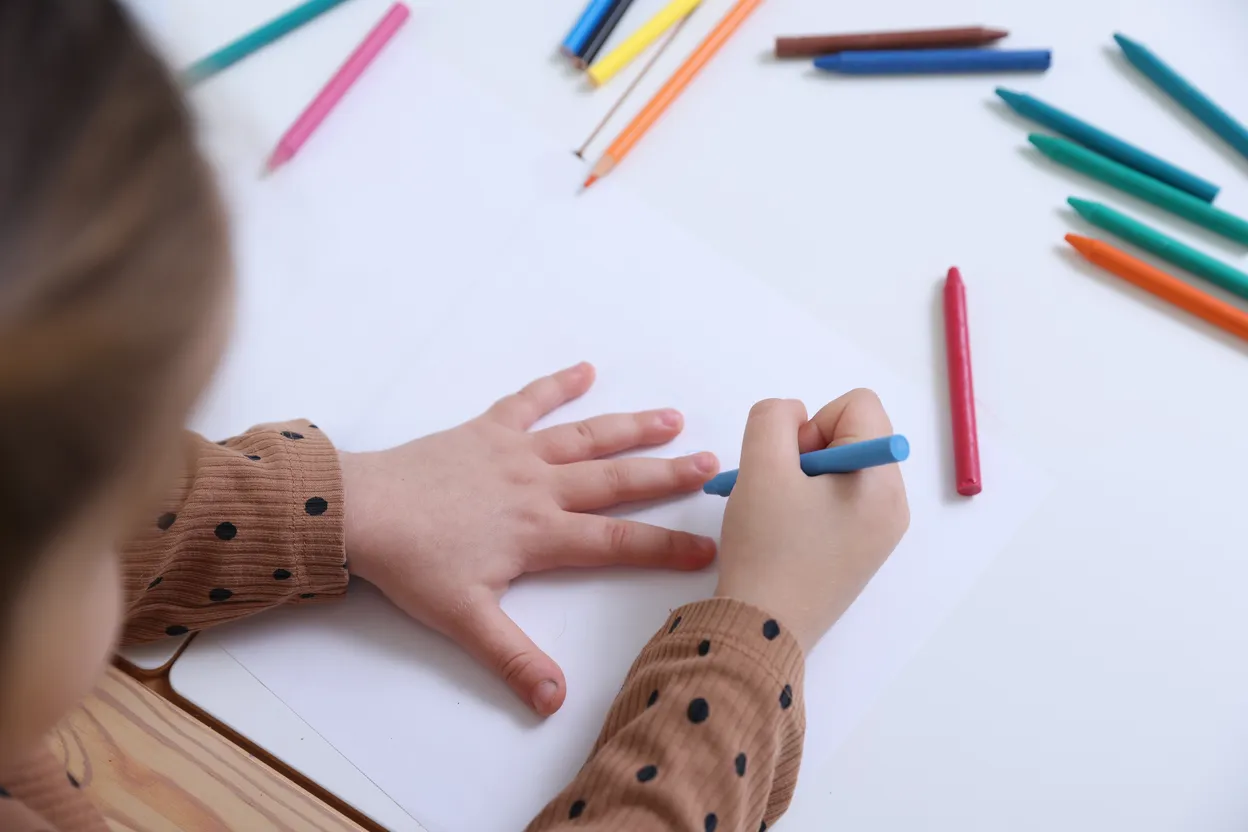
A mature tripod (three-finger) grip usually forms no earlier than age 4-6, and that's a completely normal range. Before that age, a child's hand passes through several intermediate grip stages, and there's no need to rush the process: pushing a young child into an "adult" grip too early can lock in an awkward habit that's hard to undo later.
Instead of correcting the grip, it's better to offer thicker crayons and pencils — they're easier for a small hand to hold — and keep up pencil grip and pre-writing activities like dot-to-dot tracing and pencil mazes. The hand will "ripen" into the correct grip on its own, given enough practice.
Cutting and Scissor Skills Activities
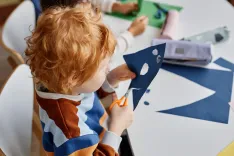
Scissor skills develop gradually starting around age 2, and require not just finger strength but also the ability to work both hands at once — one holding the paper, the other cutting.
18. Opening and closing scissors without paper — Before cutting paper, give your child safe kid scissors and have them simply open and close the blades — for example, "biting" strips of play dough. A safe first step.
19. Single snips along the edge of paper — Draw short lines along the edge of a sheet of cardstock and ask your child to make individual snips along them. This is the first real step toward scissor skills with actual paper.
20. Straight lines — Once single snips are mastered, move on to straight lines about 15 cm (6 inches) long — the child learns to move the scissors forward instead of just opening and closing them.
21. Cutting out simple shapes — Circles, squares, and other simple shapes on cardstock train the child to turn the paper with their other hand — an important element of bilateral coordination.
22. Cut-and-paste collage — Ask your child to cut pictures out of an old magazine and glue them onto a sheet of paper. This creative task turns practice into an engaging project rather than a chore.

How Do I Choose the Right Scissors for a Preschooler?
Look for scissors with rounded ("blunt") tips, a spring mechanism that automatically reopens the blades after a snip, and loops sized for a small hand. Scissors like these reduce strain on the fingers and make those first attempts at cutting paper much less frustrating.
If your child isn't ready for real scissors yet, start with plastic training scissors for play dough or cardstock — they're safer but give the same training effect.
Everyday Life Activities That Build Fine Motor Skills
Not every bit of fine motor practice needs to look like a formal "activity" — plenty of everyday tasks give the same benefit as dedicated exercises, while also building a child's independence.
23. Buttoning and zipping — Ask your child to button their own jacket or shirt. It takes precision, finger strength, and patience — and gives a huge sense of pride when it works.
24. Setting the table — Laying out plates, utensils, and napkins isn't just helping around the house — it's a full workout for coordination and movement planning.
25. Pouring liquid from a pitcher into a cup — Give your child a small pitcher of water (or dry cereal, for an easier version) and ask them to pour it into a cup on their own. A great way to train movement control in a real, rather than artificial, situation.
26. Opening containers and jars — Let your child open food containers, tubes, or screw-top jars themselves. This builds wrist strength and the strength of both hands at once.
27. Getting dressed independently — Putting on socks, Velcro shoes, or lacing up shoes — all of these are everyday but highly effective fine motor activities for preschoolers, and they save you time in the morning too.
28. Helping in the kitchen — Kneading dough, stirring ingredients with a spoon, sprinkling on toppings — simple kitchen tasks are a wonderful way to train hand strength and coordination in a natural, enjoyable setting.
29. Matching laundry into pairs — Ask your child to find matching socks and put them together. This task combines sorting, precision of movement, and an element of play.
30. Clothespins on a laundry line — Hanging little "laundry" — fabric scraps or paper clothing cutouts — on a real line with clothespins is a fun sensory play activity that combines hand strength and precision in one task.

Build Fine Motor Skills Through Play With Keiki
There isn't always time to prepare materials for the next exercise — and that's okay. The Keiki app offers interactive games for drawing, line tracing, and shape work that complement offline practice and turn screen time into meaningful fine motor development. It's a convenient way to keep up progress between sessions with play dough and scissors, without replacing hands-on play.
Help your child thrive with playful learning
Turn screen time into real growth with Keiki's educational games.
Try KeikiSummary
Building fine motor skills is a marathon, not a sprint: hand strength lays the foundation for precision, precision paves the way for a proper pencil grip, and pencil grip eventually grows into confident writing. Start with simple fine motor activities for preschoolers you already have at home — clothespins, play dough, a pitcher of water — and gradually add more challenging tasks as your child's confidence grows.
The key is not to turn these activities into a chore. Five to ten minutes of play every day will do more good than one long, tiring lesson once a week. And every small thing a child does on their own — zipping a jacket, cutting a strip of paper — is already a small win on the road to independence.