20 Shaving Cream Activities for Kids (Toddlers to Kindergarten)

If a contest were held among all household items for the title of "Most versatile, cheap, and kid-adored craft material," ordinary shaving cream would easily take first place. What for adults is a simple morning routine is real magic for a child. Fluffy and light, the foam holds its shape well, it's pleasant to touch, and it washes off in a couple of seconds.
Key takeaways
- Shaving cream is a cheap, low-mess sensory material that's basically soap, so cleanup is quick and surfaces end up cleaner.
- Choose plain, fragrance-free cream, do a patch test, and swap in edible alternatives for kids who still put things in their mouths.
- Activities scale by age, from simple smearing for toddlers to marbled art for preschoolers and science and writing practice for kindergarteners.
- Finger-writing in a thin layer builds handwriting muscle memory while keeping mistakes stress-free.
Shaving Cream Activities for Kids
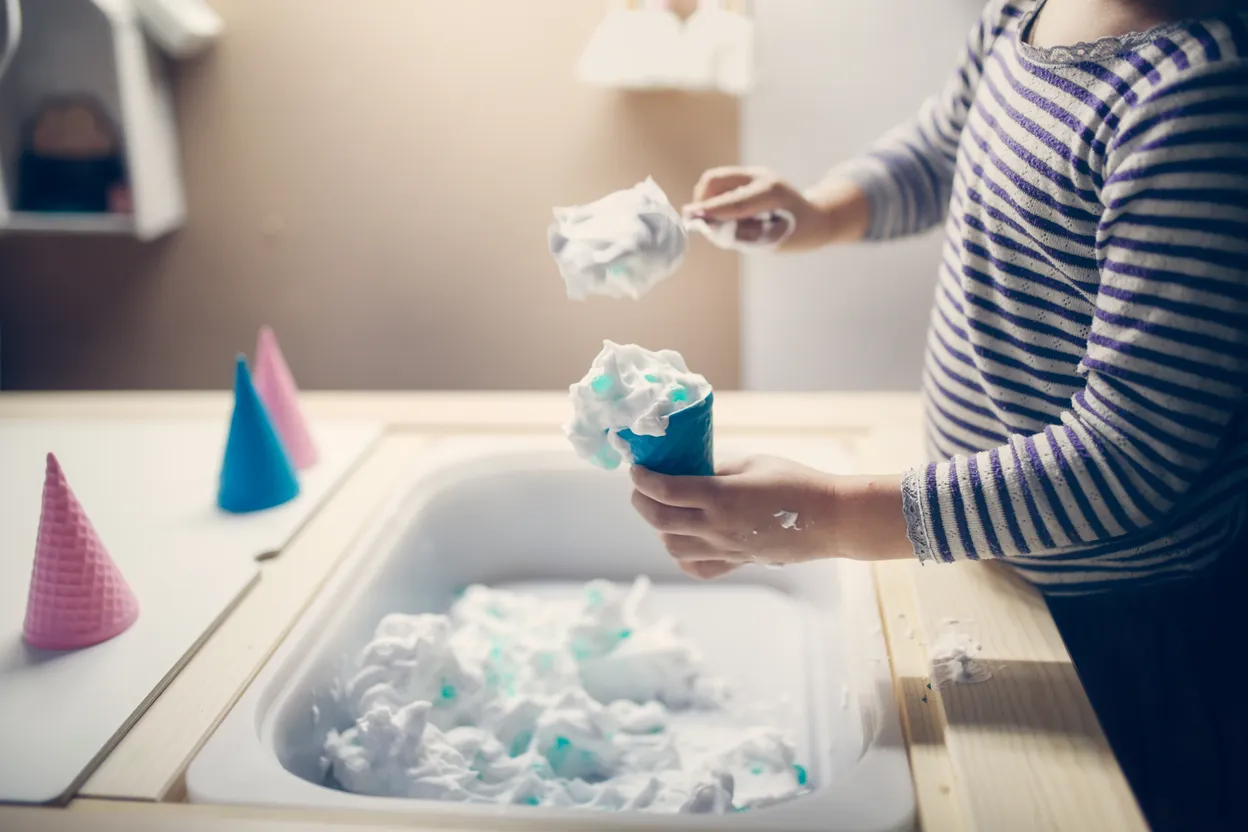
In today's world of early development, sensory play holds a place of honor. Games that engage touch, sight, and smell are important for forming new neural connections in a child's brain. And this is where shaving cream activities for kids come onto the scene. Ordinary foam becomes a tool for training fine motor skills, studying the properties of objects, relaxing the nervous system, and even preparing the hand for writing.
Many parents avoid messy play, since no one enjoys spending hours cleaning the room afterward. But the secret of foam is that it's mostly made of soap! After these activities, your children and your surfaces end up even cleaner than they were before.
Is Shaving Cream Safe for Kids? What to Know Before You Start
Before we dive headfirst into fluffy clouds, let's talk about the most important thing: safety. How okay is it to give little ones a cosmetic product?
On the whole, basic types of shaving cream are safe for children's skin, as long as you follow a few simple rules:
- Choose sensitive-skin options. The best shaving cream activities come from the cheapest, most basic foam with no dyes and minimal fragrance, or none at all. Avoid menthol gels, since they can cause slight burning or tingling on delicate children's skin, as well as gels you have to rub for a long time to get foam. We need ready-made, fluffy white foam.
- Do a patch test. If your child is prone to dermatitis or eczema, apply a drop of foam to the crook of the elbow a day before the big play session. If there's no redness, you're good to play!
- The mouth rule. Shaving cream isn't edible. If your little one is at the age (usually up to 1.5–2 years) when everything that lands in their hands goes into the mouth for a taste, replace shaving cream with whipped cream from a can or aquafaba (whipped water from canned chickpeas). This provides the same tactile experience but is 100% safe. True, in that case you won't avoid the mess.
- Eye protection. Explain the main rule to your child: hands covered in foam never touch the face and eyes. For peace of mind, keep a damp towel nearby so you can quickly wipe off at any moment.

Help your child
grow with Keiki
We’ll help you turn everyday screen time
into real learning progress.
Shaving Cream Activities for Toddlers (Ages 1–3)
Toddlers (little ones from 1 to 3) get to know the world with their whole body. It's important for them to touch, smear, squeeze, and watch the material change shape. For this age, the ideal shaving cream activities for toddlers should focus on the process, not the result.
Mess-Free Sensory Bag
If you're not ready for a full cleanup yet, this is your choice. Squeeze a little foam into a sturdy zip bag, add a couple of drops of food coloring (without mixing), and seal the bag tightly with reinforced tape. Stick the bag to the window glass or the floor. Your little one will press the bag with their fingers, mixing the colors inside. This is a pure sensory bag, suitable even for the very youngest.
Toy Car Wash
A standard shaving cream activity for toddlers. But standard doesn't mean bad. Take two plastic containers (or set the game up right in the bath). Squeeze a mountain of foam into one container and pour warm water into the other. Give your child plastic cars and an old toothbrush. Let them first "dirty" the cars in the foam and then thoroughly wash them in the pool of water. It's also a sensory bin game that's unlikely to get boring.
Animal Rescue
Hide favorite plastic animal figures (farm figures or dinosaurs work great) in a deep bowl under a thick layer of foam. Your little one's task is to plunge their hands into this white cloud, feel for the animal, and pull it out onto dry land. This tactile game stimulates the nerve endings at the fingertips.
Window Smush
Kids love breaking the rules, and drawing on windows feels like true mischief to them. Squeeze the foam right onto the glass (on the inside). Show your little one how to smear the foam with both palms, creating circles and spirals. Movements from the shoulder are incredibly useful for developing gross motor skills.
Hot and Cold Sensory Play
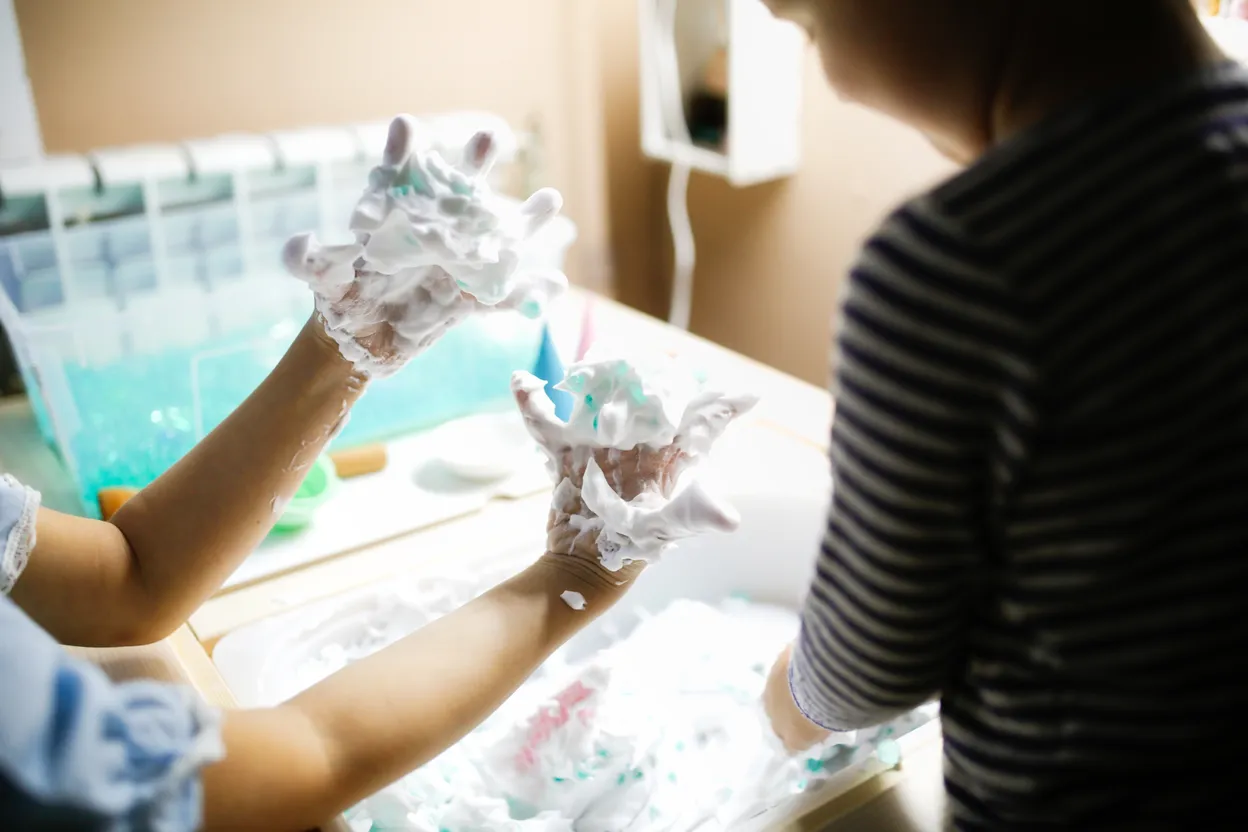
Sensory play isn't only about texture but also about temperature. Freeze water in ice molds ahead of time; you can even add coloring. Place the ice cubes in a bowl and generously cover them with shaving cream. Your child will be thrilled by the contrast: warm, soft fluffy foam and hard, cold ice.
Pretend Cupcakes
Give your child a cupcake baking tray, a spoon, and a few pompoms or large plastic buttons. Let them spoon the foam into the molds like batter and decorate the "cupcakes" on top with pompom "berries." Working with a spoon is a complex skill that requires good coordination.
Calming Smear
Sometimes the best shaving cream activity for kids is the absence of any rules. If your little one is overstimulated before bed, sit them in a dry bathtub in a diaper, squeeze a mountain of foam onto the tub wall, and simply let them stroke it and smear it over their tummy and arms. The soft texture of the foam works as a calming activity, lowering stress levels and grounding the nervous system.
Shaving Cream Activities for Preschoolers (Ages 3–5)
Children aged 3–5 are already ready for more complex tasks. Their imagination is developing actively, they love role-play, and their fine motor skills let them use tools: brushes, droppers, tongs. Here we introduce shaving cream activities for preschoolers that require a bit more concentration.
Marbled Paper Art
This is the most popular type of painting with foam, and it produces beautiful artwork at the end. Squeeze the foam onto a baking sheet in an even layer. Drop different colors of liquid food coloring or liquid watercolor on top. Give your child a toothpick so they can draw lines chaotically, creating a marbled pattern. Then carefully press a sheet of thick paper onto the foam, lift it off, and clean off the leftover foam with a ruler. A fantastic pattern will remain on the paper!
Foam Blocks
Shaving cream is also "cement" for kids' construction sites. Give your preschooler a set of light plastic blocks or even Lego Duplo pieces. Let them dip the pieces in foam and stick them together, building slippery, wintry towers.
Hidden Treasure Sort
Toss lots of small objects of different colors into the foam (red, blue, yellow buttons, coins, plastic clips). Give your child kids' tongs or tweezers and several small cups. The child has to find the objects with the tongs and sort them by color. Using tweezers is training fine motor skills before school.
DIY Puffy Paint
Mix shaving cream with PVA glue in a 1:1 ratio and add coloring. This gives you dimensional paint. If you paint clouds, a sheep, or an ice cream cone with it on cardboard and leave it to dry overnight, the paint will set but stay raised and puffy, like a sponge. You'll see, coloring reaches a whole new level with this approach.
Finger Twister
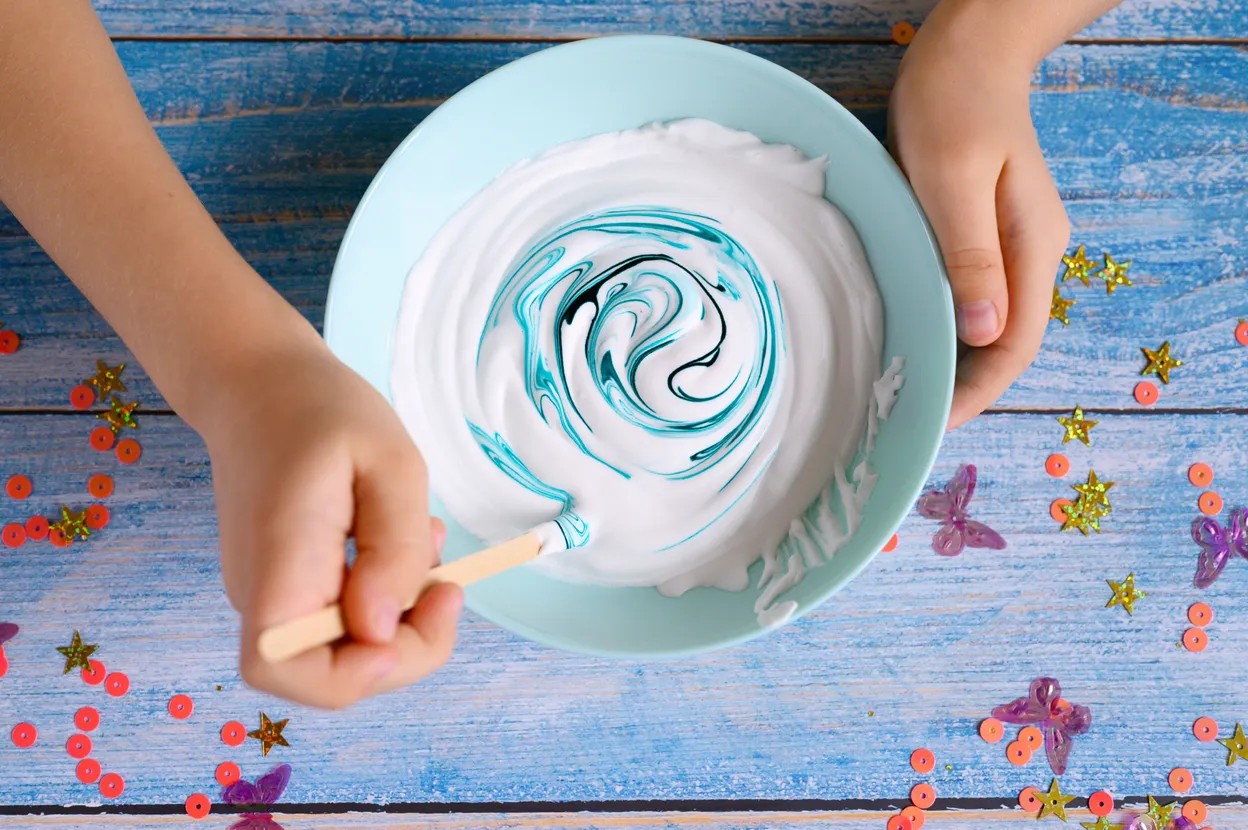
Original shaving cream games don't require buying expensive sets. Make a few small colored puddles of foam on the table, adding a drop of paint to each. Give commands: "Right hand index finger on the red foam! Left hand pinky on the green!". The game is fun, but it also teaches distinguishing the fingers and coordinating complex movements.
Summer Snowmen
Squeeze the foam into a deep container and put it in the freezer for a few hours (the foam won't freeze into a rock, but it'll get very cold and dense). Take it out and suggest your child sculpt mini snowmen right on the table, using black peppercorns for eyes and a piece of carrot for the nose.
Color Drop Experiment
Make an even white field of foam on a baking sheet. Pour water strongly colored with food dye into small cups. Give your child a dropper. Let them draw up the colored water and drip it onto the white foam. Watching the color spread across the white cloud is a mesmerizing process.
Shaving Cream Activities for Kindergarten
For children in the preparatory kindergarten group (5–6 years), games should take on educational meaning. At this age children are learning letters, numbers, and math basics and adore simple science experiments. Our shaving cream activities for kindergarten are the perfect bridge between carefree play and academic learning.
Sensory Writing Practice
Forget boring copybooks. Smear a thin layer of foam over a smooth table or plastic tray. Ask your child to use their index finger as a pen; this is a kind of writing practice. You can write numbers, their name, work through tricky elements, or set up special g practice (since writing the lowercase English "g" with its long tail is often tricky for kids, and on foam mistakes aren't scary; just wipe it away with your palm and start over).
Rain Cloud in a Jar
One of the most famous kids' science experiments. Fill a clear jar or glass 3/4 with water. Squeeze a fluffy cloud of shaving cream on top. Then have your child slowly drip blue tinted water over the foam with a dropper. When the blue water gets too heavy, it breaks through the foam and starts falling to the bottom of the jar, imitating real rain. It's an amazing visual illustration of the water cycle in nature!
DIY Sensory Snow
To get a new, squeaky texture, mix shaving cream with cornstarch (about one pack of starch per one can of foam). Knead it by hand until the mass stops sticking. You'll get cool, moldable artificial snow you can build castles with or hide toys in.
Addition Mountains
Make several small "hills" of foam on the table. Write simple problems with your finger on the table next to the hills (for example, 2 + 3 = ). The child's task is to solve the problem and stick the right number of toothpicks, cotton swabs, or Lego figures into the foam hill (in this case, five).
Color Mixing Magic
Take three sturdy zip bags. In the first, put foam, yellow and red coloring. In the second, yellow and blue. In the third, blue and red. Seal them tightly. Ask your child to squish the bags with their hands. Right before their eyes, yellow and red will turn into orange! It's the best way to learn the rules of creating secondary colors without a drop of mess on the table.
Shaving Cream Continents
For children fascinated by the planet, suggest drawing a foam map of the world. On a blue plastic tray (or simply a spread-out blue trash bag), have your child lay out the foam, forming the outlines of the continents. This develops spatial and geographic thinking, turning ordinary shaving cream kids activities into a geography lesson.
Make Sensory Play a Learning Adventure With Keiki
Sensory and messy games, like sculpting fluffy clouds or painting in foam, are an important physical experience. A child's body, their fingers and skin, need to make live contact with materials. However, development should be all-around. And here you need to balance tactile practices with quality learning wisely.
That's exactly why we at Keiki created a platform that perfectly complements your child's physical development. After sensory activities, you need to calm your little one and give them interesting, useful activities you can launch on a smartphone or tablet. The app has all kinds of educational content. For example, you can give your child word learning games: tracings, flashcards, word building in an interactive format. And to help remember new words, memory games will help too. Children can solve online logic puzzles, go through interactive mazes, and play educational mini-games, training cognitive skills and reaction speed in a bright, friendly interface.
Build real skills through fun, educational games for your child
Try KeikiConclusion
Parenting is often tied to a desire to keep things tidy. But the truth is that the most vigorous, high-quality, and happy development happens exactly where there's a little controlled chaos. By adding shaving cream activities for kids to your routine, you give your child the chance to explore the world without strict boundaries, developing their nervous system, intellect, and creativity.
Yes, it may take an extra five minutes to wipe the table or rinse the tub, but the delighted sparkle in your child's eyes, their genuine laughter, and hours of engaged, calm play are definitely worth the effort.