30 Popular Bedtime Stories for Kids (Sorted by Age)

Goodnight Moon, The Gruffalo and Dr. Seuss books come up again and again when parents name their kids' favorite bedtime books. Below are 30 picks for kids ages 2 to 6, grouped by age. The last group covers short classics you can tell from memory when there's no book in reach.
Key Takeaways
- Goodnight Moon, Dr. Seuss books and The Gruffalo top many parent favorite lists.
- Pick books with a calm, safe ending for bedtime.
- Reading the same book every night is fine.
- Fairy tales and fables work when there's no book around.
What's the Most Popular Bedtime Story?
There's no single winner, because the answer changes with the country and the way you count. In American parent polls, Dr. Seuss books and Goodnight Moon usually sit near the top. In the UK, The Gruffalo took first place in a survey of the nation's best-loved bedtime stories.
Worldwide Google search rankings look different. A 2023 study of bedtime story searches put Alice in Wonderland, Coraline and Charlie and the Chocolate Factory at the top. All three are long books for older kids, and Coraline is honestly a little creepy for a 4-year-old at 8 p.m.
This list of 30 bedtime stories keeps only books and tales that work for ages 2 to 6. Ages are a rough guide. Your kid's attention span and fear level matter more than their birthday.
Help your child
grow with Keiki
We’ll help you turn everyday screen time
into real learning progress.
Bedtime Books for Toddlers (Ages 2–3)
The best bedtime books for toddlers are short, repeat the same words a lot and end with someone going to sleep. Most of these take about five minutes to read, and many come as sturdy board books.
1. Goodnight Moon by Margaret Wise Brown
Goodnight Moon follows a little bunny saying goodnight to everything in a big green room: the kittens, the mittens, the moon. The pictures get darker page by page, so the book winds down right along with your kid. It's been a bedtime staple since 1947.
Ages 2 to 3. Best for: kids who like naming things in pictures.
2. Llama Llama Red Pajama by Anna Dewdney
In Llama Llama Red Pajama, Baby Llama is tucked in and Mama Llama goes downstairs. He calls for her, then waits, then melts down. Mama comes back and tells him she's always close, even when he can't see her. The rhymes are bouncy, and plenty of toddlers end up saying the lines with you.
Ages 2 to 4. Best for: kids who call you back into the room five times.
3. The Very Hungry Caterpillar by Eric Carle
The Very Hungry Caterpillar eats through one apple, two pears and a whole lot more, one day of the week at a time. Then he builds a cocoon and comes out a butterfly. Toddlers love poking their fingers through the holes in the pages. You also get counting and the days of the week for free.
Ages 2 to 4. Best for: little counters and finger pokers.
4. Brown Bear, Brown Bear, What Do You See? by Bill Martin Jr. and Eric Carle
Brown Bear, Brown Bear asks the same question on every page, and a new animal in a new color answers it. After two or three nights, most toddlers can "read" it back to you, and they love showing off.
Ages 2 to 3. Best for: learning colors and animal names.
5. Guess How Much I Love You by Sam McBratney
Guess How Much I Love You is a gentle back-and-forth between Little Nutbrown Hare and Big Nutbrown Hare. Each one tries to show that their love is bigger, with arms stretched wide and hops up high. It ends with Little Nutbrown Hare asleep and the line about loving someone to the moon and back.
Ages 2 to 4. Best for: a cuddly last book of the night.
6. Time for Bed by Mem Fox and Jane Dyer
Time for Bed shows animal parents putting their babies to sleep: a mouse, a goose, a cow and more. The rhymes are short and soft, and the last one tucks in a child. It's slow on purpose, so read it in your quietest voice.
Ages 2 to 3. Best for: kids who need help slowing down.
7. The Going to Bed Book by Sandra Boynton
The Going to Bed Book follows a boatload of animals as they take a bath, put on pajamas, brush their teeth and, oddly, exercise before bed. It's silly and short, and it follows a real bedtime routine. Point out the steps your kid does too, like brushing teeth.
Ages 2 to 3. Best for: teaching the steps of a bedtime routine.
8. Owl Babies by Martin Waddell
In Owl Babies, three baby owls wake up at night and find their mother gone. Sarah and Percy try to stay brave, and little Bill just keeps saying he wants his mommy. She flies back, of course. Owl Babies is a good pick for kids starting daycare or worried about you leaving.
Ages 2 to 4. Best for: kids with separation worries.
Bedtime Picture Books for Preschoolers (Ages 3–5)
Preschoolers can follow a real plot, so bedtime picture books for this age have a bit of adventure, a funny twist or a small scare that ends safely. Plan on 5 to 10 minutes each.
9. The Gruffalo by Julia Donaldson and Axel Scheffler
The Gruffalo is about a mouse walking through the woods. A fox, an owl and a snake each want to eat him, so he says he's meeting a Gruffalo who loves to eat foxes, owls and snakes. They all run off. Then a real Gruffalo shows up. The mouse tricks him into thinking everyone in the woods is scared of the mouse, and the Gruffalo runs away too. Kids love that the smallest animal wins. Some 3-year-olds find the Gruffalo a bit scary, so try it in daylight first.
Ages 3 to 6. Best for: kids who like clever heroes.
10. We're Going on a Bear Hunt by Michael Rosen and Helen Oxenbury
In We're Going on a Bear Hunt, a family wades through grass, a river, mud, a forest and a snowstorm to find a bear. When they finally find one, they run all the way home and hide under the covers. The sound words, like "swishy swashy" grass, are fun to say together.
Ages 3 to 5. Best for: kids who like to act out stories.
11. Where the Wild Things Are by Maurice Sendak
Where the Wild Things Are starts with Max being sent to bed without supper for causing trouble. His room turns into a forest, he sails off to where the Wild Things live and becomes their king. Then he gets lonely and sails home, where his supper is waiting, still hot. Kids who've just been in trouble really get Max.
Ages 3 to 6. Best for: big-feelings kids after a tough day.
12. Harold and the Purple Crayon by Crockett Johnson
Harold and the Purple Crayon follows a little boy who goes on a walk by drawing it. He draws a moon, a path, a sea and a boat. When he gets tired, he draws his own window and bed and goes to sleep. Tomorrow morning, hand your kid a purple crayon and see where their own walk goes.
Ages 3 to 6. Best for: kids who love to draw.
13. Corduroy by Don Freeman
Corduroy is a teddy bear in a department store who's missing a button on his overalls. After closing time, he searches the store at night to find one. The next day, a girl named Lisa buys him with her own savings and sews on a new button at home.
Ages 3 to 5. Best for: kids who love their stuffed animals.
14. If You Give a Mouse a Cookie by Laura Numeroff
If You Give a Mouse a Cookie starts with a cookie, which means the mouse wants milk, then a straw, then a napkin, and on and on. By the end, he's thirsty again and wants another cookie. Preschoolers love guessing what the mouse will ask for next.
Ages 3 to 6. Best for: kids who like silly cause and effect.
15. Room on the Broom by Julia Donaldson and Axel Scheffler
In Room on the Broom, a witch and her cat are flying when the wind blows away her hat, then her bow, then her wand. A dog, a bird and a frog each find one and ask to ride along. The crowded broom snaps, and a dragon wants to eat the witch. The animals scare him off together, and the witch makes a new broom with a seat for everyone. It's about sharing and helping, minus the lecture.
Ages 3 to 6. Best for: kids learning to share.
16. Goodnight, Goodnight, Construction Site by Sherri Duskey Rinker and Tom Lichtenheld
Goodnight, Goodnight, Construction Site puts a crane, a dump truck, a bulldozer and other machines to bed after a long day of work. Each truck finishes its job and curls up to sleep. It's the go-to for truck-obsessed kids who'd rather not hear about bunnies.
Ages 3 to 5. Best for: truck and digger fans.
17. The Tiger Who Came to Tea by Judith Kerr
The Tiger Who Came to Tea starts with a tiger knocking on Sophie's door. He eats all the food in the house, drinks all the water from the tap and leaves. When Daddy comes home, there's nothing for dinner, so the family goes out to eat. Kids find it hilarious, and nobody gets hurt.
Ages 3 to 5. Best for: a giggly, low-stakes story.
Bedtime Stories in Keiki World
Keiki World has bedtime stories for the nights when you're too tired to read out loud or the books are packed away.
Keiki World sessions are short by design, so a story fits the last few minutes before bed. It's a calmer way to wind down than a cartoon or a game. Once the story ends, turn off the screen and go straight to lights out.
Keiki World stories also tie into reading practice during the day. For kids who are starting to read on their own, the Short Stories reading game has simple stories with questions that check whether your kid followed along. Use that in the afternoon, and save bedtime for a book on your lap whenever you can.
Help your child thrive with playful learning
Turn screen time into real growth with Keiki's educational games.
Try KeikiBedtime Stories for 5- and 6-Year-Olds
Five- and 6-year-olds are ready for longer stories, series they can follow over several nights and books they can start reading to you.
18. Green Eggs and Ham by Dr. Seuss
In Green Eggs and Ham, Sam-I-Am follows a grumpy guy everywhere, begging him to try green eggs and ham. When he finally tastes them, he loves them. Dr. Seuss wrote the whole book with only 50 different words, so it's a great one for a new reader to read back to you.
Ages 4 to 7. Best for: picky eaters and brand-new readers.
19. Winnie-the-Pooh by A. A. Milne
Winnie-the-Pooh is a 1926 collection of stories about Pooh, Piglet, Eeyore and Christopher Robin in the Hundred Acre Wood. Each chapter is its own small adventure. In one, Pooh floats up to a bees' nest on a balloon to get honey. In another, he eats so much at Rabbit's house that he gets stuck in the door. One chapter a night is about right for a 5-year-old.
Ages 4 to 7. Best for: a first chapter book to read together.
20. Curious George by H. A. Rey and Margret Rey
Curious George is a little monkey who lives in the city with his friend, the Man with the Yellow Hat. In each book, George gets curious about something, like a phone, a kite or a bunch of balloons, and ends up in trouble. By the end, he sets things right or helps someone, and everyone forgives him. There are dozens of Curious George books, so a kid who likes one has plenty more to read.
Ages 3 to 7. Best for: curious kids who like a series.
21. The Berenstain Bears by Stan and Jan Berenstain
The Berenstain Bears books follow Mama, Papa, Brother and Sister Bear, who live in a tree house. Each book is about one everyday thing, like a new baby, a trip to the dentist or watching too much TV. Pick the one that matches what your kid is going through, and it's easier to talk about.
Ages 3 to 7. Best for: talking through real-life changes.
22. Love You Forever by Robert Munsch
Love You Forever follows a mom singing the same lullaby to her son as he grows from a baby to a grown man. At the end, he sings it to her when she's old, and then to his own baby. Kids love the funny toddler and teenager pages. Parents usually cry at the end, so pick a night when you're up for it.
Ages 3 to 7. Best for: a sweet, slow family story.
Popular Short Bedtime Stories to Tell Without a Book
Classic fairy tales and fables are easy to tell in the dark, in the car or on a trip with no books in the bag. Each one takes 2 to 5 minutes to tell. If your kid asks for more, our list of short stories for kids has plenty with simple morals.
23. Goldilocks and the Three Bears
In Goldilocks and the Three Bears, a girl walks into the bears' house while they're out. She tries their porridge, chairs and beds until one of each is "just right," then falls asleep. The bears come home and find her, and she runs off. Use a big, medium and tiny voice for the three bears.
Ages 2 to 5. Best for: learning big, medium and small.
24. The Three Little Pigs
In The Three Little Pigs, three pigs build houses of straw, sticks and bricks. The wolf huffs and puffs and blows down the first two, but the brick house holds. Kids like to join in on the huffing and puffing, so maybe skip that part if they're already sleepy.
Ages 2 to 5. Best for: kids who like to join in.
25. The Tortoise and the Hare
In The Tortoise and the Hare, a fast hare makes fun of a slow tortoise, so they race. The hare gets so far ahead that he takes a nap, and the tortoise walks past him to the finish line. It's Aesop's fable about how steady effort beats showing off.
Ages 3 to 6. Best for: kids who rush everything.
26. The Lion and the Mouse
In The Lion and the Mouse, a lion catches a tiny mouse and lets him go, laughing when the mouse promises to help him one day. Later, hunters trap the lion in a net, and the mouse chews through the ropes to free him. This Aesop fable shows kids that small friends can help in big ways.
Ages 3 to 6. Best for: talking about kindness.
27. The Three Billy Goats Gruff
In The Three Billy Goats Gruff, three goats need to cross a bridge where a grumpy troll lives. The two smaller goats tell the troll to wait for their bigger brother. The biggest goat knocks the troll into the river, and all three get to the green grass on the other side. Make the troll grumpy, not scary, at bedtime.
Ages 2 to 5. Best for: kids who like a sneaky plan.
28. The Gingerbread Man
The Gingerbread Man jumps out of the oven and runs away from an old woman, an old man and a string of animals. He shouts that nobody can catch him. Then he meets a fox at a river, who offers to carry him across, then eats him halfway over. Toddlers love the repeating "run, run, as fast as you can" line.
Ages 2 to 5. Best for: kids who love a chase.
29. The Ugly Duckling
The Ugly Duckling is a gray, awkward bird who gets teased by the other birds and runs away. He spends a cold, lonely winter on his own. In spring, he sees his reflection and finds out he's grown into a beautiful swan. Hans Christian Andersen wrote it, and it's a gentle one for kids who feel different.
Ages 3 to 6. Best for: a quiet, comforting ending.
30. The Princess and the Pea
In The Princess and the Pea, a prince wants to marry a real princess. One stormy night, a soaked girl shows up at the castle and says she is one. The queen hides a single pea under a huge stack of mattresses. In the morning, the girl says she couldn't sleep a wink, which proves she's a real princess.
Ages 4 to 6. Best for: kids who complain about their bed.
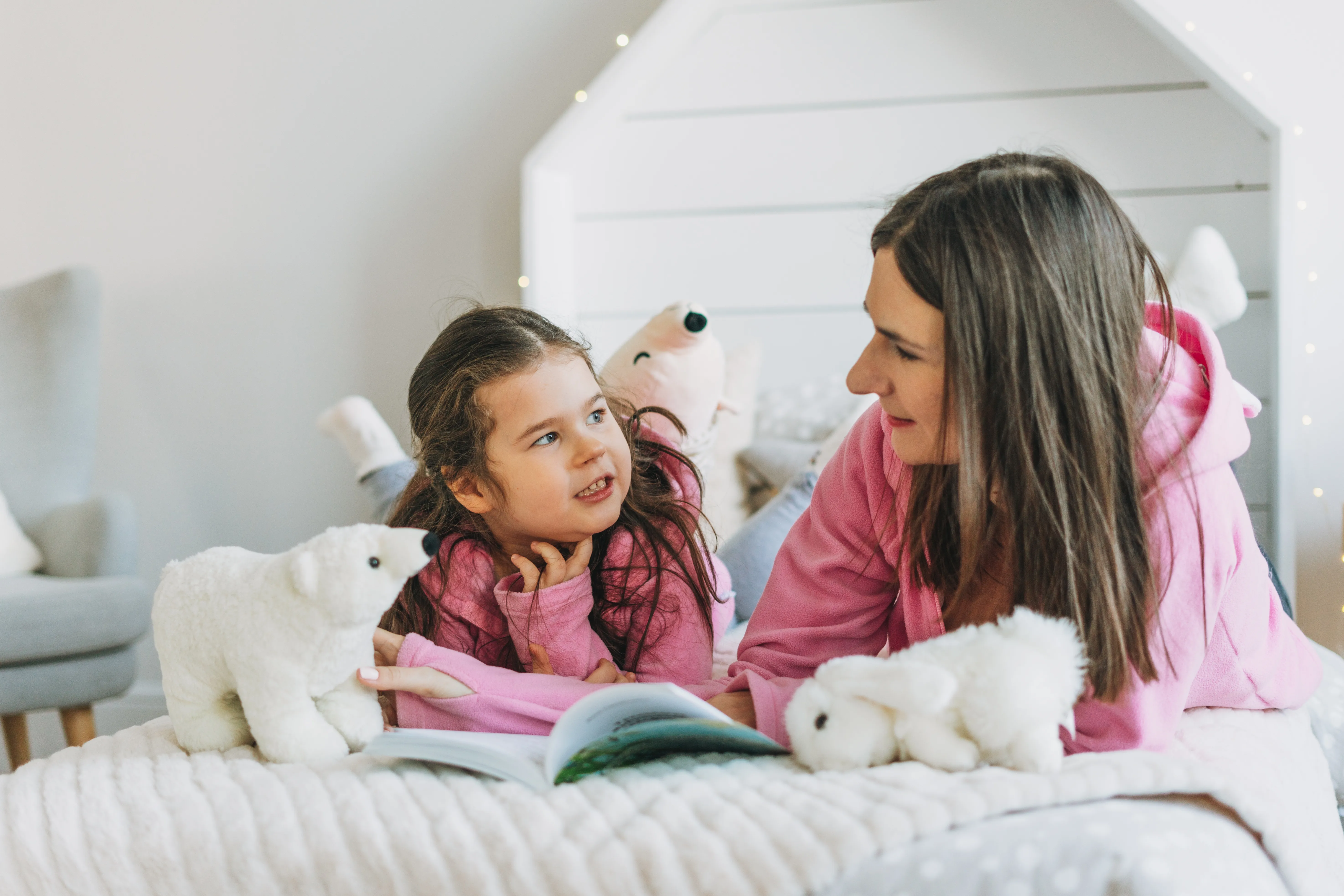
How to Pick Tonight's Story
The best bedtime story is one your kid wants to hear and you don't mind reading again tomorrow.
- Let your kid choose from two or three books. Kids fight bedtime less when they get a say in it.
- Read the same book again if they ask. Hearing a story many times helps kids learn new words and guess what comes next.
- Save scary or loud books for daytime. If The Gruffalo makes your kid nervous, read it after lunch.
- Set a rule, like one book or two short ones, and stick to it so "one more" doesn't turn into five.
A few minutes of calm movement before reading can help a wiggly kid settle. Try a pose or two from these yoga games for kids, then climb into bed for the story.