Speech Sound Development Chart: What to Expect at Every Age

Your three-year-old says "wabbit" instead of "rabbit," and someone just asked if that's normal. It usually is. A speech sounds development chart lays out the order most kids learn to make each sound. It helps you tell the difference between a sound that isn't due yet and one that's actually worth asking about.

Key Takeaways
- Speech sounds develop in a predictable order, from early sounds like p, b, and m to later ones like s, r, and "th."
- A chart like this one maps typical ranges, not strict deadlines, so a sound landing a few months late usually isn't a concern.
- By age 3, kids usually have b, n, m, p, h, w, and d; the rest fill in by 5, with r and "th" often last, by 6 or 7.
- A persistent gap past a sound's expected age, especially alongside unclear speech at age 3 or older, is worth a conversation with a speech-language pathologist.
Why Speech Sounds Develop in a Predictable Order
Speech sound development doesn't happen all at once. Kids learn certain sounds months or years before others, and that order is consistent enough that speech-language researchers can map it out. The technical term for it is the age of acquisition of speech sounds. It's the age by which most children can say a given sound correctly in everyday words, not just copy it once on request.
The order makes sense once you watch for it. Sounds that only need the lips or a simple tongue position, like p, m, and b, show up first because they take less coordination. Sounds that need precise tongue placement and timing, like s, r, and the "th" sound, take longer, sometimes years longer. It's the same kind of pattern behind a lot of other early development: skills build in a set order, with each one depending a little on the last.
That's what a chart like this is actually mapping: the typical order and age range for each sound.

Help your child
grow with Keiki
We’ll help you turn everyday screen time
into real learning progress.
The Chart: Speech Sounds by Age
This is the developmental chart of speech sounds most speech-language pathologists work from, based on a 2020 research review that looked at speech data from nearly 19,000 children. For each age, these are the sounds at least nine in ten children can say correctly in simple words, what researchers call the 90% mark.
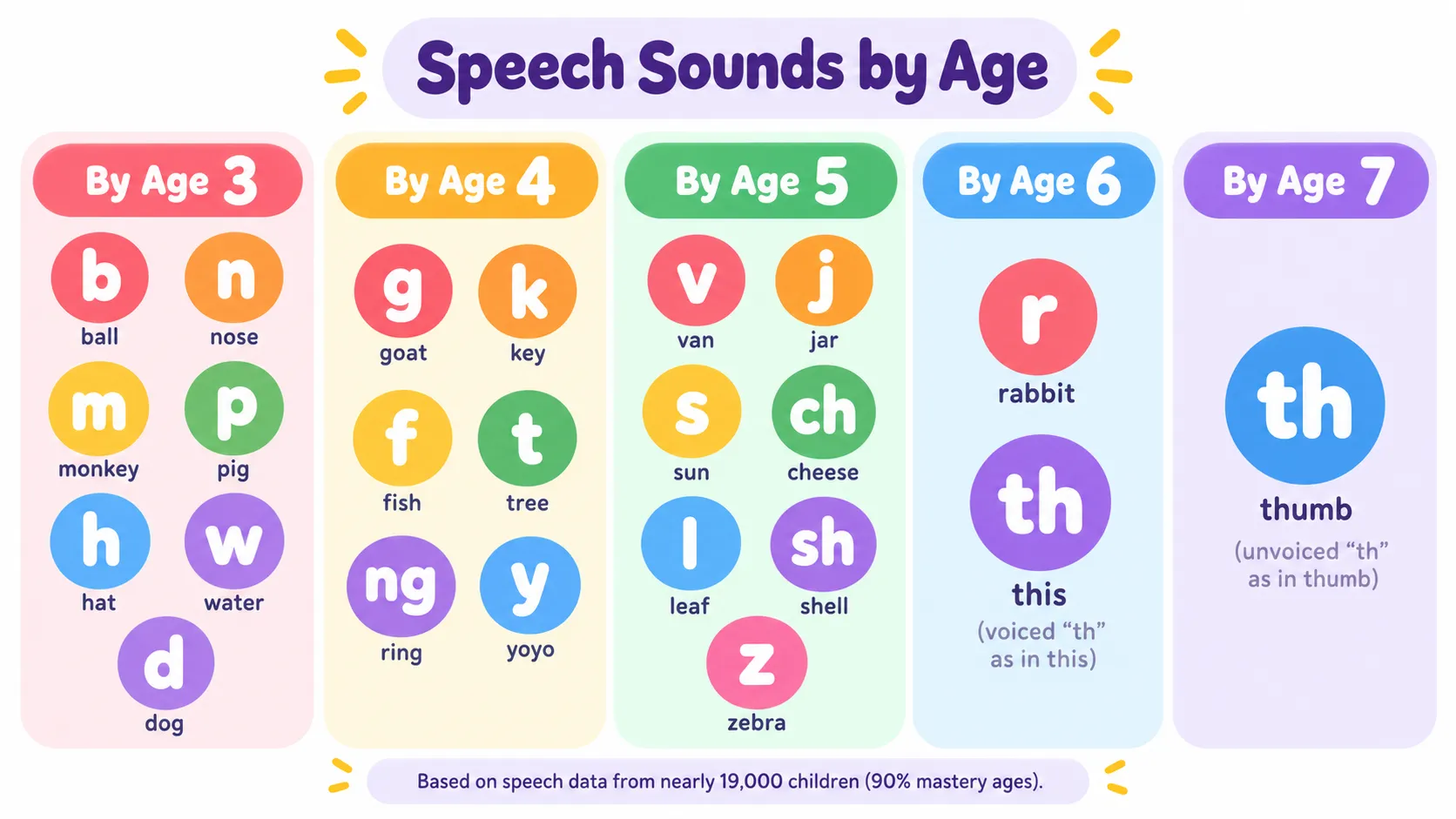
These ages are averages, and kids vary around them quite a bit. A sound landing six months after the chart says isn't automatically a problem. It falls well within how the development of speech sounds by age normally varies from one kid to the next. Pairing these milestones with other age-appropriate activities for 3-year-olds gives you a fuller picture of how your child is doing overall, not just how they talk.
The Early-Developing Sounds vs. the Late Bloomers
The early-developing speech sounds, p, b, m, h, w, d, and n, show up first. A baby's mouth can make them almost by accident through babbling, well before the rest of speech catches up. You'll usually hear most of them by your child's second birthday, a full year before the official age-3 mark on the chart.
The later sounds ask more of a young mouth. S, z, sh, ch, l, and r all need the tongue to hit a narrow, precise spot and hold it there while air moves past. That's a skill that keeps improving through kindergarten.
It's also why a kid who's otherwise talking in full sentences by age 4 can still turn "rabbit" into "wabbit" or "sun" into "thun." At four, that's typical for where those sounds are on the chart.
Make Sound Practice Part of Everyday Play
You don't need a drill-and-repeat worksheet to help a sound along. Most speech practice at this age works better folded into play your child already enjoys. Keiki World's speech games are built around exactly that. They're short, playful activities for ages 2 through 6 that have kids naming pictures, matching sounds, and repeating simple words out loud, without it feeling like practice.
Because Keiki World sorts the games by age, you can match the activity to where your child actually is on the chart instead of guessing. A three-year-old working on early sounds gets different games than a five-year-old refining s and sh. It's a few minutes a day, which fits into an already full schedule better than a dedicated practice session would.
More Speech Games to Try



How to Read the Chart Without Worrying
Sound development by age is never a straight line. Two kids can hit every other milestone on schedule and still land six months apart on when "s" clicks into place, and both are inside the normal range. The chart tells you roughly when to expect a sound, not the exact day it should appear.
A few things are worth knowing as you check your own kid against it. Speech sound milestones tend to arrive faster for sounds at the start of a word than in the middle or end of one. A sound your child can say alone often shows up later inside a word they already know how to say.
Kids learning two languages at once sometimes take a little longer to settle a sound in English specifically. None of that means the chart doesn't apply to your child. It just means the chart is a range, not a stopwatch.
When to Talk to a Speech-Language Pathologist
A few signs are worth a conversation with a specialist sooner rather than later, regardless of what the chart says.
- By age 2, your child uses very few consonants and mostly vowel sounds, instead of early sounds like p, b, m, h, w, d, and n.
- By age 3, people outside the family can't understand most of what your child says.
- At 4 or older, speech is still hard for anyone to follow.
- Your child regularly drops sounds or whole word endings well past the age that's typical for it.
- One specific sound is still missing long after its spot on the chart, like no k or g sound by age 4.
- There's any hearing concern: not responding to their name, needing the TV louder than usual, or repeated ear infections alongside unclear speech.
- Speech goes backward. If your child stops using words or skills they already had, that's worth checking no matter their age.
If any of these sound familiar, don't wait to see if it resolves on its own. If your child is under 3, you can get a free evaluation through your state's early intervention program. If they're 3 or older, your local school district can do one instead, even if your child doesn't attend school there, and you don't need a pediatrician referral for either.
Catching a snag early helps more than just the one sound. It keeps the rest of sound development moving at its own pace.