When Do Kids Learn The Alphabet?

In every parent’s life, there comes a moment when, at the playground, someone’s incredibly proud mother announces that her two-year-old already knows the entire alphabet and reads store signs syllable by syllable. The first may be true, but the second is already questionable.
Key Takeaways
- Singing the ABC song at 2 is just memorization – real letter recognition starts around 3–4, confident knowledge by 5–6.
- Teach sounds first, not letter names – that's what actually leads to reading.
- Sensory play beats flashcards – sand, clay, and letter hunts make letters stick way better than drilling.
- A 4-year-old knowing only a few letters is completely normal – stop comparing.
- Mirror writing at age 6 isn't dyslexia – it usually sorts itself out by 7–8.
The point is that it is not enough to know only when do kids learn the alphabet – mechanically, relying on visual memory, a child can memorize almost anything. It is also important to understand when teaching the alphabet actually makes sense, so the child not only recognizes letters, but also has a ready foundation for further reading development.
And, of course, parental competitions are a sport with zero practical value. Learning the alphabet is not a survival race, but a complex neurobiological process for which the brain must physically mature. In this article, we will explain real age norms without complicated academic terms. We will find out when it really makes sense to pick up an alphabet book, how simple memorization of a song differs from real reading, and how to turn the process into an engaging game.
What age do kids learn ABCs?
A child’s development does not follow a strict schedule. Some children start walking at 9 months, while others do so at 15 months, and both options are normal. The same applies to questions about letters. However, educators and neuropsychologists identify certain stages that can be used as reference points in a child’s development. Still, we can outline several key milestones for when should kids recognize letters and what to expect at each stage.
1–2 years – a time for songs and imitation
If you are wondering when do toddlers learn ABCs, the answer may surprise you: they do not really learn letters or master reading. At least not in the sense that we, as adults, put into the word “reading.”
At this age, toddlers have very strong auditory memory. They can memorize the famous “A-B-C-D...” song listing all the letters of the alphabet, just as they can memorize any counting rhymes or advertisements by ear. This is called reciting – mechanical reproduction. The child does not yet understand that “A” or “B” are graphic symbols that can be written. However, this is a wonderful stage for developing language and articulation, but you should not expect a toddler to distinguish individual letters.
3–4 years – the stage of recognition and first attempts
This is when the well-known preschool era begins. From the age of three, your child suddenly turns into a little question-asker who is interested in everything and wants to understand everything. This also happens because the child is now ready to perceive symbols: they no longer seem like abstract white noise, but begin to acquire meaning.
This is the very period when should a child know their ABCs. Children begin to recognize letters visually, pay attention to signs, book titles, and inscriptions. This is the time when children first start looking everywhere for the most important letter in their life – the first letter of their own name. By the age of four, a child may recognize 5 to 10 favorite letters, especially if they are associated with something meaningful, for example, “M” for mom or McDonald’s. The first awareness appears that the text in books carries some kind of meaning.
5–6 years – a time of real discoveries
Now we have reached the stage of at what age should a child know the alphabet more or less confidently. By the older preschool age, a child’s brain matures enough for abstract thinking, and this brings not only a burst of imagination into every action, but also enough maturity to perceive letters and text.
Usually, by the age of 5, children know most uppercase letters, and by the age of 6, they confidently recognize lowercase letters as well, connecting them with sounds. This is considered a sign of readiness for school. It is at the age of 5–6 that the age for letter recognition reaches its peak: the child understands that words are made up of letters and begins to make the first attempts at blending, or merging sounds together.
Help your child
grow with Keiki
We’ll help you turn everyday screen time
into real learning progress.
How to help your child learn the alphabet?
So, we have looked at the norms. Now comes the main question: how can you help without killing the desire to learn? Paradoxically, you can speed up learning by forgetting about strict lessons with a pointer and flashcards. Preschoolers learn only through play, sensory experience, and fun. You can support your child’s literacy with the following life hacks:
Focus on sounds, not letter names
If we had to highlight only one rule, this would be it. The phonics method, which focuses on phonemes, has proven its effectiveness. Teach your child to pronounce a short [M], not [EM], a clear [B], not [BE]. If a child learns only the names of letters, it will be incredibly difficult for them to understand why these strange letters form a word that, in reality, sounds completely different from its separate parts. Focusing on sounds also makes it easier to approach reading.
Add more sensory practices
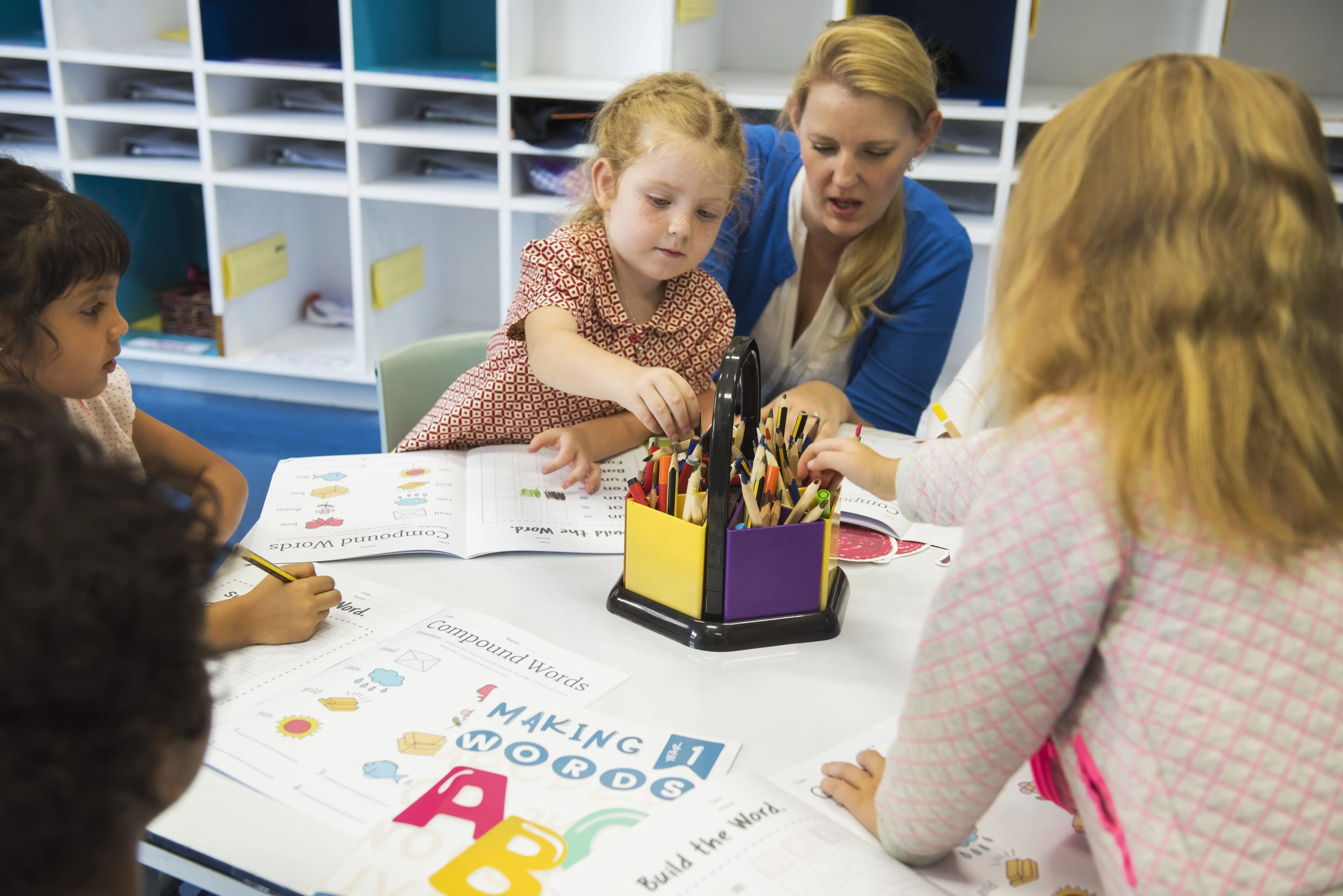
Children think with their bodies. You have surely heard the expression that a child’s brain develops best when the body is active. This also works when learning any new topic. Ordinary letter tracing with a pencil causes boredom, and that is not surprising. Think back to your own childhood – was it really interesting? Instead, you can invite children to write letters with their fingers on a tray with semolina, shaving foam, or kinetic sand. Make letters out of modeling clay or salt dough.
Go on a letter hunt
Turn an ordinary walk into a quest. If you are concerned about when do kids learn the alphabet in real life, the answer is simple: when they see letters everywhere. Look for the letter “O” on license plates, the letter “A” on supermarket signs. Turn it into an attention game.
Name parking
Write letters on sticky notes and place them on the floor like a parking lot. Take a toy car and give a command: “Urgent parking on the letter K!” This way, you satisfy the need for physical activity, and the letters will be remembered better.
And, of course, one important piece of advice: read, read, and read again. Reading aloud before bedtime is the foundation. Move your finger along the text while you read a favorite fairy tale. No matter how many techniques modern early development specialists invent, this approach remains the most effective and reliable. The child begins to understand that you are voicing these exact symbols, reading them from left to right.

Is my child behind? When to speak to a specialist
Love and care go hand in hand with anxiety. Almost all parents face this. We constantly ask ourselves: when should kids know ABCs? But there is an even more worrying question for everyone with preschool children: when is it time to sound the alarm?
The first thing to understand is this: other children are NOT a benchmark. You should never compare your child’s successes or difficulties with those of other children. The fact that a neighbor’s daughter is already reading encyclopedias at 4 is not an argument. Nor is the fact that your child recognizes only 5 letters at the age of four. The norm is a flexible concept influenced by hundreds of factors, from genetics to individual pace. However, there are several red flags that may be a reason to consult a specialist, such as a speech therapist, neuropsychologist, or pediatrician:
- no interest by the age of 5 – if the child has already turned five and is approaching five and a half, but still does not remember even the first letter of their own name, confuses basic shapes, and shows no interest in reading books together;
- speech difficulties – learning the alphabet is directly connected with the development of the speech apparatus, and if the child has a pronounced expressive speech delay or does not distinguish similar sounds by ear, this is a reason to contact a speech therapist;
- vision or hearing problems – sometimes poor memory for letters is not related to brain function, but to a simple lack of visual acuity or frequent ear infections that reduce hearing.
There is also no need to panic because of spelling. If your six-year-old writes letters in mirror image, for example, confuses “b” and “d” or writes “Я” backwards, it is too early to talk about dyslexia. In fact, this is a normal stage in the maturation of the visual cortex, and it usually resolves on its own by the age of 7–8.
Build real skills through fun, educational games for your child
Try KeikiHelp your child learn their letters with Keiki
Even when the age to know alphabet has arrived, this does not mean the learning process will be easy for parents. Teaching such a complex and abstract topic to a small child who has never encountered it before is hard work. If the child does not attend kindergarten or school preparation classes, where teachers can partly take on this role, everything falls on the parents. And not every day brings enough energy or time to make letters from dough or draw a parking lot on the floor.
But apps can be used wisely, and with the right approach, they can help and even speed up the process of learning new letters and sounds. If you are looking for a safe, smart, and educational environment for your child, pay attention to Keiki. This app is developed based on early childhood development methods and becomes your supportive tool in preschool learning. It includes many games for learning the alphabet, and the child absorbs information almost without noticing it, through play and with pleasure. The content is diverse and constantly updated:
- ABC puzzles, where the child not only assembles a picture, but also selects the right letters by matching the sound with the letter;
- various colorful adventure quests, where children need to collect and match letters to form words;
- piñata – a very fun activity for a toddler, where the child hits a piñata and collects words and articles instead of fallen sweets to build simple sentences from them;
- letter flashcards – flashcards have always been considered the simplest and most universal way to learn new letters and words, and now this can also be done in an interactive format;
- letter coloring pages – in Keiki, letters can even be colored, and connecting with them through calm creativity works well for memorization.
Even 15 minutes a day together with Keiki can diversify your leisure time and help your child build a foundation for further learning or reinforce material already covered.
Conclusion
So, when do kids learn ABCs? As is now clear from our material, strict timelines are less important than giving a child the opportunity to move at their own unique pace. Some children memorize the alphabet at three thanks to songs, while others need time until the preschool preparation group to connect sounds into meaningful words.
Your main task as a parent is not to stand over the child with a stopwatch, but to create a warm environment rich in texts and games around them. Read funny fairy tales together, make letters, draw them on a foggy bathroom mirror, and use high-quality educational apps.