Speech Therapy Exercises for Kids: What to Practice and When

A speech therapy exercise is a short drill that works on one specific skill, the kind of thing a speech-language pathologist sends home for you to practice between sessions. A speech game is looser. Your kid is just trying to win, and the skill-building happens without them noticing. Below is how exercises break down by what they build and by age, so you can jump to what your child needs right now instead of reading the whole thing.

Key Takeaways
- A speech therapy exercise targets one skill on purpose, unlike a speech game, where the skill grows as a side effect of play.
- Toddlers start with oral-motor and sound-imitation work, then preschoolers add articulation, language, and fluency practice.
- Speech sound disorders are common in young kids. If your child needs this kind of practice, you're far from alone.
- Five minutes a day, most days, gets your child further than an hour once a week.
What Counts as a Speech Therapy Exercise (and What Doesn't)
A speech therapy exercise targets one specific skill and repeats it on purpose. Usually it mirrors what a speech-language pathologist would assign: one sound, one sentence pattern, one listening skill, worked until it clicks.
It's more common than you'd guess, too. The National Institute on Deafness and Other Communication Disorders (NIDCD) puts 8 to 9% of young children in the speech sound disorder range, about 1 in 11 or 12 kids. A common problem gets a repeatable fix.
Most speech therapy exercises fall into four buckets:
- Oral-motor — building the strength and control behind speech, through blowing, sucking, and tongue movements.
- Articulation — practicing one speech sound at a time until it comes out clean.
- Language — growing vocabulary, sentence length, and the ability to tell a clear story.
- Fluency — smoothing out speech for kids who stutter.
Can an App Help With Daily Speech Therapy Practice?
Yes. Keiki World's speech games hit a lot of the same targets as these exercises, sound repetition, vocabulary, listening, except it's a few minutes of play rather than a sit-down drill. The games are sorted by age, and your kid can move through them at their own speed, so a three-year-old working on early sounds isn't doing the same thing as a five-year-old polishing trickier ones.
Use it on the days a real drill with a speech-language pathologist isn't happening. It fills the gap between sessions without you having to invent your own practice from scratch every day.
Speech Therapy Exercises for Toddlers (1-3 Years)
Your toddler needs two things before words come easily: mouth muscles strong enough to make the sounds, and practice copying sounds on purpose. Keep sessions short and tied to something they already like doing, because attention spans are tiny at this age and whole words might not even be showing up yet.
- Bubble blowing. Blow bubbles and let your toddler blow them back. This builds the breath control behind clear speech sounds.
- Straw drinking. Have them sip a thick drink, like a smoothie, through a straw. It works the same lip and cheek muscles used for sounds like "p" and "b."
- Mirror sound play. Sit in front of a mirror and make a simple sound like "ba" or "ma," then pause and wait for them to copy it. Watching their own mouth move helps them connect the sound to how it's made.
- Animal sound swap. Make an animal sound and wait for your toddler to guess or repeat it, then switch roles. This builds sound imitation and listening at the same time.
- Expectant pause. Start a familiar routine, like rolling a ball back and forth, and pause right before the fun part. A few seconds of waiting gives them a reason to try making a sound or gesture before you continue.
Five minutes, tops, at this age. If your toddler's losing interest, stop while it's still fun rather than pushing for one more round.
Speech Therapy Exercises for Preschoolers and Up (4-6+)
Preschoolers can follow more structured instructions than toddlers, which opens up three directions: one sound at a time, longer sentences, and fluency work.
Articulation Exercises for Clearer Sounds
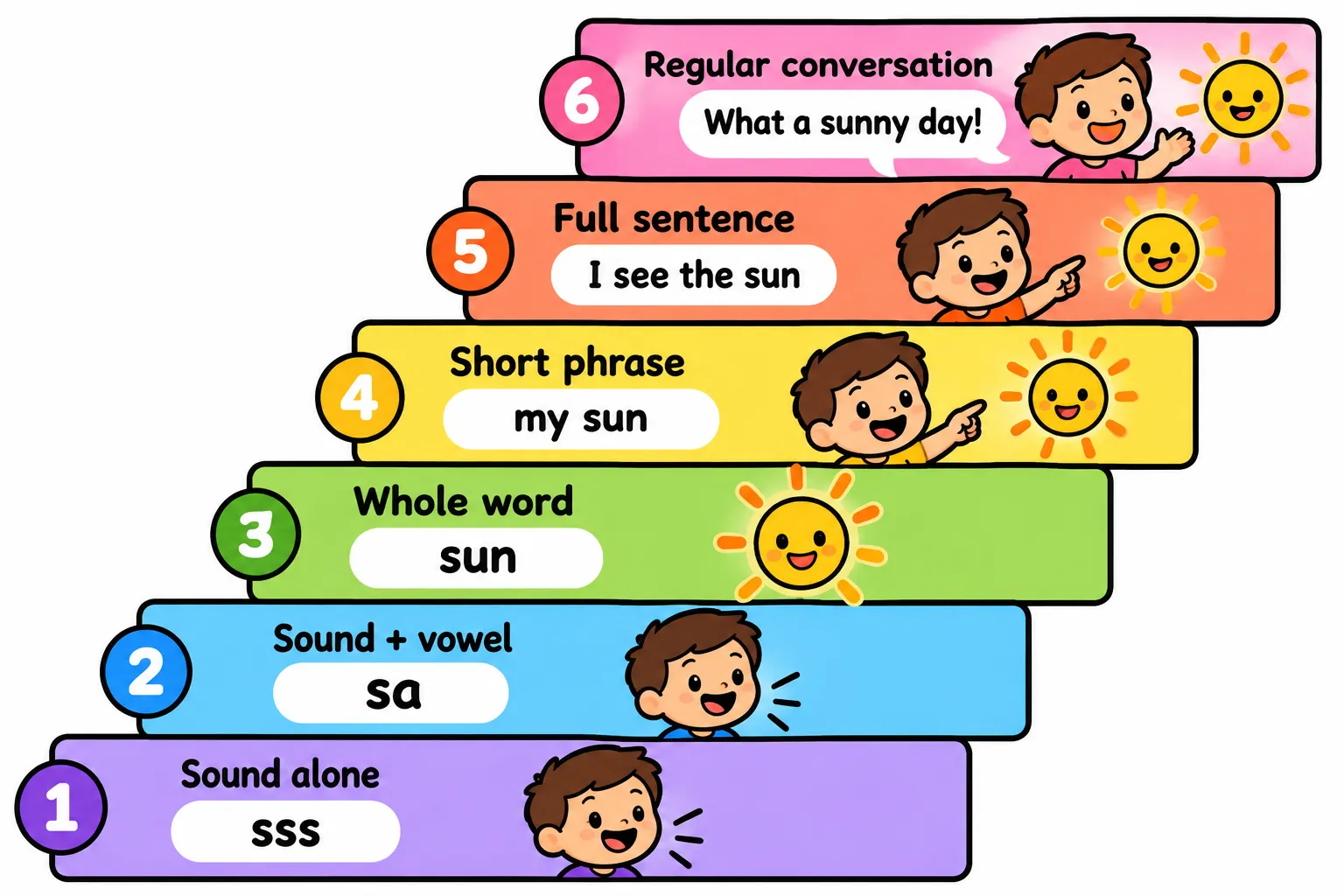
Articulation exercises work on one sound at a time, moving through a set order: alone, then in a syllable, then in a whole word, then in a sentence. Most speech-language pathologists stick to this progression, since it gives your kid's mouth time to build the right motor pattern before other sounds start crowding in around it.
Take the "s" sound as an example: "sss" alone, then "sa," then the whole word "sun," then "my sun," then "I see the sun," and finally dropping it into regular conversation. Each step only moves forward once the one before it is solid.
How you check progress depends on the sound:
- Airflow sounds ("s," "f," "v," "z"). Hold a tissue near your child's mouth. It should flutter when they get it right.
- Stop sounds ("p," "b," "t," "d"). Listen for a short, clean burst of air. A mushy or breathy sound means the lips or tongue aren't fully closing.
- Nasal sounds ("m," "n," "ng" in "ring"). Have your child rest a hand under their nose. They should feel a slight vibration.
Once a sound holds up in single words, try tongue twisters next, they force that same sound to repeat fast inside a sentence. Not sure if a sound is actually overdue yet? Keiki World's speech sound development chart has the typical age range for every consonant.
Language Exercises to Build Vocabulary and Sentences
Language exercises go after the words and sentence structure around speech, not the sounds themselves. They're a separate skill from articulation, so your kid could easily be ahead on one and behind on the other.
- Describe, don't name. Instead of naming an object, describe it and have your child guess what it is, then swap roles. This pushes them past one-word answers into fuller sentences.
- Sentence expansion. When your child says something short like "want juice," hand it back one word longer: "You want more juice." Hearing the longer version repeated helps it stick.
- Story retell. After reading a short book together, ask your child to tell you what happened in their own words. This builds sequencing and the ability to organize thoughts out loud.
- Category naming. Pick a category, like animals or food, and take turns naming things in it until someone repeats one or runs out.
This connects to reading, too. Sounding out a word doesn't help much if your kid doesn't already know the word.
Our guide to when kids learn to read covers how that timeline usually lines up with speech development.
Fluency Exercises for Smoother Speech
Stuttering comes and goes naturally between ages 2 and 5. What looks like a problem one week can ease up on its own the next, which is why fluency is the one area where you really want a speech-language pathologist's input before doing much on your own. A few gentle things are safe to try at home in the meantime.
- Slow, easy speech modeling. Talk to your child a bit slower and more relaxed than usual, without pointing out the stutter directly. Kids tend to pick up the pace of speech around them.
- Unhurried turn-taking. Give your child your full attention when they talk, and don't finish their sentences or rush them to get the word out.
- Respond to the message, not the delivery. Skip corrections like "say that again, slower." Respond to what your child said instead of how they said it.
Six months or longer of stuttering calls for a real evaluation. So does a family history of stuttering, or visible tension in the face or body while a child talks.
Build real skills through fun, educational games for your child
Try KeikiWhen These Exercises Aren't Enough
A few signs mean it's time to see a speech-language pathologist, however consistent you've been with practice at home.
- No progress on a specific sound or skill after several weeks of steady practice.
- A toddler using very few words or gestures by age 2.
- Speech that's still hard for family members to understand by age 3.
- Stuttering that's lasted more than six months, especially with visible tension or a family history of stuttering.
- Frustration or avoidance around talking that's getting worse instead of better.
A pediatrician can refer you if any of this sounds familiar. Under 3? You can also go straight to your state's early intervention program without a referral.