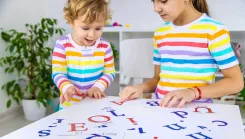
Tongue Twisters for Kids: 50 Fun Ones to Try

These children's tongue twisters work for classroom warm-ups, long drives, waiting rooms, or just a few minutes of silliness before bed. Scroll to the difficulty level that fits your kid, or read straight through and let them pick their own favorites.

Why Tongue Twisters Are Good for Kids
Tongue twisters are good for kids because they force slow, deliberate mouth movements your child wouldn't otherwise practice. A sentence like "she sells seashells" asks the tongue to switch between an "s" and "sh" sound over and over, fast. That's real articulation practice disguised as a game nobody wants to stop playing.
Tongue twisters also build confidence in a low-stakes way. Nobody expects a 4-year-old to get "Peter Piper" right on the first try, so stumbling over it is part of the fun instead of something to feel bad about. Your kid gets to fail, laugh, and try again, which is exactly the kind of repetition that helps a tricky sound click into place.
Curious which sounds your child should have down by a given age? The speech sound development chart lays out the typical order kids learn each one. Tongue twisters are a fun way to get extra reps on whichever sound your child's still working on, without it feeling like a drill.
There's a bonding piece too. A tongue twister works just as well on an adult tongue. When you trip over "unique New York" right alongside your kid, it stops being a lesson and turns into something you're both laughing at together. That shared stumble does more for a kid's willingness to keep trying than any amount of gentle correction.
Help your child
grow with Keiki
We’ll help you turn everyday screen time
into real learning progress.
Easy Tongue Twisters for Preschoolers (Ages 2–4)
Easy tongue twisters for preschoolers need to be short, mostly single-syllable, and fun to say even slowly. None of these require speed. Saying them clearly once is a win at this age.
- She sells seashells.
- Red lorry, yellow lorry.
- Six slick slimy snails.
- A big black bug bit a big black bear.
- Fuzzy Wuzzy was a bear.
- Toy boat, toy boat.
- Peggy Babcock.
- I scream, you scream, we all scream for ice cream.
- Pad kid poured curd pulled cod.
- Unique New York.
- Truly rural.
- Black bug's blood.
- Freshly fried fish.
- Cheap ship trip.
- Soldiers' shoulders.
Funny Tongue Twisters for Kids
Funny tongue twisters for kids earn their laughs from the mental image as much as the sound. These work well for ages 4 and up, once a kid can hold a slightly longer sentence in their head.
- How much wood would a woodchuck chuck if a woodchuck could chuck wood?
- A fly and flea flew up in a flue.
- A skunk sat on a stump and thunk the stump stunk.
- Betty Botter bought some butter, but she said the butter's bitter.
- Fred fed Ted bread, and Ted fed Fred bread.
- A proper copper coffee pot.
- The great Greek grape growers grow great Greek grapes.
- Nine nimble noblemen nibbled nuts.
- A tutor who tooted the flute tried to tutor two tooters to toot.
- Greek grapes, Greek grapes, Greek grapes.
- I saw a kitten eating chicken in the kitchen.
- How can a clam cram in a clean cream can?
- Six sticky skeletons.
- Lesser leather never weathered wetter weather better.
- If a dog chews shoes, whose shoes does he choose?

Tricky Tongue Twisters for Big Kids
These are the real challenge round, built for kids ages 7 and up who've already worn out the easy list. Some of them trip up adults too, which is half the fun of saying them as a family.
- Peter Piper picked a peck of pickled peppers.
- How much wood would a woodchuck chuck if a woodchuck would chuck wood as much wood as a woodchuck would if a woodchuck could chuck wood?
- Irish wristwatch, Swiss wristwatch.
- The sixth sick sheikh's sixth sheep's sick.
- Which wristwatches are Swiss wristwatches?
- Can you can a can as a canner can can a can?
- Thin sticks, thick bricks.
- A loyal royal jelly.
- Rory's lorry is low on oil.
- Six Czech crickets kicked six Czech bricks.
- Eleven benevolent elephants.
- She stood on the balcony inexplicably mimicking him hiccupping.
- Imagine an imaginary menagerie manager.
- Give papa a cup of proper coffee in a copper coffee cup.
- A dozen double damask dinner napkins.
- Three free throws.
- Denise sees the fleece, Denise sees the fleas.
- Flash message.
- Strange strategic statistics.
- The epitome of femininity.
Keep the Speech Practice Going With Keiki World
Tongue twisters are a great five-minute activity, but they're not something most families remember to do every day. That's where Keiki World's speech games come in. They turn the same kind of sound practice into a short daily habit instead of something you only remember to do on a car ride.
The games build on naming pictures, repeating words out loud, and matching sounds. Keiki World sorts them by age, so a 3-year-old working on early sounds gets different activities than a 6-year-old refining trickier ones. It's a few minutes a day, which fits a lot more easily into a real schedule than remembering to pull up a tongue twister list.
If your child loved the twisters on this page, that's usually a good sign they'll enjoy this kind of playful sound practice too. It's the same idea, just built to keep going past one car ride.
Build real skills through fun, educational games for your child
Try KeikiTips for Practicing Tongue Twisters Together
Start slow. A tongue twister said correctly at half speed is more useful than one mumbled fast, especially for a kid still working on a specific sound. Speed can come later, once the words are landing clearly.
Break it into chunks for anything longer than one short sentence. "Peter Piper picked" on its own, then add "a peck of pickled peppers" once the first part feels easy. Building it piece by piece beats throwing the whole sentence at a kid who's going to get stuck halfway through anyway.
Turn tongue twisters into a family round. Everyone takes a turn, and whoever gets through it clean gets to pick the next one. Word games pair well with this kind of practice too.
Don't correct every stumble. If your kid is giggling and trying again on their own, that's the whole point working. Save direct correction for a sound they're genuinely struggling with, not every small slip.
Match the setting to the twister. A short one like "toy boat, toy boat" fits a two-minute wait at a checkout line. Something from the tricky list is better saved for a long car ride or a rainy afternoon with nowhere to be. Pulling out the right length for the moment keeps it fun instead of rushed.