Working Memory Games for Kids That Actually Build the Skill

Your kid forgets the third step of a three-step instruction before they've even finished the first one. You've said "shoes, jacket, backpack" a hundred times. It's always the backpack that gets left behind. Nine times out of ten, that's not a listening problem. It's weak working memory, and you can build it with the right games. If you've been searching for how to improve working memory in child development, start here.

Key Takeaways
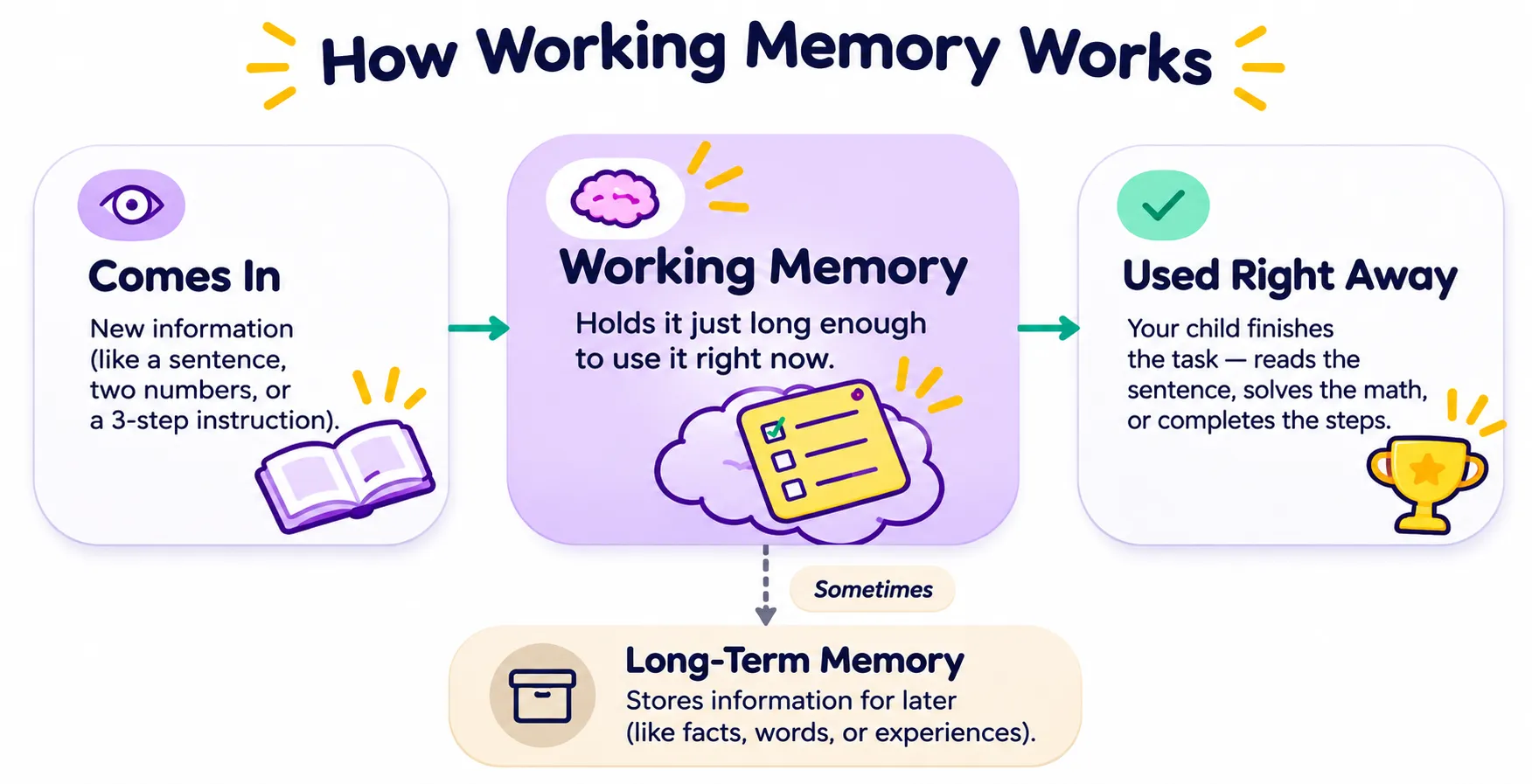
- Working memory holds information long enough to use it. It doesn't store it forever.
- Short daily practice beats one long session a week, every time.
- Bump the difficulty as soon as a game stops being a stretch.
- Mix verbal and visual games so you're covering both sides of the skill.
What Working Memory Actually Does for a Kid
Working memory is basically a mental sticky note. Your child uses it to hold onto information right when they need it, not to file it away for later. That's long-term memory's job. Working memory holds a sentence in mind while your kid finishes reading it. It holds two numbers while they add them up. It holds your three-step instruction until step three actually gets done.
A kid with weak working memory can look distracted even when they're genuinely trying hard. They lose their place mid math problem. They drop the thread of a story halfway through. You repeat yourself, and it's not because they weren't listening. The information just slipped before they got the chance to use it.
A Durham University survey of more than 3,000 schoolchildren found that 10% had working memory weak enough to seriously get in the way of learning. Teachers rarely caught it. Most of those kids just got labeled inattentive. The part worth knowing: working memory responds to practice, and practice can look exactly like play. A few minutes of games a day builds this skill the same way a bit of daily practice in a kindergarten math game builds number sense.
Games help most kids here. But if your child is forgetting instructions constantly, falling noticeably behind in class, or struggling a lot more than other kids their age, tell your pediatrician or a school psychologist. These games are a good daily habit. They're not a substitute for an actual evaluation if something bigger is going on.
Keep the Practice Going Every Day
You don't have to plan a new game every single day. Keiki World's memory games handle that part for you.
Your kid can play these solo for a few minutes while you're cooking dinner or driving somewhere. There are matching-pairs tasks, sequence-recall challenges, and "spot the change" games where a picture shifts slightly and your child has to catch what's different. The games also get harder as your kid improves, so a level that gets too easy doesn't stay too easy for long.
It's an easy way to keep working memory practice going on the days you don't have ten free minutes to sit down and play something together.

Help your child
grow with Keiki
We’ll help you turn everyday screen time
into real learning progress.
Card and Tabletop Working Memory Games
A regular deck of cards is one of the best working memory tools you already own, and you probably didn't know it. Your child has to hold their own hand in mind, track what's been played, and keep the rules straight, all at once.
- Go Fish. Ages 4 and up. Your kid has to remember both which cards they're hunting for and which ones they've already asked about. Start a 4-year-old with 3 or 4 pairs in the deck, then work up to a full suit by age 6.
- Crazy Eights. Ages 5 and up, and a real step up from Go Fish. Now they're tracking the current suit, their own hand, and whose turn it is. Deal 5 cards to start. Once they're winning without much effort, bump it to 7.
- Old Maid. Ages 4 and up, with simple rules but the same memory demands: which pairs are already matched, and which card to dodge. A 15 to 20 card deck is plenty at age 4. Add more once their hand gets easier for them to manage.
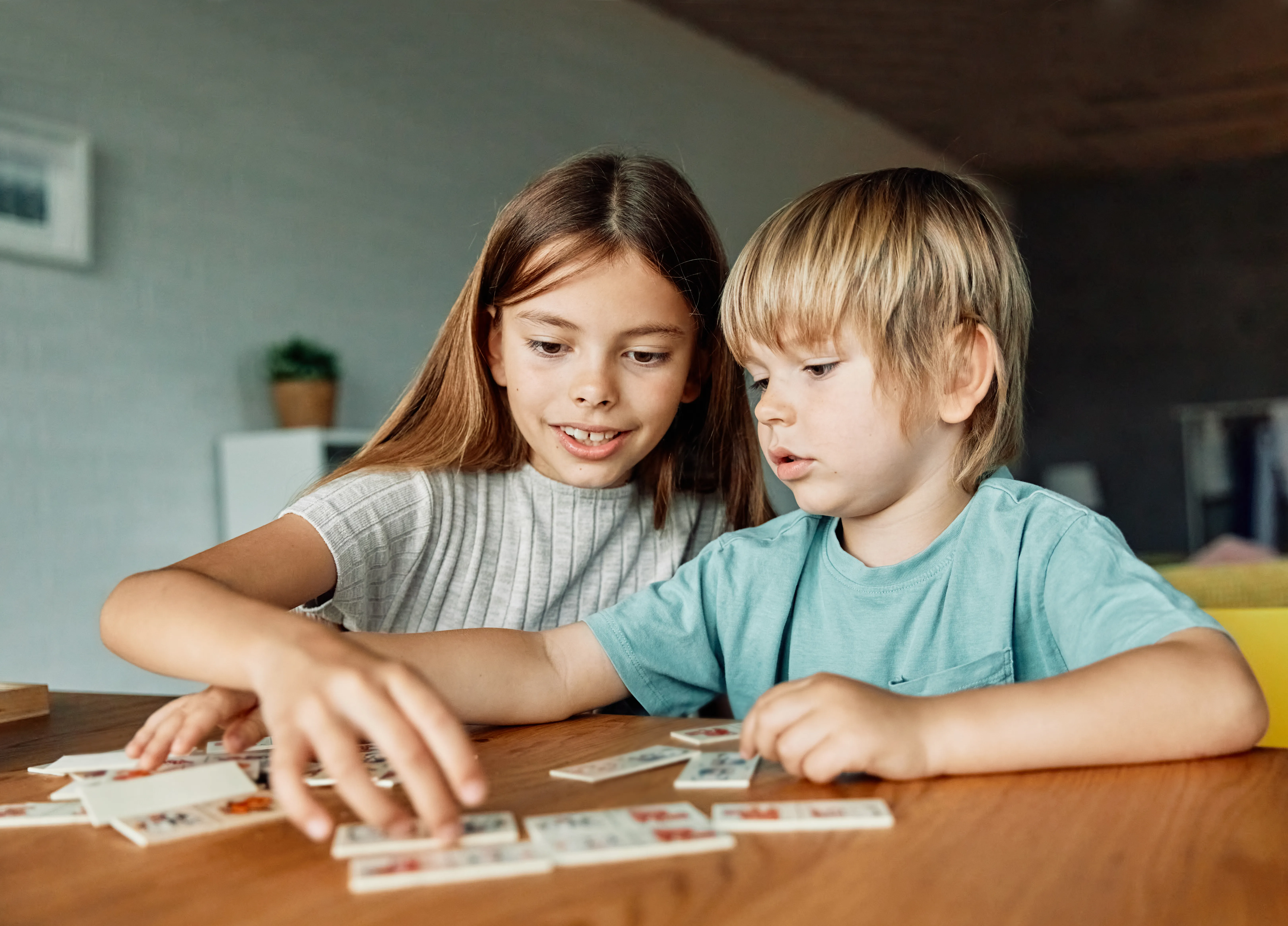
- Concentration (Memory Match). Ages 4 and up. Lay cards face-down and flip two at a time looking for a match, which is pure visual working memory: remembering what's where. Start with 8 cards (4 pairs) at age 4. Once they're matching most pairs on the first try, go up to 12, then a full deck by age 6 or 7.
- Scrabble or any letter-tile game. Ages 6 and up, once reading is underway. Kids have to hold a string of letters in mind while scanning the board for where a word fits. Start with short, simple words and a smaller tile set. Add more tiles and longer words as their vocabulary grows.
If a game's too easy, add a rule. No talking during the round. Or everyone has to say the card out loud before playing it. Small change, but it makes them hold a lot more in mind at once.
Quick No-Prep Games You Can Play Anywhere
These working memory exercises take a couple of minutes and nothing else. Good for a waiting room, a long car ride, or the five minutes before dinner's ready.
- Kim's Game. Set a few small objects on a tray, say 3 for a 3-year-old or 5 for a 5-year-old. Let them look for thirty seconds, cover the tray, and ask them to list what they saw. Sneak one object away while they're not looking and ask what's missing. Once they're nailing it most rounds, add another object.
- Simon-style sequences. Clap, clap, stomp, and have your kid copy it back. Two steps is plenty at age 3; by age 5 they can usually handle 3 or 4. Add a step each round until they slip, then drop back by one.
- Grocery list game. "I'm buying apples." Next person repeats it and tacks on an item: "I'm buying apples and milk." Keep going around until someone forgets the growing list.
- Category recall. Rattle off four or five animals, colors, or foods. Have your child repeat them back in order, then backward if they're up for the challenge.
- Simon Says. Ages 3 and up. Give instructions, but your child only follows the ones that start with "Simon says." They have to hold the rule in mind while listening for the trick. Start with slow, obvious commands. Speed up and mix in near-misses once they're catching every one.
- Red Light, Green Light. Ages 3 and up. "Green light" means go, "red light" means freeze, and your kid has to keep both rules in mind while they're moving. Call it slowly at first. Once they're reacting fast, add a third signal like "yellow light" for slow motion.
- I Spy. Ages 3 and up. "I spy something blue" means your child has to hold that one clue in mind while scanning everything around them. Stick to one obvious clue at a time for a 3-year-old. Stack two clues together, like "something blue and round," once they're guessing fast.
- Freeze Dance. Ages 2 and up. Music plays, everyone dances, and the one rule to remember is: freeze the second it stops. Start with long stretches of music and obvious stops. Shorten the stretches and throw in fake-out pauses as they get better at catching the real one.
None of these need setup, and you can dial any of them up or down on the spot. Too easy? Add an item or a step. Too hard? Pull one back.
How to Make These Games Actually Work
Two things decide whether memory training exercises like these actually do anything: how often you play, and whether you keep nudging the difficulty up. Here's how to get both right.
- Play short, play often. Five to ten minutes, most days of the week, beats a half-hour session once a week by a lot. Working memory grows from showing up again and again, not from one long sitting. A quick round of Kim's Game before bed does more than a big push on the weekend.
- Bump the difficulty the moment a game stops feeling like a stretch. Five items every time, no problem? Make it six. Three-step instructions a breeze now? Go to four. Games to build working memory only do their job when they sit right at the edge of what your child can currently manage, not comfortably under it.
- Expect slow, steady progress. Most kids can take on one more item or one more step every couple of weeks of regular play. That's what real progress looks like here, nothing dramatic. If your child's been stuck on the same level for over a month despite daily practice, bring it up at their next checkup instead of pushing through on your own.
- Watch for frustration and pull back before it turns into a meltdown. A game that's too hard too often just teaches a kid to give up. Back off for a round or two, then try pushing forward again once they're having fun.
- Mix verbal games with visual ones. Sequences and lists on one side, Kim's Game and matching cards on the other. Working memory runs on separate verbal and visual channels, so practicing both actually tells you where your kid needs more help.
A child who handles spoken instructions fine but struggles with visual sequences might also do well with letter activities, which lean on that same step-by-step tracking.
Help your child thrive with playful learning
Turn screen time into real growth with Keiki's educational games.
Try Keiki