ADHD Activities for Kids: What to Do When Your Child Can’t Settle

Your kid builds a block tower for ninety seconds. Then it's the couch, then the dog, then your phone. Sound familiar? You've got company. About 12.0% of U.S. kids ages 3 to 17 have been diagnosed with ADHD at some point, according to the CDC's 2024 figures.
Table of contents
- Key Takeaways
- What Makes an Activity Work for ADHD
- Quick Picks by Situation
- Keiki World for Kids With ADHD
- Activities for ADHD Preschoolers
- Movement Activities to Burn Energy
- Indoor Activities for an ADHD Child
- Games for Focus and Self-Control
- Calming Activities After Active Play
- How to Run Activities So They Stick
- A Sample Afternoon at Home
- When to Talk to Your Pediatrician
Below are 25 activities for kids with ADHD, grouped by what's going on right now: too much energy, stuck inside, or time to calm down. They're made for ages 3 to 6, and you probably have everything already. No diagnosis needed to try them.
Key Takeaways
- Keep rounds short: two to five minutes.
- Move first, then do the quiet stuff.
- Give every activity a clear end, like "five stickers and we're done."
- Have two or three backups ready for when interest drops.
What Makes an Activity Work for a Child With ADHD
The activities that work best are short, get the body moving, and have an obvious finish line. Here's a quick checklist.
- Short rounds. Two to five minutes beats twenty. You can always go again.
- Built-in movement. Jumping, carrying, crawling, throwing. A restless body needs a job.
- A clear start and finish. "Find five stickers, then we're done" is easier to follow than "go play for a bit."
- Fast feedback. A point, a high five, a found object. Your kid knows right away they nailed it.
- Easy swaps. If you have a backup ready, switching doesn't feel like failing.
A lot of these activities use a sand timer. No sand timer? A kitchen timer or the one on your phone works just as well.
Quick note: none of this replaces professional support. It's just stuff that makes an afternoon at home a bit easier.
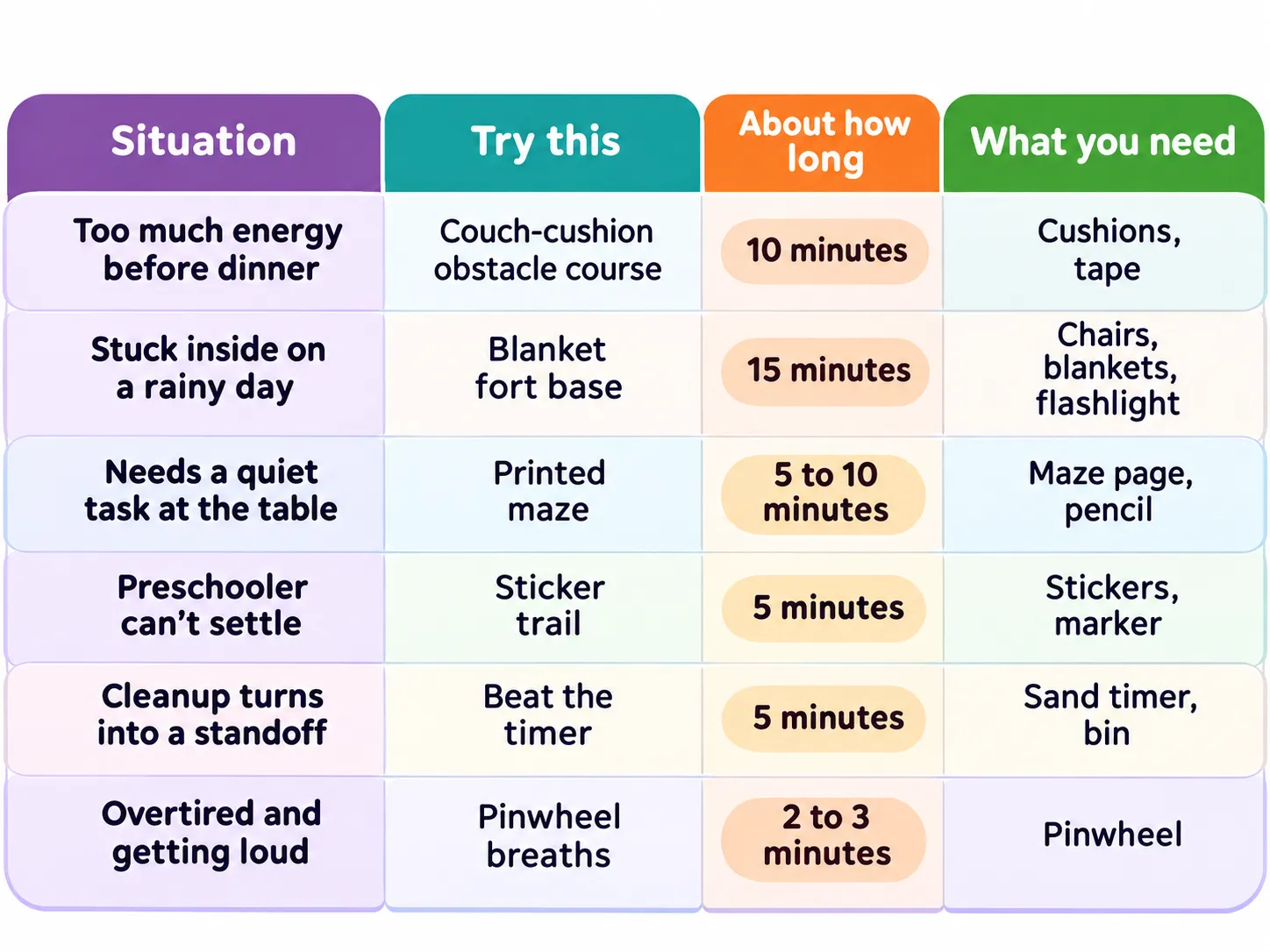
Quick Picks by Situation
Find your situation, grab an activity. Times are rough.
Keiki World for Kids With ADHD
Keiki World has a few quiet, one-goal options that fit nicely after a movement activity.
Mazes are a good one. One goal, one path, so a restless kid knows exactly when they're done. You can print Keiki World's maze coloring pages from the website and keep a few in a folder for afternoons when little hands need something to do.
When screen time makes sense, the Keiki World app has ADHD Smart Play, a set of games built with ADHD in mind that use several senses at once. There's also ADHD Font Mode, which changes how text looks so it's easier on the eyes. For quiet puzzle practice, check out the puzzle games.
Parents can also take a 7-minute "Could Your Kid Have ADHD?" quiz in the app. You'll get tips and a better sense of your child's attention and focus. It's not a diagnosis, though.

Help your child
grow with Keiki
We’ll help you turn everyday screen time
into real learning progress.
Activities for ADHD Preschoolers (Ages 3 to 5)
For ages 3 to 5, keep it to two to five minutes and get the whole body involved. They're going to wiggle anyway, so give the wiggle a job.
1. Animal Walks
You need: A clear hallway or a stretch of open floor.
- Pick an animal together. Crab: sit down, put your hands behind you, lift your bottom, and walk on hands and feet with your belly up. Frog: squat low with hands on the floor, then jump forward. Bear: hands and feet on the floor, bottom in the air, and walk. Snake: lie on your tummy and pull yourself forward with your arms.
- Show the move once yourself so your kid can copy it.
- Your kid moves like that animal down the hall to the door, then back to you.
Done when: They're back where they started. That's one round. If they want more, pick a new animal, up to three rounds.
Tip: This works great right before dinner or story time.
2. Statue Freeze Dance
You need: Music on your phone or a speaker.
- Explain the rule before you start: "When the music stops, you freeze like a statue. No moving, no talking."
- Play a song and dance together.
- After 10 to 20 seconds, pause the music and yell "Statue!"
- Count to five out loud while they hold the pose, then start the music again.
- If they wiggle, nobody's out. Laugh it off and keep going.
Done when: The song ends.
Why it helps: Stopping on cue is way easier to practice here than in the middle of a meltdown.
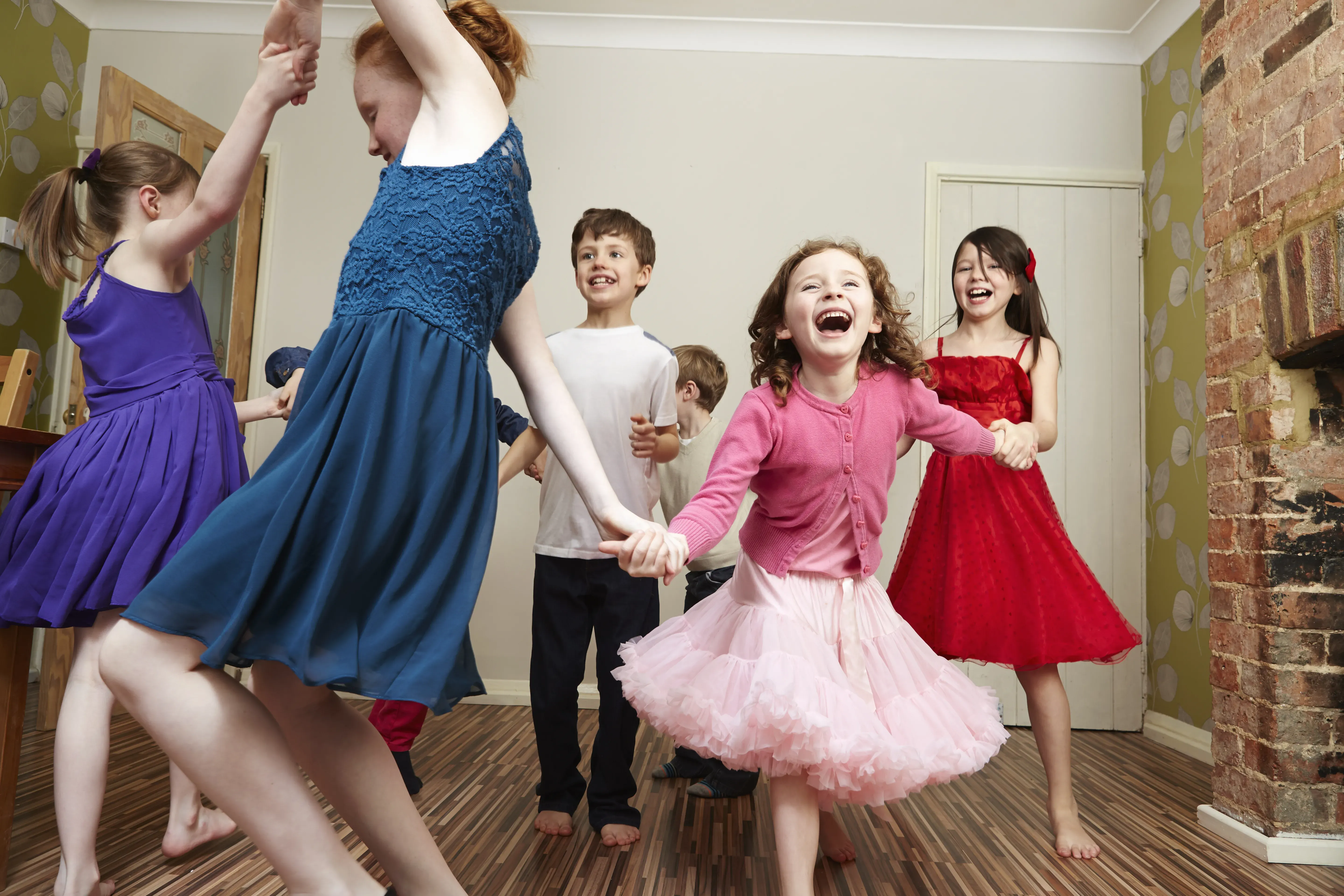
3. Sticker Trail
You need: Five stickers, a marker, and a sheet of paper.
- Write the numbers 1 to 5 on the stickers. If your kid doesn't know numbers yet, draw dots instead: one dot, two dots, and so on.
- Stick them around the room at your kid's eye level, on furniture, a door, or the side of a shelf. Keep them easy to spot the first time.
- Tell your kid to find sticker 1 first, then 2, then 3, in order.
- Each time they find one, they peel it off and stick it on the paper.
Done when: Sticker 5 is on the paper.
Make it harder: Hide the stickers in trickier spots, or use ten.
4. Scoop and Pour Tray
You need: A baking tray with sides, about two cups of dry rice or beans, two or three cups, a couple of spoons, and a towel.
- Put the towel down, then the tray on top, on the floor or a table.
- Pour the rice or beans into the tray.
- Show your kid how to scoop into a cup and pour from one cup to another.
- Give them small challenges: fill a cup to the very top, or pour without spilling.
- Set a timer for five to ten minutes.
Done when: The timer goes off. Your kid pours everything back into the tray, and you put it away.
Safety: Rice and beans are a choking hazard, and some end up in noses and ears. Stay right next to your kid the whole time, and skip this one if they still put things in their mouth.
5. Two-Step Missions
You need: Everyday things around the house.
- Get your kid's attention first. Get down to their level and make eye contact.
- Give a two-step mission once, clearly: "Grab the red cup, then bring it to me."
- Ask them to say it back to you before they go.
- Cheer when they finish both steps.
- Once they get three two-step missions right in a row, try three steps: "Get your shoes, put them by the door, then give me a high five."
Done when: They've finished five missions.
If they forget a step: Don't repeat the whole thing. Ask, "What was the first part?" and let them work it out.
6. Slow Bubble Blowing
You need: A bubble wand and bubble solution.
- Your kid dips the wand and holds it near their mouth.
- They breathe in slowly through the nose.
- They blow out as slowly as they can, like cooling hot soup.
- Point out what happens: fast blowing pops the bubble, slow blowing makes a big one.
Done when: They've done ten slow breaths.
Tip: Do it outside or in the bathroom. Bubble solution makes floors slippery.
Movement Activities to Burn Off Big Energy
Burn off the energy first, and the quiet stuff afterward goes a lot smoother. Try one before homework, dinner, or a car ride.
7. Couch-Cushion Obstacle Course
You need: Couch cushions, painter's tape, and a table or a couple of chairs.
- Set up three or four stations: a pile of cushions to climb over, a tape line on the floor to walk heel to toe, a table to crawl under, and a tape finish line.
- Walk through it once yourself so your kid sees the order.
- Your kid runs the course while you cheer and count the seconds.
- After each run, change one thing. Move the cushions, add a spin at the end, or make them crawl backward.
Done when: They've finished three runs.
Safety: Keep it on the floor. No climbing on stacked furniture, and move anything with sharp corners out of the way.
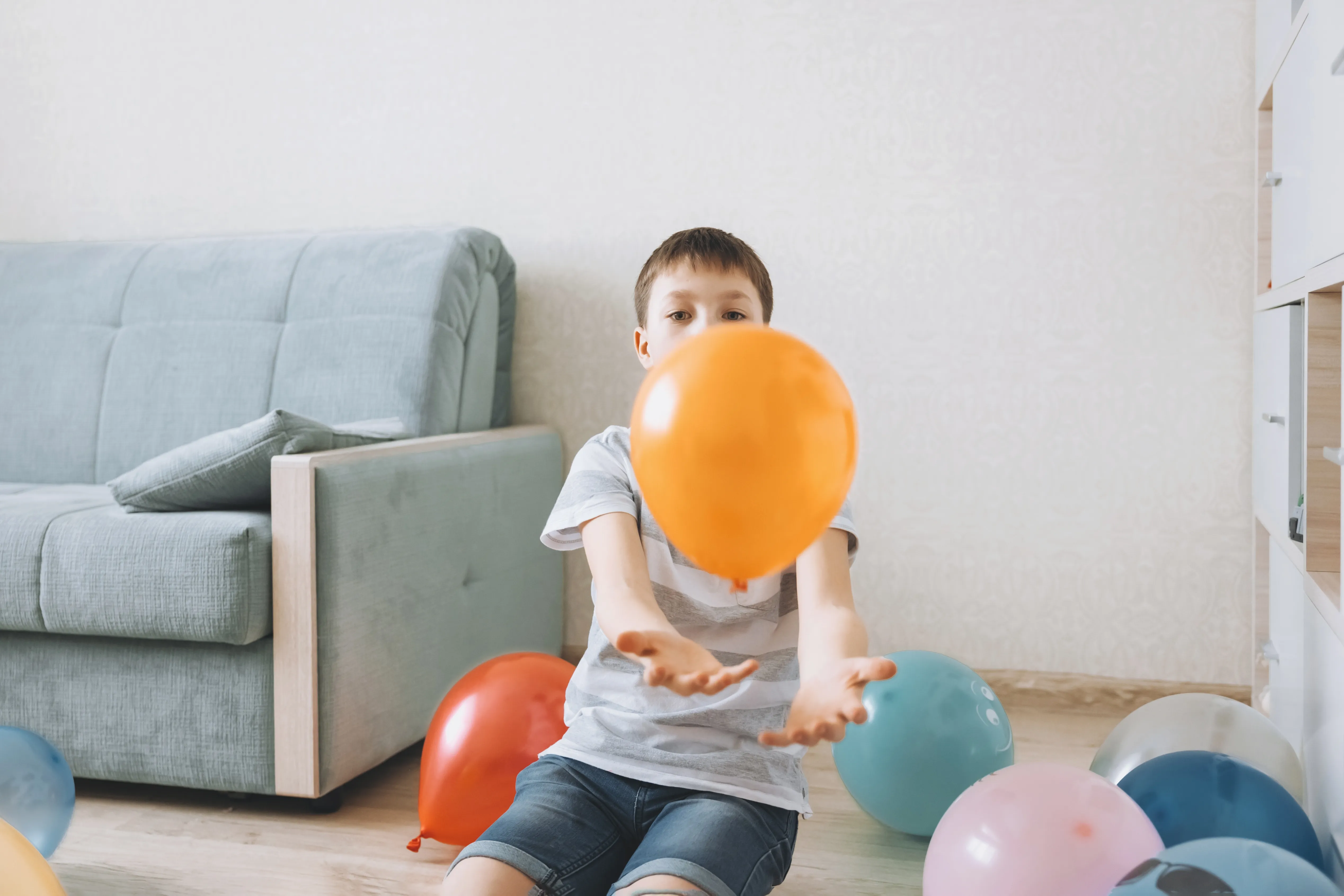
8. Balloon Keep-Up
You need: One balloon and a cleared space.
- Blow up the balloon and tie it.
- Your kid taps it into the air and tries to keep it from touching the floor.
- Count every hit out loud together.
- When it lands, remember the number and start again from zero. Try to beat the best score.
Done when: They've had three tries.
Safety: Popped balloon pieces are a choking hazard. Stay in the room, and if it pops, pick up every piece right away.
9. Heavy-Work Helping
You need: A laundry basket, a cardboard box with a few books inside, and a wall.
- Call it a job: "I need a strong helper."
- Pick one task. Carry a half-full laundry basket from one room to another. Push the box of books across the room. Or do wall push-ups: stand an arm's length from a wall, put your hands flat on it at shoulder height, bend your elbows to lean in, then push back.
- Count out loud as they go.
Done when: They've done five carries, three box pushes, or ten wall push-ups. Thank them for the help.
Tip: Keep the load light enough that they can do it without straining. It should feel like work, not a struggle.
10. Beanbag Toss
You need: Beanbags or rolled-up socks, a bucket, bowl, or laundry basket, and painter's tape.
- Put the bucket on the floor and mark a throwing line with tape about two of your kid's steps away.
- Your kid stands behind the line and throws one beanbag at a time.
- If it lands in the bucket, they take one big step back for the next throw. If it misses, they stay put and try again.
- Count the hits.
Done when: They've thrown five times. That's one round. Next round, try to beat the number of hits.
11. Hallway Races
You need: A hallway.
- Your kid stands at one end. Pick a move: frog jumps, giant steps, or tiptoes.
- They move to the door at the other end while you both count each move out loud.
- Remember the number.
- Next round, they try to get there in fewer moves. That means bigger jumps or longer steps.
Done when: They've done three rounds.
Bonus: All that counting sneaks in some math.
Indoor Activities for an ADHD Child (Rainy Days and Small Spaces)
Stuck inside? Pick something that fits in one corner and ends with a cleanup or a show-and-tell. Need more? Here are some rainy day games for kids.
12. Blanket Fort Base
You need: Two to four chairs, one or two big blankets or sheets, clothespins or a few heavy books, a pillow, a flashlight, and one book.
- Set the chairs a few feet apart in a rough square, with the backs facing each other.
- Drape the blanket over the chair backs. Clip the edges with clothespins or hold them down with heavy books.
- Your kid brings in the pillow, the flashlight, and the book.
- Crawl in together and read the book by flashlight.
Done when: The book is finished. Your kid pulls the blanket off and folds it (or tries to), and you put the chairs back.
13. Painter's Tape Roads
You need: Painter's tape and a few toy cars. It works best on hard floors, since tape doesn't stick well to carpet.
- Tape one of these on the floor: a road with a few turns, a hopscotch grid of eight squares, or a straight line about two meters (six feet) long.
- Road: your kid drives a toy car from start to finish without leaving the road.
- Hopscotch: they hop on one foot in single squares and land on two feet in side-by-side squares.
- Balance line: they walk heel to toe with arms out, without stepping off.
- Let them do it three times.
Done when: Your kid peels up all the tape and rolls it into a ball. The cleanup is the finish line.
14. Color Hunt
You need: A basket.
- Set the rules: one room only, and only things they're allowed to touch.
- Call out a color, like "Blue!"
- Your kid finds five blue things and drops them in the basket.
- Count them together and name each one.
- Your kid puts everything back where it came from.
Done when: Everything's back in place. Play up to three colors.
15. Cardboard Box Build
You need: A big cardboard box, tape, markers or crayons, and scissors for you. Paper plates make great wheels or buttons.
- Ask your kid: "Car, house, or robot?"
- Your kid shows you where doors, windows, or holes should go, and you do the cutting.
- Your kid decorates: drawing, coloring, and taping on paper plates.
- Set a timer for 15 minutes.
Done when: The timer goes off and your kid gives you a tour of what they built, or takes you for a "ride."
Safety: You handle the scissors or box cutter. Cardboard is tough and blades slip.
16. Sock-Ball Toss
You need: About ten pairs of socks, a laundry basket, and painter's tape.
- Roll each pair of socks into a ball. Your kid can help, and it's good practice for little fingers.
- Put the basket against a wall and tape three throwing spots on the floor: close, middle, and far.
- Your kid throws every sock ball from the close spot. Count how many go in.
- They pick up all the socks. That's the reset. Then they move to the middle spot, then the far one.
Done when: They've thrown from all three spots. Bonus round: the socks go back in the drawer.
Games for ADHD Kids That Build Focus and Self-Control
Good focus games have two or three rules, quick turns, and instant feedback. These five check every box.
17. Memory Flip
You need: Six matching pairs of cards. Picture memory cards work best for little kids. You can also pull pairs from a deck of playing cards or draw simple pictures on index cards.
- Mix up the cards and lay them face down in three rows of four.
- On your turn, flip over two cards and say what you see: "A dog... and a car. No match."
- If they match, keep them. If not, flip them back over in the same spots.
- Take turns until every card is gone.
Done when: All pairs are found. Count who has more.
Make it harder: Add two more pairs each time your kid finishes quickly.
18. Simon Says, With Your Kid as Simon
You need: Nothing.
- Explain the rule: if Simon says "Simon says touch your nose," you do it. If Simon just says "Touch your nose," you don't move.
- You be Simon first and give five commands so your kid gets the hang of it.
- Swap. Your kid gives five commands and you follow. Mess up on purpose sometimes. Kids love catching you.
- Keep swapping every five commands.
Done when: You've each been Simon twice.
Why it helps: As the follower, your kid practices not moving. As Simon, they practice keeping the rule in their head.

19. I Spy Colors
You need: Nothing.
- Pick something your kid can see from where they're sitting.
- Say, "I spy with my little eye something green."
- Your kid gets five guesses. After three wrong guesses, give a hint: "It's on the shelf."
- Once they find it or use up their guesses, switch. Now they spy and you guess.
Done when: You've each had three turns as the spy.
20. Block Pattern Copy
You need: Blocks in two or three colors. Building bricks, plastic cups, or crayons work too.
- Build a row of three blocks: red, blue, red.
- Your kid builds the same row right underneath yours.
- Ask, "What comes next?" They add the next block to keep the pattern going (blue, then red).
- When that's easy, try longer patterns like red, red, blue, or add a third color.
Done when: They've copied and continued five patterns.
If they get stuck: Point to each block and say the colors out loud together.
21. Beat the Timer
You need: A timer and a bin.
- Pick a number of toys: ten is a good start.
- Set the timer for two or three minutes, enough time that your kid can actually win.
- Say "Ready, set, go!" and start the timer.
- Your kid tosses toys in the bin while you count each one out loud.
- Made it? Celebrate. Didn't make it? Say "So close!" and restart the timer so they can finish.
Done when: Ten toys are in the bin. Play again until the floor is clear.
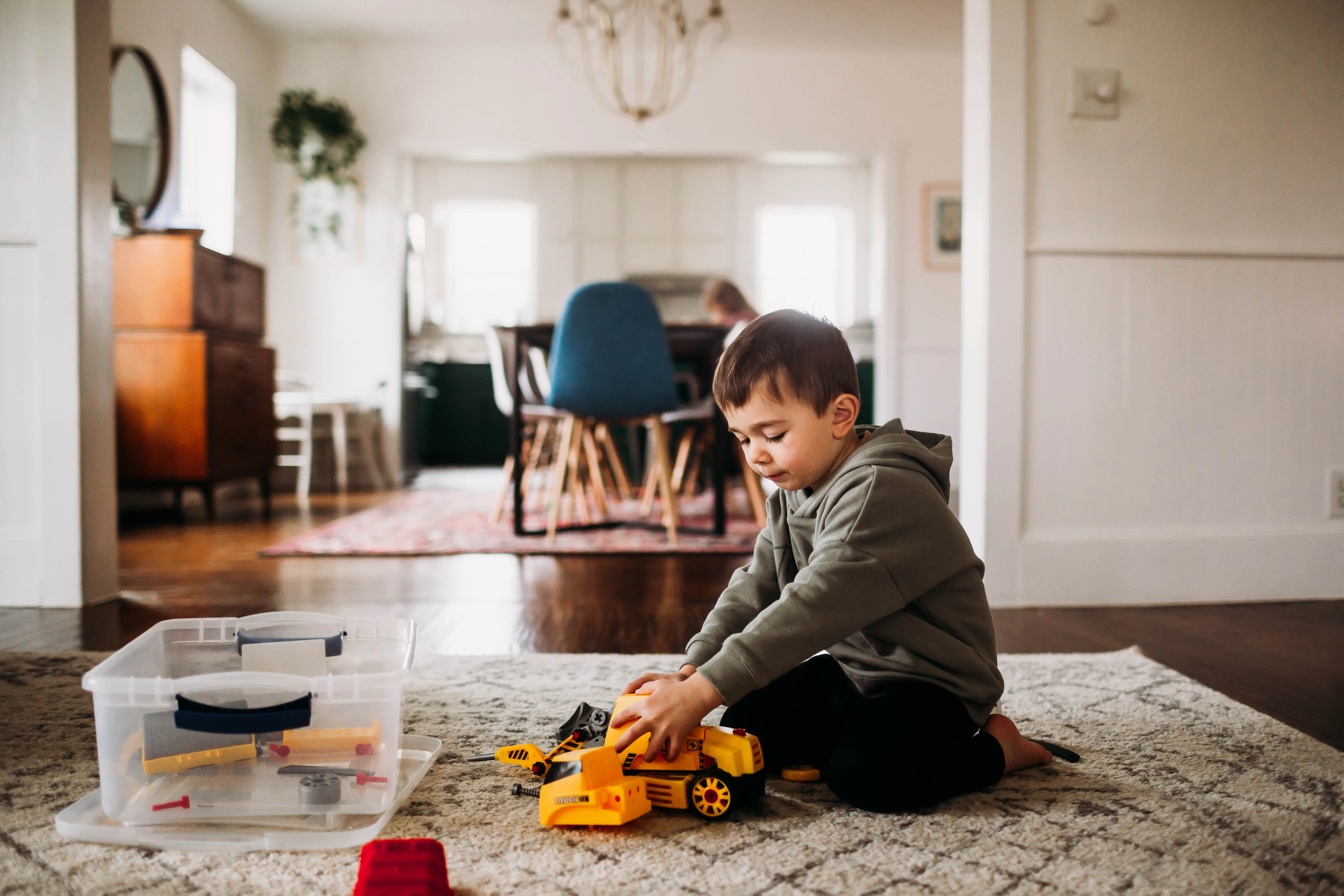
Calming Activities for When Energy Spills Over
Calming activities work best right after a burst of movement, before your kid gets overtired. Louder voices or faster running? That's your cue.
22. Pinwheel Breaths
You need: A pinwheel. A strip of paper or a feather works too.
- Sit down together. Your kid holds the pinwheel at arm's length.
- Breathe in slowly through the nose while you count to three.
- Blow out slowly through the mouth to keep the pinwheel spinning as long as possible.
- Watch it together until it stops.
Done when: They've done five slow breaths.
Tip: Practice on a calm day first, so it feels familiar when they really need it.
23. Water or Bean Sensory Bin
You need: A plastic bin or big bowl, a towel, and either warm water with cups and sponges, or two to three cups of dry beans with scoops and small containers.
- Put the towel down and the bin on top.
- For water: fill it a few centimeters (an inch or two) deep with warm water. Check the temperature with your wrist. Add cups and sponges.
- For beans: pour them in and add scoops and containers.
- Let your kid pour, scoop, fill, and squeeze. No goal needed.
- Set a timer for ten minutes.
Done when: The timer goes off. Your kid helps dump the water or pour the beans back into their container.
Safety: Never leave a young child alone with water, even a little. Kids can drown in a few centimeters. With beans, stay close, since they're a choking hazard.
24. Animal Yoga Poses
You need: A bit of floor space. A rug or yoga mat helps.
- Tree: stand on one foot, rest the other foot against your ankle or calf, and press your hands together over your head.
- Cat: get on hands and knees, round your back up high like a scared cat, and tuck your head down.
- Cow: stay on hands and knees, let your belly drop toward the floor, and look up. A "moo" is optional but encouraged.
- Frog: squat down with your feet wide and your hands on the floor between your knees.
- Hold each pose for five slow breaths. Count them out loud together.
Done when: You've done all four poses. Want more? Try these yoga games for kids.
25. Calm Corner
You need: A quiet corner, a pillow, one or two books, a soft toy, and a sand timer.
- Set it up in a corner that doesn't get much foot traffic.
- Show it to your kid when everyone's in a good mood: "This is a spot you can go when your body feels too fast."
- Practice together. Sit there, flip the timer, and look at a book until the sand runs out.
- When your kid gets worked up, offer it as a choice: "Do you want the calm corner or a hug?"
Done when: The sand runs out. Check in: "Feel better? Want another round?"
Important: Always a choice, never a punishment. If it turns into a time-out spot, it stops working.
Build real skills through fun, educational games for your child
Try KeikiHow to Run Activities for ADHD Kids So They Stick
Set the rules before you start, and stop before they lose interest. These six habits help the most.
- Start with five to ten minutes. You can add more later.
- Give a two-minute warning before you switch or stop: "Two more minutes, then we clean up."
- Use a sand timer or a visual timer your kid can see. That way the timer ends it, not you.
- Praise the effort, and be specific: "You waited for your turn."
- Offer two choices, like "fort or color hunt?" Kids love feeling in charge.
- Quit while it's still fun. If they want more, tomorrow's round is an easier sell.
A Sample Afternoon at Home
Mix one movement activity, one quiet one, and a calm-down. Here's what 45 minutes could look like.
- Minutes 0 to 10: couch-cushion obstacle course, three runs.
- Minutes 10 to 20: a printed maze at the table, with a sand timer.
- Minutes 20 to 30: memory flip with six pairs.
- Minutes 30 to 40: beat the timer to put the toys away.
- Minutes 40 to 45: pinwheel breaths on the couch.
If your kid's energy shifts, swap in something else from the list. That's what the backups are for.
When to Talk to Your Pediatrician
If your kid's focus, energy, or impulsive behavior is making daily life hard, talk to your pediatrician. That goes for trouble at home, at preschool, or with friends, no matter how many activities you've tried.
These ideas support your kid. They don't diagnose or treat anything. Your pediatrician can look at the whole picture and suggest an evaluation if it makes sense. Before the appointment, jot down when the hard moments happen, how long they last, and what helped.